Showing posts with label Digital Rights. Show all posts

Censoring Seductive Child Behaviour

December 08, 2006
define:seductive
define:unaware
define:immature
define:maturing

"Covert pedophilia in the Victorian society". Is that a good line, or is that a good line? Censorship as a matter of viewpoint - as of recently Globe and Mail want you to purchase the article without realizing the click-through rates for both, Doubleclick serving the ads at their site and them, if it were distributing it for free, but anyway guess they should have told Google either :

"The Legards' central thesis is that the debate over children and sexual imagery has been dominated and distorted by two opposing myths: one is "the quasi-religious conception of childhood innocence," which involves "the irrational denial of childhood sexuality"; the other is "the ideology" of the artist as someone "possessing mystical abilities and unique rights" that should not be constrained by the state."

After thoughtcrime and intention-crime policing, it's about time behaviour-policing starts taking place, now wouldn't that be truly outrageous? Something no one is again going to do anything about, thinking he's either the only one seeing it, or perhaps prefers to keep playing in his own corner?

Anyway, discussions like these should only happen after the real problem, with real child porn online gets solved. And that wouldn't happen by fighting the distribution channels as they're too many to control and police, but by making sure the production stage never happens at the first place.

Another article on the topic "Clothed Child Porn Online?". By the way, are you finally seduced now? A rocket scientist doesn't seem to be, throughout the "decade of dedicating downloading". Such a collection can now definitely acts as a new digitally fingerprinted database to keep track of. Continue reading →

What search engines know, or may find out about us?

February 03, 2006
Today, CNET's staff did an outstanding job of finding out what major search companies retain about their users. AOL, Google, Microsoft and Yahoo! respond on very well researched questions!

Whatever you do, just don't sacrifice innovation and trust in the current services for misjudged requests at the first place from my point of view.

At the bottom line, differentiate your Private Searches Versus Personally Identifiable Searches, consider visiting Root.net, and control your Clickstream. You can also go through Eric Goldman's comments on the issue and his open letter regarding Search Engines and China.

As a matter of fact, I have just came across a very disturbing fact that I compare with initiatives to mine blogs for marketing research, EPIC has the details on its front page. It was about time a private entity comes up with the idea given the potential and usability of the idea. Could such a concept spot, or actually seek for cyber dissidents in restrictive regimes with the idea to actually reach them, besides mining for extremists' data? I really hope so!
Technorati tags:  
Continue reading →

January's Security Streams

January 31, 2006
It's been quite a busy month, still I've managed to keep my blog up to date with over 30 posts during January, here they are with short summaries. Thanks for the comments folks!

I often get the question, how many people is my blog attracting, the answer is quantity doesn't matter, but the quality of the visits, still, for January there were 7,562 unique visits and over 13,000 pageloads. I'm already counting over 400 .mil sub domains, have the majority of security/AV vendors(hi!) reading it, and the best is how long they spend on average, and how often they come back. To sum up, 60% of all visits come from direct bookmark of my blog, 30% through referers, and 10% from search engines. It is also worth mentioning my last referring link, notice the domain and what they are interested in.

1. What's the potential of the IM security market? Symantec thinks big" gives a brief overview of the wise acquisition Symantec did and a little something the IM security market.

2. "Keep your friends close, your intelligence buddies closer!" mentioning the release of a book excerpt and provides further resources on various NSA and intelligence related topics

3. "Security quotes : a FSB (successor to the KGB) analyst on Google Earth" is Google Earth or satellite imagery a national security threat? At least the Russian FSB thinks so!

4. "How to secure the Internet" discusses the U.S National Strategy to Secure Cyberspace and some thoughts on the topic

5. "Malware - Future Trends" the original announcement for the release of my research

6. "Watch out your Wallets!" gives more info on ID theft and talks about a case that left a 22 years old student in debt of $412,000

7. "Would we ever witness the end of plain text communications?" a released report on the growth of VPNs prompted me to open up the topic, recently, Yahoo! communicate over SSL by default which is a great progress from my point of view

8. "Why we cannot measure the real cost of cybercrime?" an in-depth summary of my thoughts on why we cannot measure the real cost of cybercrime, and why I doubt the costs outpace those due to drug smuggling

9. "The never-ending "cookie debate" tries to emphasize on how the Cookie Monster should worry about cookies only, and what else to keep in mind concerning further techniques that somehow invade your privacy

10. "The hidden internet economy" here I argue on what would the total E-commerce revenues be given those afraid to purchase over the Internet actually start doing it.

11. "Security threats to consider when doing E-Banking" provides a link to practical research conducted by a dude I happen to know :)

12. "Insecure Irony" is indeed an ironical event, namely how a private enterprise, one used to gather intelligence actually lost sensitive info belonging to the Intelligence Community

13. "Future Trends of Malware" the post mentioning my Slashdotted research and the rest of the people and respected sites that recognized it

14. "To report, or not to report?" how can you measure costs when the majority of companies aren't even reporting the breaches, cannot define a breach, or think certain breaches don't require law enforcement intervention?

15. "Anonymity or Privacy on the Internet?" argues on what exactly different individuals are trying to achieve, is it Anonymity, is it Privacy and provides further resources on the topic

16. "What are botnet herds up to?" gives a brief overview of recent botnet herds' activities the ways used to increase the revenues through affiliate networks, or domaining. It also provides good resources on the topic of Bots and Botnets

17. "China - the biggest black spot on the Internet’s map" a very recent and resourceful overview of Internet Censorship in China, that also provides further resources on the topic

18. "FBI's 2005 Computer Crime Survey - what's to consider?" one day after the release of the FBI's survey I summarized the key points to keep in mind

19. "Why relying on virus signatures simply doesn't work anymore?" a very practical post that argues and tries to build more awareness on how the number of signatures detected by a vendor doesn't actually matter, still there are other solutions that will get more attention with the time. I received a lot of feedback on this, both vendors and from folks I met through my blog, thanks for the ideas!!

20. "2006 = 1984?" gives more details on private sector companies innovating in the wrong field, and further resources on censorship and surveillance practices

21. "Cyberterrorism - recent developments" an extended overview of Cyberterrorism, and a lot of facts worth mentioning obtained through a recently released report on the topic

22. "Still worry about your search history and BigBrother?" Some humor, be it even a black one is always useful

23. "Homebrew Hacking, bring your Nintendo DS!" Homebrew hacking is slowly emerging and I see a lot of potential in the "do it yourself culture"

24. "Visualization, Intelligence and the Starlight project" a post worth checkin' out, it provides an overview of various visualization technologies and talks about the Starlight project

25. "The Feds, Google, MSN's reaction, and how you got "bigbrothered"?" I'm not coining new terms here, "bigbrothered" is slowly starting to be used be pretty much everyone, yet I try to give practical tips on why the whole idea was wrong from the very beginning, and how other distribution vectors should also be considered

26. "Personal Data Security Breaches - 2000/2005" I came across a great report summarizing the issue, and tried to highlight the cases worth mentioning, some are funny, others are unacceptable

27. "Skype to control botnets?!" good someone is brainstoring, but that's rather unpractical compared to common sense approaches botnet herders currently use

28. "Security Interviews 2004/2005 - Part 1" Grab a beer and start going through this great contribution, soon to appear at Astalavista itself!

29. "Security Interviews 2004/2005 - Part 2" Part 2

30. "Security Interviews 2004/2005 - Part 3" and Part 3

31. "Twisted Reality" Everything is not always as it seems, and it's Google I have in mind :(

32. "How we all get 0wn3d by Nature at the bottom line?" :)

33. "Was the WMF vulnerability purchased/sold for $4000?!" among the few vendors I actually trust released a nice summary no one seems to be taking into consideration, still I find it truly realistic given the potential of the 0day market for software vulnerabilities

Till next month, and thanks to all readers for taking their time to go through my research and contributions!

Technorati tags :
,
Continue reading →

Twisted Reality

January 30, 2006
I looked up the definition of Evil today, and I found it, I tried to play a Google War and came across 256 million occurrences of it, still there's a hope for all of us I guess. On the 17th of January I blogged on how China turned into the biggest black spot on the Internet's map, to find out that I even have activists commenting in my blog :)

Google has agreed to "remove certain sensitive information from our search results" you all know it by now, what you perhaps don't know is how what used to be the old Google still has its marks on the web. Google's Information for Webmasters still states that :

"Google views the comprehensiveness of our search results as an extremely important priority. We're committed to providing thorough and unbiased search results for our users."

I guess Chinese users should print this and stick it on their walls to remind them of the past as it says exactly the same. They have also removed their "censored notice" from "older removals", how come, and for what reason? Lack of accountability for when "local laws, regulations, or policies" were removing "sensitive information" before the date?! Google is my benchmark for disruption, but I guess its actions and "do no evil" motto were simply too pure for the business world, which on the majority of occasions is capable of destroying morale, even individuals..

Welcome in a "Twisted Reality" where one event looks like an entirely different one - on request, and the list is getting bigger!

But what is actually filtered in china these days, what are the topics of interest? Four years ago, a great initiative brough more insights into what's deemed "sensitive information", and while of course the list is changed on-the-fly, it is important to know how it blocks the top results, as this is where all the traffic goes.

Recently, CNET did a nice research on which sites are blocked by which search engine, I ever saw Neworder in there :)

The best thing about China's backbone is how centralized it really is and the way researchers are finding common censorship patters that could prove useful for future research. Is TOR with its potential applicable in China, and would initiatives such as the the Anonymous OS, or even TorPark, an USB extension of the idea, the future?

Meanwhile, in case they are interested parties reading this post, consider taking a look at the "Handbook for Bloggers and Cyber-Dissidents" courtesy of Reporters Without Borders.

Technorati tags :
, , , , , ,
Continue reading →

Still worry about your search history and BigBrother?

January 23, 2006
The Patriot Search, recently started "helping" any government by making your search activity "public". Its search syntax terrorist:true *keyword*, and terrorist:false *keyword*, gives everyone the opportunity to be honest :) Why did the idea start at the first place? 

Because "only 4 out of 5 search engines allowed the government to see "private" user data". Though, a distinction between private searches VS personally identifiable searches should be made as well.

What's going to happen in the future? Search engines regulation, P3P, or stock market losses due to an initiative whose requirements I feel were totally wrong from the very beginning?

Consider going though David Berlind's comments as well!

Technorati tags :
,,,
Continue reading →

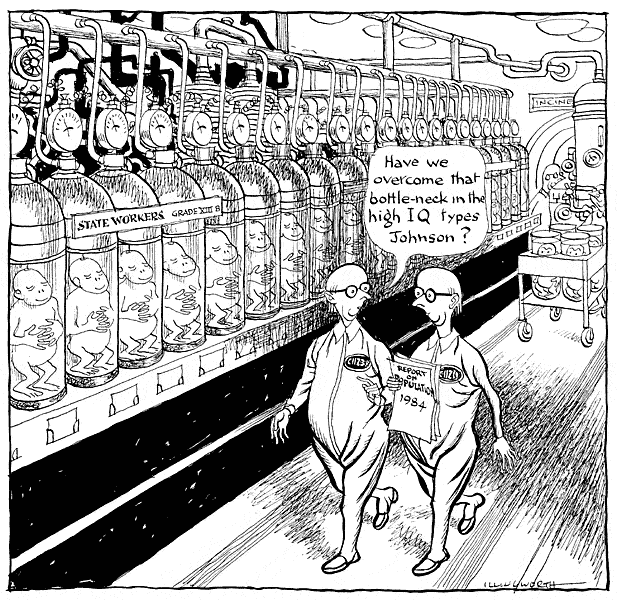
2006 = 1984?

January 23, 2006
I recently came across great, and very informative slides on current, and future trends of surveillance technologies that simply stick to the point, as any good slides so to say. "From Target Market to Total Surveillance" is courtesy of the The Special Interest Group for Military Applications (SIGMil) at the University of Illinois, and is among the many talks and quality projects they have running. 

"The Survey of Orwellian Technologies" outlines the current situation of privacy invasion and who's who on the market for censorship solutions. 

For instance it correctly states that :

- Cisco built the Great Firewall at discount to corner router market

-Video and telephone surveillance networks
-Buying habits and physical location history
-Net access history, web posts and email

Nortel, developed network traffic analysis system dedicated to catching political opposition (Falun Gong)

Motorola, competed with Nokia to provide location tracking 

Microsoft, censors words in blog software 

Yahoo, actively collaborates in tracking state political opponents via their email, search and chat usage 

Google, censors prohibited sites/queries from search– Alters news results to favor nationalized news(Still, Google recently declined the request for access for its databases, compared to the rest of search engines, Yahoo!, MSN)

The worst in this case, from my point of view the experience gained by the companies, in the wrong direction.

I once mentioned how businesses don't have a business choice but to comply, the thing is now the Western media has already started seeking accountability and higher levels of moral.

Basically, profitability shouldn't be an objective,when encouraging the further development of such "regimes". I guess, I still don't have a content filtering agreement with the Chinese government, but I don't even want to..:)

The entire idea of censorship in here is to avoid events in direct confrontation with current "reality", and I think the it isn't wise, keeping it quiet is even worse. The bad thing is that even IBM used to do "business" with the wrong party I guess . What is greed and profit maximization, what is business and morale? Words we remember on Xmas's day for sure!

More info on the topic can also be found at :

Technorati tags :
Continue reading →

China - the biggest black spot on the Internet’s map

January 17, 2006
Chinese Internet users have the potential to outpace the number of the U.S Internet population, yet, the majority of them still remain behind the most sophisticated online censorship systems in the world, the Great Chinese Firewall

I am definitely not buying into the idea of trying to take control of all the information coming in and going out of a country for the sake of my well being, as any individual has the right to decide what's good and bad for them. 

If I, for instance knew there's a virus on the streets of my city, I would take immediate precautions, or at least, see how "my" government reacts on the crisis. Yet, how responsible, moral, or legal according to international human rights standards is to prosecute users who have been spreading the news about the SARS virus from within the Great Firewall is perhaps another point.

Isn’t central planning the panacea of Communism, be it, old-school or modern(an excuse for the old-school) one, and isn’t the obvious fact that the government cannot, but wants to play God, an utopia by itself? It is disturbing how business ethics surpass moral ones for the sake of business continuity, so to say. Though, efforts are made to break the ice, until a collective campaign is not started I doubt anything will change. For the time being, what they don't like, they either hijack(forward to another site), or completely restrict.

With over 100,000 cybercafes, and 30,000 state police enforcing policies on the Internet, the Chinese government is trying to estaliblish a very effective self-censorship atmosphere, namely, prosecuting those somehow violating it. The idea is to, of course, cut the costs of their censorship efforts.

U.S companies don’t have a business choice, but to comply in case they are interested in taking advantages of the business opportunities in the country.

Activists have been expressing their attitude towards assistance like that, while I feel the majority of business leaders still don't have the incentive to take action, besides the human moral obligations, ones that are often neglected when doing business. Sad, but true :)

For me, it's not businesses complying with local laws that bothers me, but the playground for the these vendors that’s fuelling innovation in the wrong direction. That very same innovation is later on to used on Western countries or pretty much anywhere around the world. For the time being, China is still winning against the Web, and the term cyberdissident is getting rather common. For instance, the recently started Cryptome.cn, pointed out a great link to the actual known number of Chinese actions against journalists. That's disturbing.

One of the most resourceful and timely research currently available is ONI's Internet Filtering in China in 2004-2005 : A Country Study. Interested in finding out whether a certain sites is currently blocked in China? Check the Real-Time Testing of Internet Filtering in China, courtesy of Harvard Law School, whose Empirical Analysis of Internet Filtering in China still gives an overview of the situation and what's to consider.

Further research and opinions on the topic can be found at :

Internet Development and Information Control in the People’s Republic of China
Internet censorship in mainland China
The Internet in China: Civilian and Military Uses
Internet in China: Big Mama is Watching You
Internet Filtering in China
The limits of Internet filtering : A moral case for the maximization of information access over the Internet
Controlling Online Information: Censorship & Cultural Protection
Tools for Censorship Resistance
The Filtering Matrix
Tor: An anonymous Internet communication system

Technorati tags :
,,,,
Continue reading →

Anonymity or Privacy on the Internet?

January 16, 2006
Last week, Bruce Schneier wrote a great comment on Anonymity, how it won’t kill the Internet, and that it has to do with accountability mostly.

Logically, if identification is impossible, then there cannot be adequate accountability. Though, alternative methods based on the collective trust exist, and are as anonymous, as necessary. Spoofed identities, perhaps even hijacked ones should also be taken into consideration. But how important is Anonymity today? What is Anonymity and Privacy anyway? When is the first desired to preserve the second? How blur is the line in between? I think Anonymity is so much broader than it is originally perceived.

I’ve once mentioned the possibilities of IP cloaking for competitive intelligence/disinformation. On the other hand, for me today’s concept of anonymity has three dimensions :

- The individuals trying to achieve anonymity with the idea to express their right of free speech, and access censored information
 
A chinese citizen is the first thing that comes to my mind, though many others are having the same problems when trying to access information or express their right of free speech, such as Saudi Arabia, United Arab Emirates, Bahrain, Iran, Singapore, Burma, and Tunisia.

- Those trying to avoid accountability for certain actions, in one way or another
Anonymous-p2p.org has for instance featured a list of P2P applications that improve anonymity to a certain extend. In this case, anonymity is desired in order to cover up certain actions. The use of proxy servers to try to hide originating host should also be mentioned as a possibility.

- Those with an established pseudo-anonymity, netizens for instance

I think pseudo-anonymity is important in today’s society, it’s utopian worlds(online gaming worlds etc.), express freedom and promote creativity to a certain extend. The entire trust and accountability model is actually entrusted on the service, for instance, Ebay as mentioned in the original article. You trust that Ebay’s practices going beyond this pseudo-anonymity would achieve accountability in case it’s necessary.

What others think on privacy, and why is anonymity hard?

There’s no Privacy, get over it” Sun's CEO Scott McNealy, back in 1999

John Young, Cryptome.org on privacy, data aggregation, data mining, terrorism fears and our constantly digitized lifes :

Privacy should be a right of citizens worldwide, in particular the right to keep government and business from gaining access to private information and personal data. The argument that government needs to violate privacy in order to assure security is a lie. The business of gathering private information by corporations and then selling that to government and other businesses is a great threat to civil liberties. Much of this technology was developed for intelligence and military uses but has since been expanded to include civil society.

Dan Farmer and Charles C.Mann – Surveillance Nation
Low-priced surveillance technologies will help millions of consumers protect their property, plan their commutes, and monitor their families. But as these informal intelligence-gathering networks overlap and invade our privacy, that very could evaporate.”

Continue reading →