Showing posts with label Antivirus. Show all posts

No Anti Virus Software, No E-banking For You

May 30, 2006
Malware and Phishing are the true enemies of E-commerce, its future penetration, and E-banking altogether. Still, there are often banks envisioning the very basic risks, and hedging them one way or another, as "Barclays gives anti-virus software to customers"

"Barclays Bank is issuing UK internet banking customers with anti-virus software, as part of attempts to reduce online identity theft. The bank has signed a deal with Finnish anti-virus firm F-Secure, which will provide software to the bank’s 1.6m UK internet banking customers. While other banks offer discounted anti-virus software deals to customers, Barclays is the first in the UK to give it away for free. ’Nearly two-thirds of home PCs don’t have active virus protection, and one in five is actually infected by a virus, placing people at risk from data theft, as well as damage to their computers,’ said Barnaby Davis, director of electronic banking at Barclays."

I find the idea a very good mostly because compared to other banks that try to reestablish the email communication with their customers, but starting from the basics, you can't do E-banking without generally acceptable security measure in place. And while an AV solution doesn't necessarily mean the customer wouldn't get attacked by other means, or that it would be actually active in the moment of the attack, this is a very smart to do. To take advantage of even more benefits, Barclays must actively communicate their contribution and unique differentiating point to their customers, in comparison with the other banks -- it's getting harder for companies to retain customers due to improved access to information, thus more informed decisions.

You can't just deal with the technological part of the problem, but avoid the human side in it, as education and awareness will result in less gullible, but more satisfied and longer retained customers. Phishing is today's efficient social engineering, and a bank's site shouldn't be assumed "secure" as on many occasions site-specific vulnerabilities improve the truthfulness of the scam itself. Forwarding the responsibility for secured access to the E-banking feature to final customers should be simultaneous with the bank auditing its web services. In the upcoming years, with the rise of mobile banking, I think we will inevitably start seeing more mobile phishing attempts.

Ebay's PayPal is still a major player in online payments, on its way to dominate mobile payments too. The trend and potential of cross-platform malware is what both AV vendors and payment providers should keep in mind. Continue reading →

The anti virus industry's panacea - a virus recovery button

April 20, 2006
Just when I thought I've seen everything when it comes to malware, I was wrong as a PC vendor is trying to desperately position itself as one offering a feeling of security with the idea to strip its product and lower the customer price. The other day I came across to a fancy ad featuring Lenovo's ThinkVantage Virus Recovery Button, and promoting its usefulness even when there's no AV solution in place :


"Rescue and Recovery is a one button recovery and restore solution that includes a set of self recovery tools to help users diagnose, get help and recover from a virus or other system crashes quickly, even if the primary operating system will not boot and you are remote from your support team."


The video ad is indeed fascinating, and while their Embedded Security Subsystem 2.0 "locks your sensitive data behind hardware-based encryption", you'd better take advantage of their utilities options and try to avoid such a weak positioning in respect to malware. The Virus Recovery Button seems to be directly targeting the masses and totaly removing the complexity issue by introducing a button-based solution to malware -- dangerous as backups and their idea could have proven useful during the first generations of malware.


Anti virus signatures, response time, and various other proactive malware prevention approaches such as, IPS, buffer overflow protection are among today's most widely discussed approaches when dealing with malware, and of course, the principle of least privilege to user accounts. But why the anti virus button when it can be an anti-hacker one? I feel they'd better stick to their OEM agreements and find other ways to achieve competive advantage in pricing than providing a false sense of security.


In my recent "Malware - future trends" research I mentioned on the fully realistic scenario of having your security solution turn into a security problem itself. While this is nothing new, in this case we have a misjudged security proposition, as recovering to a pre-infection state doesn't necessariry mean confidentiality of sensitive personal/financial information wouldn't be breached by the time the user is aware of the infection, if it ever happens of course.


Moreover, Lenovo was recently under scrutiny as "The U.S.-China Economic Security Review Commission (USCC) argues that a foreign intelligence like that of the Communist Party of China (CPC) can use its power to get Lenovo to equip its machines with espionage devices. Lenovo has strongly declined that it is involved in any such activities", and while they eventually reached a consensus on using the machines on unclassified systems only, it doesn't mean they aren't exposed to a wide variety of threats going beyond China backdooring them, such as Zotob over border-screening systems at airports.


As a matter of fact, the rival PC/notebook propositions might still be owned by U.S companies, but are mostly assembled in China these days -- too much hype for nothing.


UPDATE - Sites that picked up the post

LinuxSecurity.com
MalwareHelp.org


Technorati tags:
, , , , Continue reading →

Recent Malware developments

February 13, 2006
In some of my February's streams :) "The War against botnets and DDoS attacks" and "CME - 24 aka Nyxem, and who's infected?" I covered some of the recent events related to malware trends in the first months of 2006. This is perhaps the perfect time to say a big thanks to everyone who's been expressing ideas, remarks and thoughts on my malware research. While conducting the reseach itself I realized that I simply cannot include everything I want it, as I didn't wanted to release a book to have its content outdated in less than an year, but a "stick to the big picture" representation of the things to come. The best part is that while keeping daily track of the trends and trying to compile a summary to be released at the end of the year, many more concepts that I didn't include come to my mind, so I feel I'll have enough material for a quality summary and justification of my statements. So what are some of the recent developments to keep in mind?

A lot of buzz on the CME-24 front, and I feel quite a lot of time was spent on speculating on the infected population out of a web counter whose results weren't that very accurate as originally though. And as vendors closely cooperated to build awareness on the destructive payload, I think that's the first victory for 2006, no windows of opportunity The best is that CAIDA patiently waited until the buzz is over to actually come up with reliable statistics on Nyxem.

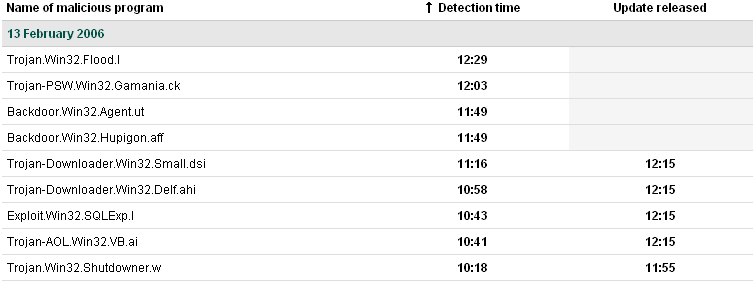
It's rather quiet on the AV radars' from the way I see it, and quickly going through F-Secure's, Kaspersky's (seem to be busy analyzing code, great real-time stats!), Symantec's I came across the similarities you can feel for yourself in "the wild" :) Symantec's ThreatCon is normal, what's interesting to note is VirusTotal's flood of detected WMF's, which is perhaps a consequence of the *known* second vulnerability.

James Ancheta's case was perhaps the first known and so nicely documented on botnet power on demand. Recently, a botnet, or the participation in such shut down a hospital's network, more over I think StormPay didn't comply with a DDoS extortion attempt during the weekend?

Joanna Rutkowska provided more insights on stealth malware in her research (slides, demo) about "about new generation of stealth malware, so called Stealth by Design (SbD) malware, which doesn't use any of the classic rootkit technology tricks, but still offers full stealth. The presentation also focuses on limitations of the current anti-rootkit technology and why it’s not useful in fighting SbD malware. Consequently, alternative method for compromise detection is advocated in this presentation, Explicit Compromise Detection (ECD), as well as the challenges which Independent Software Vendors encounter when trying to implement ECD for Windows systems – I call it Memory Reading Problem (MRP). "

How sound is the possibility of malware heading towards the BIOS anyway? An "Intelligent P2P worm's activity" that I just across to also deserves to be mentioned, the concept is great, still the authors have to figure out how to come up with legitimate file sizes for multimedia files if they really want to fake its existence, what do you think on this?

Some recent research and articles worth mentioning are, Kaspersky's Malware - Evolution : October - December 2005 outlines the possibilities for cryptoviral extortion attacks, 0days vulnerabilities, and how the WMF bug got purchased/sold for $4000. There's also been quite a lot of new trojans analyzed by third-party researchers, and among the many recent articles that made me an impression are "Malicious Malware: attacking the attackers, part 1" and part 2, from the article :

"This article explores measures to attack those malicious attackers who seek to harm our legitimate systems. The proactive use of exploits and bot networks that fight other bot networks, along with social engineering and attacker techniques are all discussed in an ethical manner."

Internet worms and IPv6 has nice points, still I wish there were only network based worms to bother about. Besides all I've missed important concepts in various commentaries, did you? Malware is still vulnerabilities/social engineering attacks split at least for the last several months, still the increased corporate and home IM usage will inevitable lead to many more security threats to worry about. Web platform worms such as MySpace and Google's AdSense Trojan, are slowly gaining grounds as a Web 2.0 concept, so virus or IDS signatures are to look for, try both!

During January, David Aitel reopened the subject of beneficial worms out of Vesselin Bontchev's research on "good worms". While I have my reservations on such a concept that would have to do with patching mostly the way I see it, could exploiting a vulnerability in a piece of malware by considered useful some day, or could a network mapping worm launched in the wild act as an early response system on mapped targets that could end up in a malware's "hitlist"? And I also think the alternative to such an approach going beyond the network level is Johnny Long's (recent chat with him) Google Dorks Hacking Database, you won't need to try to map the unlimited IPv6 address space looking for preys. Someone will either do the job for you, or with the time, transparancy in IPv6, one necessary for segmented and targeted attacks will be achieved as well.

Several days ago, Kaspersky released their summary for 2005, nothing ground breaking in here compared to previous research on how the WMF vulnerability was purchased/sold for $4000 :) but still, it's a very comprehensive and in-depth summary of 2005 in respect to the variables of a malware they keep track of. I recommend you to go through it. What made me an impression? 
- on average, 6368 malicious programs detected by month

- +272% Trojan-Downloaders 2005 vs 2004

- +212% Trojan-Dropper 2005 vs 2004

- +413% Rootkit 2005 vs 2004

- During 2005, on average 28 new rootkits a month

- IM worms 32 modifications per month

- IRC worms are on -31%

- P2P worms are on -43%, the best thing is that Kaspersky labs also shares my opinion on the reason for the decline, P2P busts and general prosecutions for file-sharing. What's also interesting is to mention is the recent ruling in a district court in Paris on the "legality of P2P" in France and the charge of 5 EUR per month for access to P2P, but for how long? :) P2P filesharing isn't illegal and if you cannot come up with a way to release your multimedia content online, don't bother doing at all. In previous chats I had with Eric Goldman, he also makes some very good points on the topic.

- +68% Exploit, that is software vulnerabilities and the use of exploits both known or 0day's with the idea to easily exploit targeted PC, though I'm expecting the actual percentage to be much higher

- Internet banking malware reached a record 402% growth rate by the end of 2005 The Trojan.Passwd is a very good example, it clearly indicates that it is written for financial gains. E-banking can indeed prove dangerous sometimes, and while I'm not being a paranoid in here, I'd would recommend you go through Candid's well written "Threats to Consider when doing E-banking" paper

- A modest growth from 22 programs per month in 2004 to 31 in 2005 on the Linux malware front

I feel today's malware scene is so vibrant that it's getting more and more complex to keep track of possible propagation vectors, ecosystem here and there, and mostly communicating what's going on to the general public(actually this one isn't). 
What's to come and what drives the current growth of malware?
- money!
- the commercialization of the market for software vulnerabilities, where we have the first underground purchase of the WMF exploit, so have software vulnerabilities always been the currency of trade in the security world or they've started getting the necessary attention recently?
- is stealth malware more than an issue compared to utilizing 0day vulnerabilities, and is retaining current zombie PCs a bigger priority than to infecting new ones?
- business competitors, enemies, unethical individuals are actively seeking for undetected pieces of malware coded especially for their needs, these definitely go beneath the sensors
- Ancheta's case is a clear indication of a working Ecosystem from my point of view, that goes as high as to provide after-sale services such as DDoS strength consultations and 0day malware on demand

To sum up, malware tends to look so sneaky when spreading and zoomed out :) I originally came across the VisualComplexity project in one of my previous posts on visualization. Feel I've missed something that's worth mentioning during the last two months? Than consider expanding the discussion!
You can also consider going through the following resources related to malware :
Continue reading →

The War against botnets and DDoS attacks

February 09, 2006
In one of my previous posts talking about botnet herders I pointed out how experiments tend to dominate, and while botnets protection is still a buzz word, major security vendors are actively working on product line extensions. DDoS attacks are the result of successful botnet, and so are the root of the problem besides the distributed concept. Techworld is reporting that McAfee is launching a "bot-killing system", from the article :

"Unlike conventional DDoS detection systems based on the statistical analysis of traffic, the first layer of the new Advanced Botnet Protection (ABP) intrusion prevention system (IPS) uses a proxy to pass or block packet traffic dependent on whether or not it is “complete”. "

The best thing is that it's free, the bad thing is that it may give their customers a "false sense of security", that is, while the company is actively working on retaining its current customers, I feel "SYN cookies" and their concept has been around for years. Moreover, using a service provided by a company whose core competencies have nothing to do with DDoS defense can be tricky. Companies worth mentioning are Arbor Networks, and Cisco's solutions, besides the many other alternative and flexible ways of dealing with DDoS attacks.

In my research research on the Future trends of Malware, I pointed out some of the trends related to botnets and DDoS attacks, namely, DDoS extortion, DDoS on demand/hire, and with the first legally prosecuted case of offering botnet access on demand, it's a clear indication that of where things are going. Defense against frontal attacks isn't cost-effective given that at the bottom line the costs to maintain the site outpace the revenues generated for the time, hard dollars disappear, soft ones as reputation remain the same.

My advice is to take into consideration the possibility to outsource your problem, and stay away from product line extensions, and I think it's that very simple. A differentiated service on fighting infected nodes is being offered by Sophos, namely the Zombie Alert, which makes me wonder why the majority of AV vendors besides them haven't come up with an alternative given the data their sensor networks are able to collect? Moreover, should such as service be free, would it end up as a licensed extensions to be included within the majority of security solutions, and can a motivated system administrators successfully detect, block, and isolate zombie traffic going out of the network(I think yes!)? 

As far as botnets are concerned, there were even speculations on using "Skype to control botnets", now who would want to do that, and under what reason given the current approaches for controlling botnets, isn't the use of cryptography or security through obscurity("talkative bots", stripping IRCds) the logical "evolution" in here?

Something else worth mentioning is the trend of how DoS attacks got totally replaced by DDoS ones, my point is that the first can be a much more sneaky one and easily go beneath the radar, compared to a large scale DDoS attack. A single packet can be worth more than an entire botnets population, isn't it?

How do you think DDoS attacks should be prevented, active defense such as the solutions mentioned, or proactive solutions? What do you think?

You can also go though other resources dealing with DDoS attacks and possible solutions to the problem :
Technorati tags :
, , , , , , , Continue reading →

Why relying on virus signatures simply doesn't work anymore?

January 19, 2006
As a fan of VirusTotal and Norman's Sandbox being always handy when making analyses or conclusions, and me looking for metrics and data to base my judgments on, besides experience, I feel their "Failures in Detection" of VT deserve more attention then they it's actually getting. 

With over 14, 000 files submitted on a weekly basis, where most of them are supposedly 0day malicious software, it's a great resource to consider. Using these scanners for the basis of its service (saw yours?!), it is still able to conclude the plain truth - signature based anti virus protection is having deep troubles as a concept these days. 

Moreover, vendors covering or enjoying monopolistic competition in specific geographical regions, without having the necessary AV expertise is something that is actually happening. So what made me an impression?

Failures in Detection (Last 7 days)

- 14, 016 failures that is, infected files not detected by at least one antivirus engine
- 372 samples detected by all vendors

What's important to note here is that, response time towards a new piece of malware in the wild is crucial as always. But that's great when it's actually achieved. The independent folks at Av-test.org, have featured a very nice Excel sheet on the "Reaction Times of the latest MS05-039-based Worm Attacks"(2005-08-22) so you can take a look for yourself. 

And as I've once mentioned my opinion on the growing possibility of 0day malware on demand, proactive measures would hopefully get the attention of vendors. Some folks are going as high as stating that AV scanners and AV defense as a concept will eventually end up as product line extension of a security appliance? Though, I feel you will never be able to license a core competency of a vendor that's been there before the concept of DDoS started getting public! And obviously, the number of signatures detected by them doesn't play a major role like it used years ago. Today's competitive factors have to do with, but not only of course :

Heuristic
Policy-Based Security
IPS (Intrusion Prevention Systems)
Behaviour Blockers
Protection against Buffer Overruns


I also advise you to go though a well written research on the topic of Proactive Antivirus protection, as it highlights the issues to keep in mind in respect to each of these. Is client side sandboxing an alternative as well, could and would a customer agree to act as a sandbox compared to the current(if any!) contribution of forwarding a suspicious sample? Would v2.0 constitute of a collective automated web petrol in a PC's "spare time"? How sound is this and the other concepts in terms of usability and deployment on a large scale?

Signatures are always a necessary evil as I like to say, ensure that at least your anti virus software vendor is not a newly born company with a modest honeyfarm and starting to perceive itself as a vendor, vendor of what? Solutions or signatures?!

Don't get me wrong, my intention behind this post was to make you think, as a customer or decion-maker on the approaches your current vendor uses, and how to make better decisions. At the bottom line, it's still a vendor's sensor network or client side submissions, even exchange of data between them, that provides the fastest response to *known* malware!

Technorati tags :
,,,,,
Continue reading →

Malware - future trends

January 09, 2006
I'm very excited to let you know that, I have finally managed to release my "Malware - future trends" publication. Basically, it will provide you with an overview of the current trends, the driving factors behind the scene, and some of the trends to come, from my point of view.

As factors contributing to the rise and success of malware I have pointed out :
- Documentation and howto's transformed into source code
- Vulnerabilities, even patches, easily turned into exploits
- Clear signs of consolidation on the malware scene
- The media as a fueling factor for growth
- Over 960M unique Internet users and their connectivity, or purchasing power
- The demand for illegal services

And as far as the trends themselves are concerned, I have indicated :
- Mobile malware will be successfully monetized
- Localization as a concept will attract the coders' attention
- Open Source Malware
- Anonymous and illegal hosting of (copyrighted) data
- The development of Ecosystem
- Rise in encryption and packers
- 0day malware on demand
- Cryptoviral extortion / Ransomware will emerge
- When the security solutions (antivirus etc.) ends up the security problem itself
- Intellectual property worms
- Web vulnerabilities, and web worms - diversity and explicit velocity
- Hijacking botnets and infected PCs
- Interoperability will increase the diversity and reach of the malware scene

Have an opinion? Feel I have somehow missed a point? Let me know, or directly comment on this post! Thanks folks!

Technorati Tags :
,,,,, Continue reading →