Showing posts with label Security Trends. Show all posts

Valuing Security and Prioritizing Your Expenditures

May 15, 2006
I often blog on various market trends related to information security and try to provide an in-depth coverage of emerging or current trends -- in between active comments. In previous posts "FBI's 2005 Computer Crime Survey - what's to consider?", "Spotting valuable investments in the information security market", "Why we cannot measure the real cost of cybercrime?", "Personal Data Security Breaches - 2000/2005" and, "To report, or not to report?" I emphasized on the following key points in respect to data security breaches and security investments :


- on the majority of occasions companies are taking an outdated approach towards security, that is still living in the perimeter based security solutions world


- companies and data brokers/aggregators are often reluctant to report security breaches even
when they have the legal obligation to due to the fact that, either the breach still hasn't been detected, or the lack of awareness on what is a breach worth reporting


- the flawed approaches towards quantifyingthe costs related to Cybercrime are resulting in overhyped statements in direct contradiction with security spending


- companies still believe in the myth that spending more on security, means better security, but that's not always the case


- given the flood of marketing and the never ending "media echo" effect, decision makers often find themselves living with current trends, not with the emerging ones, which is what they should pay attention to


It is often mistaken that the more you spend on security, the higher level of security would be achieved, whereas that's not always the case -- it's about prioritizing and finding the most suitable metrics model for your investment.


Here's an article describing exactly the same impression :


"Security breaches from computer viruses, spyware, hacker attacks and equipment theft are costing British business billions of pounds a year, according to a survey released Tuesday. The estimated loss of $18 billion (10 billion pounds) is 50 percent higher than the level calculated two years ago, according to the survey that consultancy PricewaterhouseCoopers conducted for the U.K. Department of Trade and Industry. The rise comes despite the fact that companies are increasing their spending on information security controls to an average 4 percent or 5 percent of their IT budget, compared with 3 percent in 2004."


That's pretty much the situation everywhere, companies are striving to apply metrics to security investments and this is where it all gets blur. Spending more on security might seems to be logical answer, but start from the fact that open networks, thus exposed to a great deal of uncontrollable external factors, undermine the majority of models so far. Bargaining with security, or "Getting paid for getting hacked" remains a daily practice whatsoever. Let's consider various social aspects concerning the participants.


A financial executive often wants to know more on :

- Do I get any return on my investment (ROI) ?
- What % of the risk is mitigated and what are your benchmarking methods?
- What may I lose if I don't invest, and where's the sweet spot?
- How much is enough?
- How do I use basic financial concepts such as diversification in the security world?
- How would productivity be influenced due to the lack of solutions, or even their actual use?


A security consultant on the other hand might be interested in -- How do I convince senior management in the benefits of having a honeyfarm in respect to mitigating the overall risk of having real systems breached into, without using Cyberterrorism as the basis of discussion?


These different school's of though, positions, responsibilities and budget-allocation hungry individuals are constantly having trouble communicating with each other. And while you cannot, and perhaps even should not try to educate your security workforce in to the basics of finance, an understanding of both side's point of view may change things -- what you don't see value in, is often someone else's treasure.


Another recent article on the topic of justifying security expenditure, or mostly assigning value made me an impression :


"So we came up with Value Protection," Larson says. "You spend time and capital on security so that you don't allow the erosion of existing growth or prevent new growth from taking root. The number-one challenge for us is not the ability to deploy the next, greatest technology. That's there. What we need to do now is quantify the value to the business of deploying those technologies." "It adds value; we're very supportive of it," says Steve Schmitt, American Water's vice president of operations, of Larson's Value Protection metric. For a while, people were just trying to create reasonable security, Schmitt says, "but now you need something more—something that proves the value, and that's what Bruce developed. Plus, as a secondary benefit, it's getting us better visibility from business owners and partners on risks and better ways to mitigate the risks."


Good point on first estimating the usefulness of current technologies, before applying the "latest", or "newest" ones. The rest comes to the good old flaws in the ROSI model, how would you be sure that it would be the $75,000 virus outbreak that will hit your organization, and not the $5000 one? "Return On Security Investment (ROSI) – A Practical Quantitative Model" emphasized on the challenges to blindly assigning the wrong value to a variable :


"The virus scanner appears to be worth the investment, but only because we’re assuming that the cost of a disaster is $25,000, that the scanner will catch 75% of the viruses and that the cost of the scanner is truly $25,000. In reality, none of these numbers are likely to be very accurate. What if three of the four viruses cost $5,000 in damages but one costs $85,000? The average cost is still $25,000. Which one of those four viruses is going to get past the scanner? If it’s a $5,000 one, the ROSI increases to nearly 300% – but if it’s the expensive one, the ROSI becomes negative!"


Among the first things to keep in mind while developing a risk management plan, is to identify the assets, identify the potential attackers, and find ways to measure the threat exposure and current threatscape as well. In a publication I wrote three years ago, "Building and Implementing a Successful Information Security Policy", that as a matter of fact I still find a quality and in-depth reading on the topic, I outlined some ideas on achieving the full effect of the abovementioned practices -- it's also nice to came across it given in assignments and discussed in lectures too. An excerpt on Risk Analysis :

"
As in any other sensitive procedure, Risk Analysis and Risk Management play an essential role in the proper functionality of the process. Risk Analysis is the process of identifying the critical information assets of the company and their use and functionality -- an important (key) process that needs to be taken very seriously. Essentially, it is the very process of defining exactly WHAT you are trying to protect, from WHOM you are trying to protect it and most importantly, HOW you are going to protect it."


Identifying the threats and some current threats worth keeping in mind
- windows of opportunities/0day attacks
- lousy assets/vulnerability/patch management
- insecure end users' habits
- sneaky and sophisticated malicious software
- wireless/bluetooth information leakage
- removable media information leakage


How would you go for measuring the risk exposure and risk mitigated factor?


Risk exposure and risk mitigated are both interesting and hard to quantify, should we consider the whole population given we somehow manage to obtain fresh information on the current threats ( through the use of Early Warning System such as Symantec's DeepSight Analyzer, The Internet Storm Center, or iDefense's Intelligence services for instance). Today, it is often based on :


- the number of workstations and network assets divided by the historical occurrence of a particular security event on the network -- the use of mobile agents for the specifics of a company's infrastructure effects is hard sometimes


- on the historical TCO data related to typical breaches/security events


Risk mitigated is often tackled by the use of Best practices -- whether outdated or relevant is something else, Cyber Insurance and the current, sort of, scientifically justified ROSI model are everyday's practice, but knowing the inner workings of your organization and today's constantly changing threatscape and how it(if) affects you is a key practice while prioritizing expenditure. You cannot, and should not deal with all the insecurities facing your organization, instead consider prioritizing your security expenditure, not just following the daily headlines and vendor-released, short-term centered research.


It's hard to quantify intellectual property's value, the way it's hard to quantify TCO loses due to security breaches and it's perhaps the perfect moment to mention the initiative that I undertook in the beginning of this year - a 50/50 security/financial cross-functional team on coming up with a disruptive idea -- more on the current status soon, still, thanks for the time and efforts folks! To sum up, a nice quote by the authors of the research I mentioned : "Most of the problems stem from the fact that security doesn’t directly create anything tangible – rather it prevents loss. A loss that’s prevented is a loss that you probably won’t know about."


At the bottom line, are you making money out of having security, that is thinking business continuity, not contingency planning, and should we keep on trying to adapt financial concepts, and not rethinking them all?


Recommended reading/resources on the topic of justifying security expenditure :
Return on Information Security Investment
Risk - A Financial Overview
Calculated Risk - Guide to determining security ROI
The Return on Investment for Network Security
Analysis of Return on Investment for Information Security
Methodologies for Evaluating Information Security Investments
Risk Assessment for Security Economcis - very informative slides
Economics and Security Resource page
Information Security in the Extended Enterprise: Some Initial Results From a Field Study of an Industrial Firm
PKI and Financial Return on Investment
Privacy Breach Impact Calculator
Guide to Selecting Information Technology Security Products Continue reading →

Spotting valuable investments in the information security market

April 18, 2006
Back in January I mentioned the possible acqusition of SiteAdvisor in my "Look who's gonna cash for evaluating the maliciousness of the Web?" post and it seems McAfee have realized the potential of this social-networking powered concept on a wide scale, and recently acquired SiteAdvisor -- this was meant to happen one way or another and with risk of being over-enthusiastic I feel I successfully spotted this one.


Next to SiteAdvisor's pros and cons that I commented on, I also provided a resourceful overview of some of the current malware crawling projects out there, to recently find out that WebRoot finally went public with the Phileas spyware crawler, and that Microsoft's Strider Crawler came up with the Typo-Control project -- great idea as a matter of fact. What are some of the current/future trends in the information security industry? Are the recent flood of acquisitions the result of cheaper hardware and the utilization of open-source software, thus cutting costs to the minimum while the idea still makes it to the market?


Have both, entry and exit barriers totally vanished so that anyone could get aspired of becoming a vendor without the brand at the first place? Excluding the big picture, it is amazing how uninformed both, end and corporate users are, yet another lack of incentive for security vendors to reach another level of solutions -- if it ain't broken, don't improve it.


Moreover, what would the effect be of achieving the utopian 100% security on both, the market and the world's economy? On one hand we have "the worst year" of cybercrime, whereas spending and salaries are booming, and they should be as the not knowing how much security is enough, but trying to achieve the most secured state is a driving factor for decades to come.


The bottom line is, the more insecurities, the more security spending, the higher the spending, the higher the growth, and with increasing purchasing power, corporate R&D, and government initiatives you have a fully working economic model -- going to war, or seeing terrorists everywhere is today's driving force for military/intelligence spending compared to the "Reds are everywhere" propaganda from both camps of course, back in the Cold War period. Fighting with inspired bureaucrats is always an issue as well.


The Ansoff's Product/Market Matrix often acts as the de-facto standard for developing business opportunities, that is, of course, if you're not lead by a visionary aim, promote an internal "everyday startup" atmosphere to stimulate creativity, or benchmark against competitors. On the majority of occassions a security vendor is looking for ways to diversify its solutions' portfolio, thus taking advantage of re-introduced product life cycles and new sources for revenues.


While there should be nothing wrong with that given a vendor is actually providing a reliable solution and support with it, I often argue on how marketable propositions centric business model is not good for the long-term competitiveness of the company in question.


It's the judgement and competitors myopia that I'm talking about. In respect to the current information security market trends, or let's pick up the anti virus solutions segment, that means loosing sight of the big picture with the help of the mainstream media -- cross refferenced malware names, "yet another" malware in the wild, or supposed to be Russian hacker selling his soul for E-gold(cut the stereotypes here and go through the majority of recent statistics to see where all that phishing, spam and malware is coming from), is a common weakness of a possible decision-maker looking for acquisitions. Focusing on both, current trends, and current competitions is the myopia that would prevent you from sensing the emerging ones, the ones that would improve your competitiveness at any time of execution of course.


The way we have been witnessing an overal shift towards a services based world economy in comparisson to a goods based one, in the informaiton security market services or solutions will inevitably profiliate in the upcoming future. When was the last time you heart someone saying "I don't need an anti-virus scanner, but an anti-virus solution, what's yours and how is it differentiated from the others I'm aware of"? Un-informed decisions, quick and cheap way to get away with the "security problem", or being totally brainwashed by a vendor's salesforce would result in enormous long-term TCO(total cost of ownership) problems, given someone actually figures a way to make the connection in here.


Some time ago, I came across a great article at CSOOnline.com "2 Vendor Megatrends and What They Mean to You" giving insight on two trends, namely, consolidation of security providers and convergence -- the interception between IT and physical security. And while it's great in respect to covering these current trends, I feel the article hasn't mentioned the 3rd one - Diversification. An excerpt :


"One trend is consolidation. "We're seeing the bigger players buying out many of the smaller companies. And I think the largest of the security firms are looking to provide a full range of enterprise services," says C. Warren Axelrod, director of global information security at Pershing, a Bank of New York Securities Group company. "The larger firms, like Internet Security Systems, Symantec and Computer Associates, are buying in many areas to complement what they have. They're basically vying for control of the security space." Axelrod is dead on, and consolidation is just as rampant among physical security vendors as it is in the IT world."


I feel consolidation is happening mainly because different market segments are constantly getting crowded and mainly because it's very, very hard to get a name in the information security market these days, so instead of run for your own IPO, compete against market players whose minor modification may ruin your entire idea, you'd better get acquired one way or another. @stake is an example of how skilled HR runs away from the acquirer, at least for me counting the HR as the driving force besides the brand.


More from the article :

"The second trend is convergence—the confluence of IT and physical security systems and vendors—which, in some sense, is another form of consolidation, only it's happening across the line that historically divided those two worlds."


Tangible security is often favored by investors as it targets the masses, and the most visible example besides perimeter based defenses are the hardware appliances themselves. These days, there isn't a single anti virus, anti spam or anti spyware solution provider without a hardware appliance, but what's to note is how their OEM agreements are still working and fully applicable, it's all about greed, or let's avoid the cliche and say profit maximization -- whatever the market requires the vendors deliver!


Very in-depth article, while I can argue that vendors are so desperate to "consolidate bids" on a national level, as they usually try to get as big part of the pie as possible. What's else to note is that the higher the market transparency, the more competitive the environment, thus greater competition which is always useful for the final user. In respect to heterogenity and homogenity of security solutions, and all-in-one propositions, the trade-offs are plain simple, cut total TCO by using a single vendor, get your entire infrastructure breached into by an attacker that would sooner or later find a vulnerability in it -- find the balance and try to avoid the myth that complexity results in insecurities, as it's a unique situation every time.


What we're witnessing acquisition-to-solution turn-around periods of several months in response to an emerging market - the IM one, mobile anti-virus scanners seem to be the "next big thing", whereas it would take quite some time for this segment to develop, still you'd better be among the first to respond to the interest and the fact that there are more mobile phones capable of getting infected with a virus, than PCs out there -- 3G, 4G, mobile banking would fuel the growth even more, and these are just among the few issues to keep in mind. In a previous post, I also mentioned on a creative use of security intelligence information in Sophos's Zombie Alert service, and a product-line extensions, namely McAfee's bot killing system. What no one pictured would happen is emerging these days - vulnerabilities turning into IP and the overal commercialization of the security vulnerabilities market, and getting paid for getting hacked is a growing trend as well -- much more's to come for sure.


The secrets to successful acquisitions?

- retain the HR that came with it, and better put something on the table at the first place
- don't try to cannibalize the culture there, Flickr is the perfect example out of the security market
- go beyond the mainstream media sources, and PR releases, use open source competitive intelligence tools in order not to miss an opportunity
- attend as much cons as possible to keep track of who's who and where's the industry heading to
- cost-effectively keep in touch with researchers, and an eye on their blogs, you never know who would be your early warning system for business development ideas


Try to stay on the top of security, not in line with it.


Technorati tags:
, , , , , , , Continue reading →

Old physical security threats still working

March 16, 2006
In "The Complete Windows Trojans Paper" that I released back in 2003 (you can also update yourself with some recent malware trends!) I briefly mentioned on the following possibility as far as physical security and malware was concerned :


"Another way of infecting while having physical access is the Auto-Starting CD function. You've probably noticed that when you place a CD in your CDROM, it automatically starts with some setup interface; here's an example of the Autorun.inf file that is placed on such CD's:
[autorun]open=setup.exeicon=setup.exe So you can imagine that while running the real setup program a trojan could be run VERY easily, and as most of you probably don't know about this CD function they will get infected and won't understand what happened and how it's been done. Yeah, I know it's convenient to have the setup.exe autostart but security is what really matters here, that's why you should turn off the Auto-Start functionality by doing the following: Start Button -> Settings -> Control Panel ->System -> Device Manager -> CDROM -> Properties -> Settings"


and another interesting point :


"I know of another story regarding this problem. It's about a Gaming Magazine that used to include a CD with free demo versions of the latest games in each new edition. The editors made a contest to find new talents and give the people programming games the chance to popularise their productions by sending them to the Editors. An attacker infected his game with a new and private trojan and sent it to the Magazine. In the next edition the "game" appeared on the CD and you can imagine the chaos that set in."


Things have greatly changed for the last three years, while it may seem that global malware outbreaks are the dominant trend, slow worms, 0day malware and any other "beneath the AVs radar" concepts seem to be the next pattern.


It's "great" to find out that age-old CD trick seems to be fully working, whereas I can't reckon someone was saying "Hello World" to WMF's back then! TechWorld wrote a great article two days ago titled "Workers duped by simple CD ruse", an excerpt :


"To office workers trudging to their cubicles, the promotion looked like a chance at sweet relief from the five-day-a-week grind. By simply running a free CD on their computers, they would have a chance to win a vacation. But the beguiling morning giveaway in London's financial district last month was more nefarious than it appeared. When a user ran the disc, the code on it prompted a browser window that opened a Web site, Chapman said. The site then tried to load an image from another Web site, Chapman said."


While we can argue how vulnerable to security theats and end user is these days, compared to physical security ones, there are lots of cases pointing out the targeted nature of attacks, and the simple diversification of attack methods from what is commontly accepted as current trend. My point is that if you believe the majority of threats are online based ones, someone will exploit this attitude of yours and target you physically.


And while I feel the overall state of physical security in respect to end users and their workstations has greatly improved with initiatives such as ensuring the host's integrity and IPSs, what you should consider taking care of is - who is capable of peeping behind your back and what effect may it have on any of your projects? 3M's Privacy Filters are a necessity these days, and an alternative to the obvious C.H.I.M.P. (monitor mirror). Be aware!


UPDATE - this post recently appeared at LinuxSecurity.com - Old physical security threats still working


More resources on physical security can also be found at :

19 Ways to Build Physical Security into a Data Center
Securing Physical Access and Environmental Services for Datacenters
CISSP Physical Security Exam Notes
Physical Security 101
SANS Reading Room's Physical Security section


Technorati tags :
, , Continue reading →

Recent Malware developments

February 13, 2006
In some of my February's streams :) "The War against botnets and DDoS attacks" and "CME - 24 aka Nyxem, and who's infected?" I covered some of the recent events related to malware trends in the first months of 2006. This is perhaps the perfect time to say a big thanks to everyone who's been expressing ideas, remarks and thoughts on my malware research. While conducting the reseach itself I realized that I simply cannot include everything I want it, as I didn't wanted to release a book to have its content outdated in less than an year, but a "stick to the big picture" representation of the things to come. The best part is that while keeping daily track of the trends and trying to compile a summary to be released at the end of the year, many more concepts that I didn't include come to my mind, so I feel I'll have enough material for a quality summary and justification of my statements. So what are some of the recent developments to keep in mind?

A lot of buzz on the CME-24 front, and I feel quite a lot of time was spent on speculating on the infected population out of a web counter whose results weren't that very accurate as originally though. And as vendors closely cooperated to build awareness on the destructive payload, I think that's the first victory for 2006, no windows of opportunity The best is that CAIDA patiently waited until the buzz is over to actually come up with reliable statistics on Nyxem.

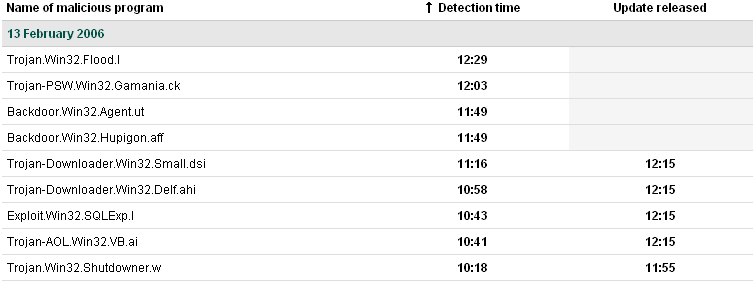
It's rather quiet on the AV radars' from the way I see it, and quickly going through F-Secure's, Kaspersky's (seem to be busy analyzing code, great real-time stats!), Symantec's I came across the similarities you can feel for yourself in "the wild" :) Symantec's ThreatCon is normal, what's interesting to note is VirusTotal's flood of detected WMF's, which is perhaps a consequence of the *known* second vulnerability.

James Ancheta's case was perhaps the first known and so nicely documented on botnet power on demand. Recently, a botnet, or the participation in such shut down a hospital's network, more over I think StormPay didn't comply with a DDoS extortion attempt during the weekend?

Joanna Rutkowska provided more insights on stealth malware in her research (slides, demo) about "about new generation of stealth malware, so called Stealth by Design (SbD) malware, which doesn't use any of the classic rootkit technology tricks, but still offers full stealth. The presentation also focuses on limitations of the current anti-rootkit technology and why it’s not useful in fighting SbD malware. Consequently, alternative method for compromise detection is advocated in this presentation, Explicit Compromise Detection (ECD), as well as the challenges which Independent Software Vendors encounter when trying to implement ECD for Windows systems – I call it Memory Reading Problem (MRP). "

How sound is the possibility of malware heading towards the BIOS anyway? An "Intelligent P2P worm's activity" that I just across to also deserves to be mentioned, the concept is great, still the authors have to figure out how to come up with legitimate file sizes for multimedia files if they really want to fake its existence, what do you think on this?

Some recent research and articles worth mentioning are, Kaspersky's Malware - Evolution : October - December 2005 outlines the possibilities for cryptoviral extortion attacks, 0days vulnerabilities, and how the WMF bug got purchased/sold for $4000. There's also been quite a lot of new trojans analyzed by third-party researchers, and among the many recent articles that made me an impression are "Malicious Malware: attacking the attackers, part 1" and part 2, from the article :

"This article explores measures to attack those malicious attackers who seek to harm our legitimate systems. The proactive use of exploits and bot networks that fight other bot networks, along with social engineering and attacker techniques are all discussed in an ethical manner."

Internet worms and IPv6 has nice points, still I wish there were only network based worms to bother about. Besides all I've missed important concepts in various commentaries, did you? Malware is still vulnerabilities/social engineering attacks split at least for the last several months, still the increased corporate and home IM usage will inevitable lead to many more security threats to worry about. Web platform worms such as MySpace and Google's AdSense Trojan, are slowly gaining grounds as a Web 2.0 concept, so virus or IDS signatures are to look for, try both!

During January, David Aitel reopened the subject of beneficial worms out of Vesselin Bontchev's research on "good worms". While I have my reservations on such a concept that would have to do with patching mostly the way I see it, could exploiting a vulnerability in a piece of malware by considered useful some day, or could a network mapping worm launched in the wild act as an early response system on mapped targets that could end up in a malware's "hitlist"? And I also think the alternative to such an approach going beyond the network level is Johnny Long's (recent chat with him) Google Dorks Hacking Database, you won't need to try to map the unlimited IPv6 address space looking for preys. Someone will either do the job for you, or with the time, transparancy in IPv6, one necessary for segmented and targeted attacks will be achieved as well.

Several days ago, Kaspersky released their summary for 2005, nothing ground breaking in here compared to previous research on how the WMF vulnerability was purchased/sold for $4000 :) but still, it's a very comprehensive and in-depth summary of 2005 in respect to the variables of a malware they keep track of. I recommend you to go through it. What made me an impression? 
- on average, 6368 malicious programs detected by month

- +272% Trojan-Downloaders 2005 vs 2004

- +212% Trojan-Dropper 2005 vs 2004

- +413% Rootkit 2005 vs 2004

- During 2005, on average 28 new rootkits a month

- IM worms 32 modifications per month

- IRC worms are on -31%

- P2P worms are on -43%, the best thing is that Kaspersky labs also shares my opinion on the reason for the decline, P2P busts and general prosecutions for file-sharing. What's also interesting is to mention is the recent ruling in a district court in Paris on the "legality of P2P" in France and the charge of 5 EUR per month for access to P2P, but for how long? :) P2P filesharing isn't illegal and if you cannot come up with a way to release your multimedia content online, don't bother doing at all. In previous chats I had with Eric Goldman, he also makes some very good points on the topic.

- +68% Exploit, that is software vulnerabilities and the use of exploits both known or 0day's with the idea to easily exploit targeted PC, though I'm expecting the actual percentage to be much higher

- Internet banking malware reached a record 402% growth rate by the end of 2005 The Trojan.Passwd is a very good example, it clearly indicates that it is written for financial gains. E-banking can indeed prove dangerous sometimes, and while I'm not being a paranoid in here, I'd would recommend you go through Candid's well written "Threats to Consider when doing E-banking" paper

- A modest growth from 22 programs per month in 2004 to 31 in 2005 on the Linux malware front

I feel today's malware scene is so vibrant that it's getting more and more complex to keep track of possible propagation vectors, ecosystem here and there, and mostly communicating what's going on to the general public(actually this one isn't). 
What's to come and what drives the current growth of malware?
- money!
- the commercialization of the market for software vulnerabilities, where we have the first underground purchase of the WMF exploit, so have software vulnerabilities always been the currency of trade in the security world or they've started getting the necessary attention recently?
- is stealth malware more than an issue compared to utilizing 0day vulnerabilities, and is retaining current zombie PCs a bigger priority than to infecting new ones?
- business competitors, enemies, unethical individuals are actively seeking for undetected pieces of malware coded especially for their needs, these definitely go beneath the sensors
- Ancheta's case is a clear indication of a working Ecosystem from my point of view, that goes as high as to provide after-sale services such as DDoS strength consultations and 0day malware on demand

To sum up, malware tends to look so sneaky when spreading and zoomed out :) I originally came across the VisualComplexity project in one of my previous posts on visualization. Feel I've missed something that's worth mentioning during the last two months? Than consider expanding the discussion!
You can also consider going through the following resources related to malware :
Continue reading →

Cyberterrorism - recent developments

January 23, 2006
I've once blogged about why you shouldn't stereotype when it comes to Cyberterrorism, and going through the most recent and well researched report on"Terrorism Capabilities for Cyberattack : Overview and Policy Issues"I came across great similarities to what I posted. I think cyberterrorism shouldn't be just perceived as shutting down a stock exchange, or slowing it down, the irony here is that it could actually happen for "good" on a certain occasions :)

Going back to the report, it's a very recent overview of cyberterrorism, and the way it's perceived. Flawed or not I'll leave up to you to decide. What made me an impression anyway?

- CIA's 2005 "Silent Horizon" to practice defending against a simulated widespread cyberattack directed against the United States. I really don't think frontal attack are of any interest, or are they?

- Stolen credit cards were used in the terrorist attacks in Bali. There have also been other cases, of exactly the same, using cyber activities for funding real world crime and terrorism.

- How sensitive information on a future Army command and control system was stolen from an unclassified system by at least reportedly, Chinese hackers. Unclasiffied doesn't necessarily mean someone wasn't having a false sense of security on a .mil domain I guess.

- The U.S Elite Military Hacking Crew, the so called Joint Functional Component Command for Network Warfare (JFCCNW) I feel every military forces have or should have these.

The report also highlights that the Internet is now a prime recruiting tool for insurgents in Iraq. Insurgents have created many Arabic-language Web sites that are said to contain coded plans for new attacks. Some reportedly give advice on how to build and operate weapons, and how to pass through border checkpoints .

- Other news articles report that a younger generation of terrorists and extremists, such as those behind the July 2005 bombings in London, are learning new technical skills to help them avoid detection by law enforcement computer technology

Which is exactly what I've mentioned in my post on Cyberterrorism. I feel, communication, and coordination, besides research is the ultimate goal here.

The only thing that make made me sort of a bad impression was how the only major innovation mentioned is quantum cryptography, and steganography mentioned just twice. I think that this isn't entirely the case, and breaking cryptography doesn't necessarily have to come in form of directly attacking the algorithm itself. That happens to be impossible sometimes, but the first time when I came across the fact that the AU government can use spyware on criminals with the idea too obtain keys, or whatsoever, it makes such issues irrelevant.

On the other hand, the way the Internet provides "them" with more opportunities, the more their traceability improves, or at least give clues to a certain extend.

Technorati tags :
,,,,
Continue reading →

Why relying on virus signatures simply doesn't work anymore?

January 19, 2006
As a fan of VirusTotal and Norman's Sandbox being always handy when making analyses or conclusions, and me looking for metrics and data to base my judgments on, besides experience, I feel their "Failures in Detection" of VT deserve more attention then they it's actually getting. 

With over 14, 000 files submitted on a weekly basis, where most of them are supposedly 0day malicious software, it's a great resource to consider. Using these scanners for the basis of its service (saw yours?!), it is still able to conclude the plain truth - signature based anti virus protection is having deep troubles as a concept these days. 

Moreover, vendors covering or enjoying monopolistic competition in specific geographical regions, without having the necessary AV expertise is something that is actually happening. So what made me an impression?

Failures in Detection (Last 7 days)

- 14, 016 failures that is, infected files not detected by at least one antivirus engine
- 372 samples detected by all vendors

What's important to note here is that, response time towards a new piece of malware in the wild is crucial as always. But that's great when it's actually achieved. The independent folks at Av-test.org, have featured a very nice Excel sheet on the "Reaction Times of the latest MS05-039-based Worm Attacks"(2005-08-22) so you can take a look for yourself. 

And as I've once mentioned my opinion on the growing possibility of 0day malware on demand, proactive measures would hopefully get the attention of vendors. Some folks are going as high as stating that AV scanners and AV defense as a concept will eventually end up as product line extension of a security appliance? Though, I feel you will never be able to license a core competency of a vendor that's been there before the concept of DDoS started getting public! And obviously, the number of signatures detected by them doesn't play a major role like it used years ago. Today's competitive factors have to do with, but not only of course :

Heuristic
Policy-Based Security
IPS (Intrusion Prevention Systems)
Behaviour Blockers
Protection against Buffer Overruns


I also advise you to go though a well written research on the topic of Proactive Antivirus protection, as it highlights the issues to keep in mind in respect to each of these. Is client side sandboxing an alternative as well, could and would a customer agree to act as a sandbox compared to the current(if any!) contribution of forwarding a suspicious sample? Would v2.0 constitute of a collective automated web petrol in a PC's "spare time"? How sound is this and the other concepts in terms of usability and deployment on a large scale?

Signatures are always a necessary evil as I like to say, ensure that at least your anti virus software vendor is not a newly born company with a modest honeyfarm and starting to perceive itself as a vendor, vendor of what? Solutions or signatures?!

Don't get me wrong, my intention behind this post was to make you think, as a customer or decion-maker on the approaches your current vendor uses, and how to make better decisions. At the bottom line, it's still a vendor's sensor network or client side submissions, even exchange of data between them, that provides the fastest response to *known* malware!

Technorati tags :
,,,,,
Continue reading →

FBI's 2005 Computer Crime Survey - what's to consider?

January 19, 2006
Yesterday, the FBI has released their Annual 2005 Computer Crime Survey, and while I bet many other comments will also follow, I have decided to comment on it the way I've been commenting on the U.S 2004’s "Annual Report to Congress on Foreign Economic Collection and Industrial Espionage" in previous posts. This one is compiled based on the 24, 000 participating organizations from 430 cities within the U.S, so look for the averages where possible :)

What are the key summary points, and what you should keep in mind?

- Attacks are on the rise, as always

That's greatly anticipated given the ever growing Internet penetration and the number of new users whose bandwidth power is reaching levels of a middle sized ISP. Taking into consideration the corporate migration towards IP based business infrastructure, and even the military's interest in that, it results in quite a lot of both, visible/invisible targets. My point is that, to a certain extend a new Internet user is exposed to a variety of events that are always static in terms of security breaches, or was it like that several years ago? Less 0day's, lack of client side vulnerabilities(browsers) the way we are seeing it today, and cookies compared to spyware were the "worst" that could happen to you. Things have changed, but malware is still on the top of every survey/research you would come across.

- The threat from within

Insiders dominate the corporate threatscape as always, and the average financial losses due to "Laptop/Desktop/PDA Theft", act as an indicator for intellectual or sensitive property theft that is actively quantified to a certain extend, though it is still mentioned in a separate section. As far as insiders and the responses given in here, "the threat you're currently not aware of, is the threat actually happening" to quote a McAfee's ad I recently came across to. Especially in respect to insiders.

- To report or not to report?

According to the survey "Just 9% said they reported incidents to law enforcement, believing the infractions were not illegal or that there was little law enforcement could or would do. Of those reporting, however, 91% were satisfied with law enforcement's response. And 81% said they'd report future incidents to the FBI or other law enforcement agencies."

The key point here is the lack of understanding of what a threat is, or perhaps what exactly should be reported, or why bother at all? And given that out of the 9% reporting 91% are satisfied I can simply say that, "If you don't take care of your destiny, someone else will".

Overall, you should consider that the lack of quality statistics is the result of both, the "stick to the big picture" research and survey approaches, or because of companies not interested/understanding what a security threat worth reporting actually is? I greatly feel the industry and the Internet as a whole is in need of a commonly accepted approach, and while such exist, someone has to perhaps communicate them in a more effective way. Broad and unstructured definitions of security, result in a great deal of insecurities to a certain extend, or have the potential to, doesn't they?

- Who's attacking them?

Their homeland's infrastructure and the Chinese one, as the top attacks originally came from " The U.S. (26.1%) and China (23.9%) were the source of over half of the intrusion attempts, though masking technologies make it difficult to get an accurate reading", and yes, Russia "of course".

Though, you should keep in mind that whenever someone sparkles a debate on certain country's netblocks attacking another country's one, it's always questionable.

- What measures are actually taken?
Besides actively investing in further solutions, and re-evaluating their current measures, what made me an impression as worth mentioning is :

- patching, whether the patch comes from a third-party or the vendor itself is something else, yes it's the reactive measure that could indeed eliminate "known" vulnerabilities, yet it's proactive approaches companies should aim at achieving

- keeping it quiet, as you can see the 3rd measure taken is to actually not report what has happened, wrong, both in respect to the actual state of security, and the potential consequences in case a sensitive info breach occurred and customers did the job of reporting and linking it.

- tracing back? I think it's a bit unrealistic in today's botnets dominated Internet, namely an enterprise might find out that some of its external port scans are coming from internal infected PCs. When attacked you always want to know where the hell is it coming from, and who's involved, and while entirely based on the attackers techniques put in place, I feel that close cooperation with ISPs in reporting the infected nodes should get the priority compared to tracing the attacks back. That greatly depends on the attack, its severity, and traceability of course.

To sum up, the bottom line is that, antivirus software and perimeter based defenses dominate the perception of security as always, companies are actively investing in security and would continue to do so. It's a very recent survey for you to use, or brainstorm on!

Technorati tags :
,,,,
Continue reading →

Future Trends of Malware

January 16, 2006
Great news, that I greatly anticipated, my "Malware - Future Trends" research got Slashdotted. The strange thing is how my actual post and numerous others from different respected sites weren't approved. I guess I would have to live with that, given the huge number of hits and new subscribers to my feed I have received for the last couple of days :))

Someone once said, that it’s all about to courage to write down what you think. And he was right, but he missed to mention, that you should also stand behind what you believe in. There’s nothing more important than disseminating that kind of information to the broadest audience possible, in the fastest way achievable. The comments, links recognition and active feedback that I have been receiving, are the best benchmark for the usefulness of my research. So, thanks!

My “Malware – future trends” publication has recently appeared at :

Packetstormsecurity.org
Securiteam.com
Net-security.org
LinuxSecurity.com
Infosecwriters.com
WhiteDust.net
ISECA.org
BankInfoSecurity.com
Wiretapped.net
Astalavista.com
CGISecurity.com
Megasecurity.org
Secguru.com
Wikipedia's entry on Malware

to name few of the sites, and in various blog comments :

Computerworld’s IT Management Blog
Datamation's Blog
Sergio Hernando's post, and the Google translation
Alan Cardel's Blog
Worm Blog

And many others : 1, 2, 3, 4, 5, 6, 7, 8, 9, 10, 11, 12, 13, 14, 15, 16, 17, 18, 19, 20

The more naysayers, the more important is what you are doing, and I have come across a lot of them, though I wouldn’t even bother to link them back. They are a valuable incentive on a certain occasions. It's a great feeling that I missed for a little while, it reminds of the how differently people react to one another’s success and hard work. I totally enjoy people quoting me on every sentence from a 26 pages publication I pretty much finalized on Xmas eve, just for the idea of doing it.

Cheer up, guys, and go through my points objectively.

What I truly like, is the debate it opened up here and there, one of the main ideas behind it. Feel free to post your comments at my original announcement, Malware - Future Trends.

Technorati tags :
,,,,, Continue reading →