Showing posts with label Zero Day Initiative. Show all posts

Where's my 0day, please?

March 07, 2006
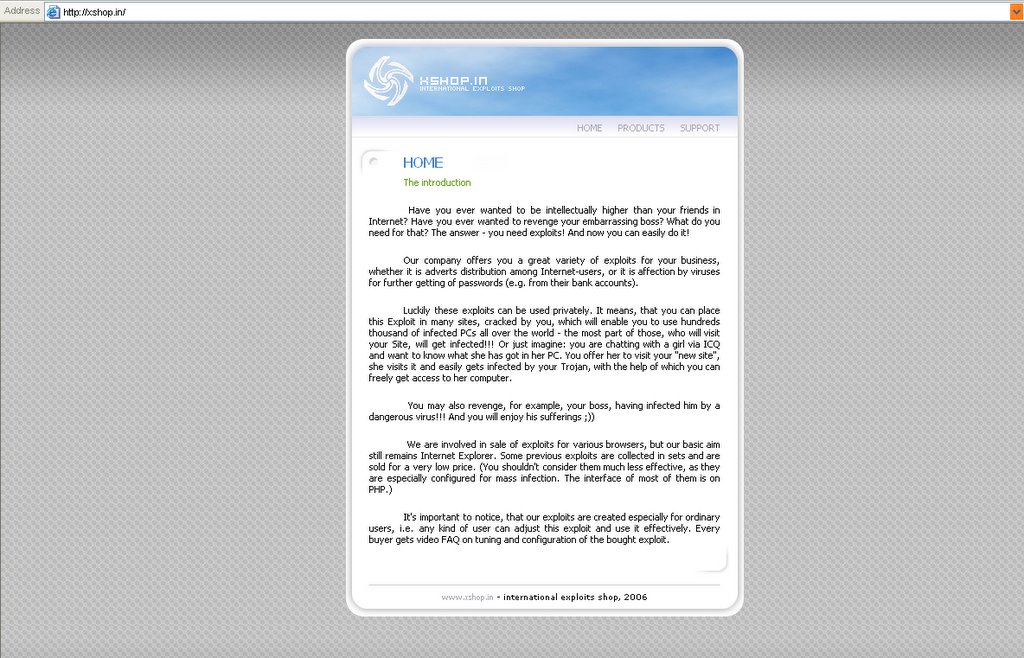
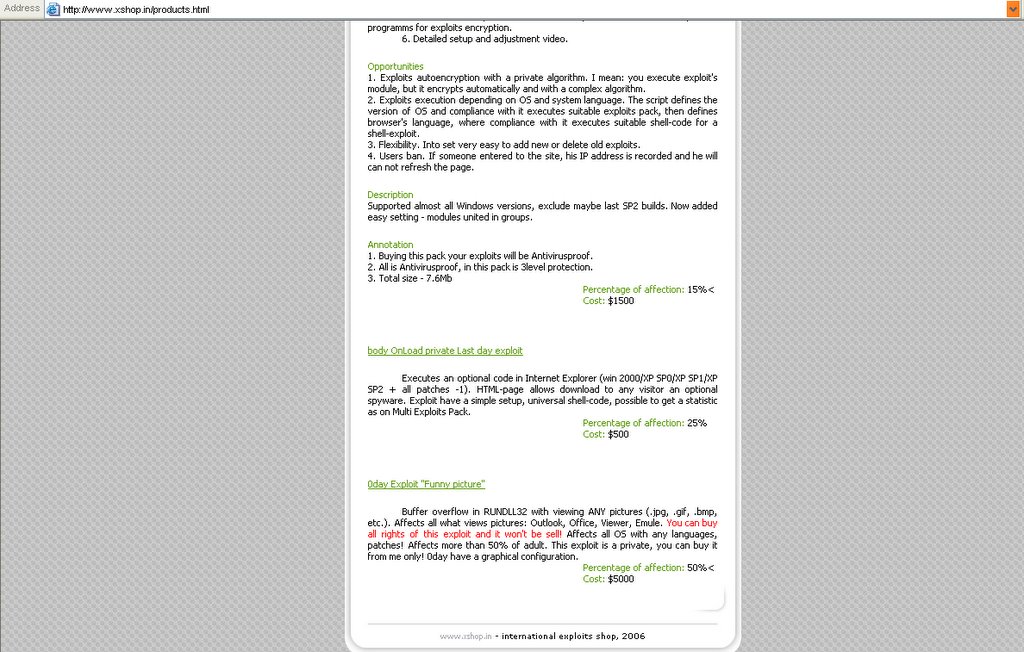
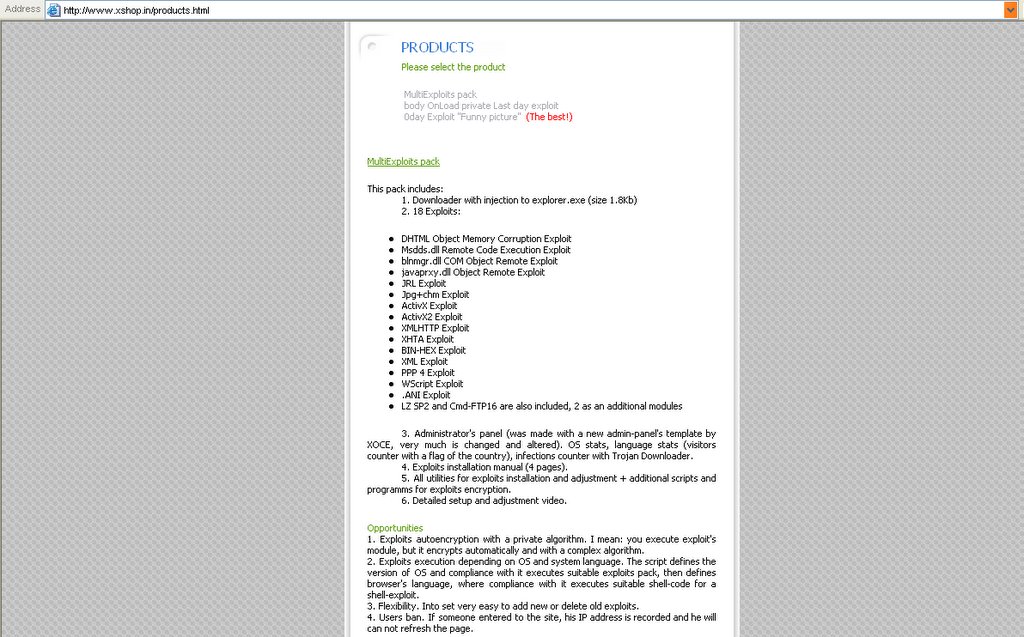
A site I was recently monitoring disappeared these days, so I feel it's about time I blog on this case. I have been talking about the emerging market for software vulnerabilities for quite some time, and it's quite a success to come across that the concept has been happening right there in front of us. Check out the screenshots. The International Exploits Shop I came across to looks like this :


It appears to be down now, while it has simply changed its location to somewhere else. Google no longer has it cached, and the the only info on this wisely registered .in domain, can be found at Koffix Blocker's site.


A lot of people underestimate the power of the over-the-counter(OTC), market for 0day security vulnerabilities. Given that there isn't any vulnerabilities auction in place that would provide a researcher with multiple proposals, and the buyers with a much greater choice or even social networking with the idea to possibly attract skilled HR, the seller is making personal propositions with the idea to get higher exposure from the site's visitors. Whoever is buying the exploit and whatever happens with it doesn't seem to bother the seller in this case.


As there's been already emerging competition between different infomediaries that purchase vulnerabilities information and pay the researchers, researchers themselves are getting more and more interested in hearing from "multiple parties". Turning vulnerability research, and its actual findings into an IP, and offering financial incentives is tricky, and no pioneers are needed in here!


There's been a lot of active discussion among friends, and over the Net. I recently came across a great and very recent research entitled "Vulnerability markets - what is the economic value of a zero-day exploit?", by Rainer Boehme, that's worth the read. Basically, it tries to list all the market models and possible participants, such as :


Bug challenges
- Bug challenges are the simplest and oldest form of vulnerability markets, where the producer offers a monetary reward for reported bugs. There are some real-world examples for bug challenges. Most widely known is Donald E. Knuth’s reward of initially 1.28 USD for each bug in his TEX typesetting system, which grows exponentially with the number of years the program is in use. Other examples include the RSA factoring challenge, or the shady SDMI challenge on digital audio watermarking


Bug auctions
-Bug auctions are theoretical framework for essentially the same concept as bug
challenges. Andy Ozment [9] first formulated bug challenges in the terms of auction theory,
in particular as a reverse Dutch auction, or an open first-price ascending auction. This allowed him to draw on a huge body of literature and thus add a number of eciency enhancements to the original concept. However, the existence of this market type still depends on the initiative of the vendor


Vulnerability brokers
-Vulnerability brokers are often referred to as “vulnerability sharing circles”. These clubs are
built around independent organizations (mostly private companies) who oer money for new vulnerability reports, which they circulate within a closed group of subscribers to their security alert service. In the standard model, only good guys are allowed to join the club


-Cyber Insurance
Cyber-insurance is among the oldest proposals for market mechanisms to overcome the security market failure. The logic that cures the market failure goes as follows: end users demand insurance against financial losses from information security breaches and insurance companies sell this kind of coverage after a security audit. The premium is assumed to be adjusted by the individual risk, which depends on the IT systems in use and the security mechanisms in place.


Let's try define the market's participants, their expectations and value added through their actions, if any, of course.


Buyers
-malicious (E-criminals, malware authors, competitors, political organization/fraction etc.)
-third party, end users, private detectives, military, intelligence personnel
-vendors (either through informediary, or directly themselves, which hasn't actually happened so far)


Sellers
-reputable
-newly born
-questionable
-does it matter at the bottom line?


Intermediaries
-iDefense
-ZeroDayInitiative-Digital Armaments


Society
-Internet
-CERT model - totally out of the game these days?


As iDefense simply had to restore their position in this emerging market developed mainly by them, an offer for $10,000 was made for a critical vulnerability as defined by Microsoft. I mean, I'm sort of missing the point in here. Obviously, they are aware of the level of quality research that could be sold to them.


Still I wonder what exactly are they competing with :


- trying to attract the most talented researchers, instead of having them turn to the dark side? I doubt they are that much socially oriented, but still it's an option?


- ensuring the proactive security of its customers through first notifying them, and them and then the general public? That doesn't necessarily secures the Internet, and sort of provides the clientele with a false feeling of security, "what if" a (malicious) vulnerability researcher doesn't cooperate with iDefense, and instead sells an 0day to a competitor? Would the vendor's IPS protect against a threat like that too?


- fighting against the permanent opportunity of another 0day, gaining only a temporary momentum advantage?


- improving the company's clients list through constant collaboration with leading vendors while communication a vulnerability in their software products?


A lot of research publications reasonably argue that the credit for the highest social-welware return goes to a CERT type of a model. And while this is truly, accountability and providing a researcher with the highest, both tangible, and intangible reward for them is what also can make an impact. As a matter of fact, is blackmailing a nasty option that could easily become reality in here, or I'm just being paranoid?


To conclude, this very same shop is definitely among the many other active out there for sure, so, sooner or later we would either witness the introduction of a reputable Auction based vulnerabilities market model, or continue living with windows of opportunities, clumsy vendors, and 0day mom-and-dad shops :) But mind you, turning vuln research into IP and paying for it would provide enough motiviation for an underground 0bay as well, wouldn't it?


14.03.2006

OSVDB's Blog - Where's my 0day, please?
OSVDB's Blog - Vulnerability Markets


11.03.2006

LinuxSecurity.com - Where's my 0day, please?
FIRST - Where's my 0day, please?


10.03.2006 - Sites that picked up the story :

Net-Security.org - Where's my 0day, please?
MalwareHelp.org- The International Exploits Shop: Where's my 0day, please?
Security.nl - Internationale Exploit Shop levert 0days op bestelling
WhiteDust.net - Where's my 0day, please?
Reseaux-Telecoms.net - Danchev sur l'Achat de failles
Informit Network - 0-Days for Sale


09.03.2006 - Two nice articles related to the issue appeared yesterday as well, "Black market thrives on vulnerability trading", from the article :


"Security giant Symantec claims that anonymous collusion between hackers and criminals is creating a thriving black market for vulnerability trading. As criminals have woken up to the massive reach afforded to their activities thanks to the Internet, hackers too are now able to avoid risking prison sentences by simply selling on their findings. Graeme Pinkney, a manager at Symantec for trend analysis, told us: 'People have suddenly realised that there's now a profit margin and a revenue stream in vulnerabilities... There's an element of anonymous co-operation between the hacker and criminal.'"


and "The value of vulnerabilities", a quote :


“ There are no guarantees, and therefore I think it would be pretty naive to believe that the person reporting the issue is the only one aware of its existence. That in itself is pretty frightening if you think about it. "


Technorati tags:
, , , , , , , Continue reading →

0bay - how realistic is the market for security vulnerabilities?

December 12, 2005
In Issue 19 (July, 2005) of the Astalavista Security Newsletter that I release on a monthly basis, I wrote an article entitled "Security Researchers and your organization caught in between?" whose aim was to highlight a growing trend, namely the monetization of vulnerability research, who benefits and who doesn't.

A recent, rather significant event at least for me covering and monitoring this issue for quite some time now, was an Ebay listing for a "brand new Microsoft Excel vulnerability". A bit ironical, but I had a chat with Dave Endler, director of security research at TippingPoint, and the issue of their future position as bidders for someone else's research were discussed a week before the Ebay's listing in Issue 23 (November, 2005) of Astalavista's Security Newsletter.


Two of today's most popular, and at least public commercial entities paying hard cash for security vulnerabilities are : iDefense, and the ZeroDayInitiative (TippingPoint).

But what is the need for creating such a market? Who wins and who loses? What are the future global implications for this trends, originally started by iDefense?

In any market, there are sellers and buyers, that's the foundation of trade besides the actual exchange of goods/services and the associated transaction. What happens when buyers increase, is that sellers tend to increase as well, and, of course, exactly the opposite. Going further, every economy, has its black/underground or call it whatever you want variation. And while some will argue a respected researcher will contribute to the the development of even more botnets, who says it has to be respected to come with a vulnerability worth purchasing?! It's a Metasploit world, isn't it?!

Going back to the market's potential. Sellers get smarter, transparency is build given more buyers join seeking to achieve their objectives in this case, provide proactive protection to their clients only, and build an outstanding, hopefully loyal researchers' database. These firms, to which I refer as buyers have happened to envision the fact that there are thousands of skilled vulnerability researchers', who are amazingly capable, but aren't getting a penny out of releasing their vulnerabilities research. Ego is longer important, and getting $ for research on a free will basis is a proven capitalistic approach. What these companies(and I bet many more vendors will open themselves for such a service) didn't take into consideration in my opinion, is that, starting to work with people giving $ as the ultimate incentive will prove tricky in the long-term.

What will happen of the Swiss cheese of software(yet the one that dominates 95% of the OS market today) Microsoft starts bidding for security vulnerabilities in its products? Bankruptcy is not an option, while I doubt they will ever take this into consideration, mainly because it would seriously damage a market sector, the information security one. Imagine, just for a sec. that Microsoft decides to seriously deal with all its vulnerabilities? But today's lack of accountability for software vendors' actions related to vulnerabilities is making it even worse. If MS doesn't get sued for not releasing a patch in any time frame given, why should we, the small compared to MS vendor care?

Howard Schmidt, former White House cybersecurity adviser, once proposed that programmers should be held responsible for releasing vulnerable code. I partly agree with him, you cannot cut costs in order to meet product/marketing deadlines while hiring low skilled programmers who do not take security into consideration, which opens another complex discussion on what should a developer focus on these days - efficiency or security, and where's the trade-off?

I originally commented on this event back then :
The position of Schmidt prompts him to address critical issues and look for very strategic solutions which may not be favored by the majority of the industry as I’m reading through various news comments and blogs. I personally think, he has managed to realize the importance of making a distinction in how to tackle the vulnerabilities problem,who’s involved, and who can be influenced, where the ultimate goal is to achieve less vulnerable and poorly coded software. Software vendors seek profitability, or might actually be in the survival stage of their existence, and as obvious as it may seem, they facts huge costs, and extremely capable coders or employees tend to know their price! 

What’s the mention are the tech industry’s “supposed to be” benchmarks for vulnerabilities management, picture an enterprise with the “IE is the swiss cheese in the software world in terms of vulnerabilities, and yet no one is suing Microsoft over delayed patches” – lack of any incentives, besides moral ones, in case there’re clear signs and knowledge that efficiency is not balanced with security. And that’s still a bit of a gray area in the development world.

Vulnerabilities simply cannot exist, and perhaps the biggest trade-off we should also face is the enormous growth of interactive applications, innovation approaches for disseminating information, with speeds far outpacing the level of attention security gets. Eventually, we all benefit out of it, web application vulnerabilities scanners and consultants get rich, perhaps the (ISC)² should take this into consideration as well :-)

Even though you could still do the following :
- build awareness towards common certifications addressing the issue
- ensure your coders understand the trade-offs between efficiency and security and are able to apply certain marginal thinking, whereas still meet their objectives
- as far as accountability is concerned, do code auditing with security in mind and try figure out who are those that really don’t have a clue about security, train them
- constantly work on improving your patch release practices, or fight the problem from another point of view

But unless, coders, and software vendors aren’t given incentives, or obliged under regulations (that would ultimately result in lack of innovation, or at least a definite slow down), you would again have to live with uncertainly, and outsource the threats posed by this issue. M icrosoft’s “Improving Web Application Security: Threats and Countermeasures” book, still provides a very relevant information.

Slashdot’s discussion


What also bothers me, is how is the virginity of the vulnerability identified? I mean, what if I have already found it, developed an exploit for it, sold it to the underground, and cashed with the industry as well, and no one came across it on his/her :) honeyfarm? The researcher's reputation is a benchmark, but in the long-term, the competitive market that's about to appear, will force the buyers to start working on a mass basis. There's a definitely a lot to happen!

Welcome to the wonderful world of purchasing 0-day security vulnerabilities! Have an enemy, bid for his ownage, have a competitor, own them without having to attract unnecessary attention, I'm just kiddin' of course, although the possibilities are disturbing.

What I really liked about this important moment in vulnerability research, was that it was about time the security researchers wanted to see how valued their research is in terms of the only currency that matters in the process - the hard one. In my point of view, monetizing the vulnerabilities research market wasn't the best strategic approach on fighting 0-day vulnerabilities, in this case, ensure you have the most impressive minds on your side, and that your clients get hold of the latest vulnerabilities before the public does.

So - who's the winner - it's...Symantec who first realized the long-term importance of security vulnerabilities, and where, both researchers and actual vulnerabilities are - Bugtraq/SecurityFocus, by acquiring it for US$75 million in cash, back in 2002, and later one integrating its joys into the DeepSight Analyzer - remarkable. Both from a strategic point of view, and mainly because that, by the time any post on any of the associated mailing lists doesn't get approved, it's Symantec's staff having first look at what's to come for the day of everyone.

SecurityFocus is running a story about the Ebay vulnerability listing, and so is eWeek, Slashdot also picked up the story. It was about time for everyone, given it actually happened during the weekend :-)


Technorati tags :
Continue reading →