Saturday, August 05, 2006

Future in Malicious Code 2006

What's new on the malware front? Quite some new developments to be included in Q2's summary for 2006, I'm about to finalize any time now. Just came across to a great continuation of my original Malware - Future Trends publication, this time courtesy of the Royal Canadian Mounted Police, quoting and further expending the discussion on my key points :

- Mobile malware will be successfully monetized
- Localization as a concept will attract the coders' attention
- Open Source Malware
- Anonymous and illegal hosting of (copyrighted) data
- The development of Ecosystem
- Rise in encryption and packers
- 0day malware on demand
- Cryptoviral extortion / Ransomware will emerge
- When the security solutions (antivirus etc.) ends up the security problem itself
- Intellectual property worms
- Web vulnerabilities, and web worms - diversity and explicit velocity
- Hijacking botnets and infected PCs
- Interoperability will increase the diversity and reach of the malware scene

A brief summary :

"This report will provide an overview of the numerous malicious code trends experts are observing and those they predict will be seen in the foreseeable future. This is not a document that will chart the future of malicious code as that would be impossible. Malware writers move very quickly. They are adaptable and very often they are exploiting vulnerabilities before the rest of the security industry is fully aware of them. Their flexibility and reaction speed is essential if they wish to continue to make a profit and stay ahead of the anti-virus companies who are constantly devising new ways to detect and remove hostile code. As a result, some of the trends covered in this document may never fully evolve and others that have not been mentioned will, no doubt, appear.This document will give readers a better sense of what is coming “down the pipe” and perhaps, a better idea of what to look for when dealing with tomorrow’s malicious code."

Professionally questioning a vendor's or mogul's self-mythology is the anti-mogul speciality. Don't just slice the threat on pieces and take credit for slicing it, let's discuss the pie itself.

Meanwhile, keep an eye on my Delicious Information Warfare summaries, and syndicate them if time equals opportunities.


Friday, August 04, 2006

Mobile Devices Hacking Through a Suitcase

Define:nerd

"Luca Carettoni and Claudio Merloni are security consultants at Milan, Italy-based Secure Network. The two created the BlueBag to raise awareness about the potential of attacks against Bluetooth-enabled devices, they said in an interview at the Black Hat security event in Las Vegas. The BlueBag is a roll-aboard suitcase filled with hardware. That gear is loaded with software to scan for Bluetooth devices and launch attacks against those, the two men said. We started evaluating how Bluetooth technology was spread in a metropolitan area, Carettoni said. We went around airports, offices and shopping malls and realized that a covered bag can be used quite effectively for malicious purposes."

Outstanding execution of the idea, I still wonder what would the content of the suitcase look like through an X-ray if they ever get to pass through one of course. Go through the entire photo session at Black Hat 2006, by Joris Evers @CNET NEWS.com's team, as well as over the basics of bluetooth (in)security.

Thursday, August 03, 2006

Achieving Information Warfare Dominance Back in 1962

The point here isn't the consolidation indicated in the article :

"The consolidation involves Singer’s headquarters staff, and subordinate Naval Security Group Activities (NSGA) and detachments (NSGD). When fully completed, the action will combine the Navy's enlisted Cryptologic Technicians and Information Warfare officers into the same organization as the Navy’s Information Systems Technicians and Information Professional officers. The IO warfare area is composed of five core integrated capabilities: Electronic Warfare, Computer Network Operations, Psychological Operations, Military Deception and Operational Security. These combine with related capabilities to provide “Information Dominance,” the concept of controlling an adversary’s use of the information and communications environment while protecting one’s own."

but the advances of intercepting electromagnetic emissions reflected off the Moon back in 1962, through the NRRO 600-Foot Steerable Parabolic Antenna :

"Naval Radio Research Observatory (NRRO). This observatory is to be erected at Sugar Grove, West Virginia for exploiting lunar reflective techniques for the purposes of intelligence collection, radio astronomy, and communications-electronics research. A 600-foot steerable parabolic radio antenna will provide for the reception of electromagnetic emissions reflected off the moon. As an intelligence device it will provide for reception and analyzing emissions from areas of the world not now accessible by any other known method, short of physical penetration. The Observatory is planned to be operational in FY 1962."

Here's more info on the concept :

"Although the 600-ft telescope was never built, a satellite-based alternative, called `GRAB' (Galactic RAdiation Background), was launched in June of 1960. Again, this was a dual-use system. The world's first elint satellite and astronomical observatory were integrated into the same satellite bus, with astronomy serving as an operational front for the whole. A second GRAB was launched in 1962. This interface of classified and basic research tells us about the pursuit of science and science-based technologies during the Cold War."

Nowadays it just seems to be full of bird listeners using parabolic microphones, activists "hacking" TV and Radio signals, and others conducting sophisticated TECHINT on the war field.

Related resources:
InformationWarfare
Cyber Warfare
PSYOPS
Intelligence

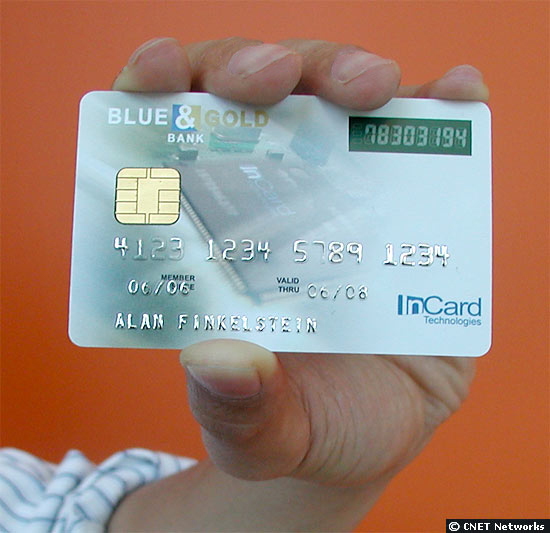
One Time Password Generating Credit Card

This is cute as it solves a major problem with customers having to use, and more easily lose tokens. Neat integration with the push of a button on the one time password generating credit card :

"It took InCard four years to develop the card, Finkelstein said. The company combined technology from a Taiwanese display maker, a U.S. battery manufacturer and a French security team, he said. A Swiss partner, NagraID, owns the rights to the process to combine the pieces and actually manufacture the technical innards of the card. The biggest development challenges were the ability to bend the card, power consumption and thickness, Finkelstein said. The result is a card that's as thin and flexible as a regular credit card and is guaranteed to work for three years and 16,000 uses. "Which is about 15 times a day, seven days a week," Finkelstein said."

Compliance with the FFIEC, or an emerging trend of convergence, trouble is it doesn't solve the majority of issues related to phishing attacks, rather it has the potential to undermine other companies' offerings. Now all they need is someone who'll take the role of an evangelist besides the well networked company executives.

Related posts:
Anti Phishing Toolbars - Can You Trust Them?
Heading in the Opposite Direction
No Anti Virus Software, No E-banking for You