Tuesday, November 14, 2006

Satellite Imagery Trade-offs

Informative to know :

"Eventually, Andersen said, the big but light telescopes could solve a spy-satellite conundrum. Now, those camera equipped satellites must fly closer to Earth to generate usable pictures. That means their orbits exceed the speed of Earth’s rotation, so the satellites cannot spend much time photographing one location. If spy satellites had huge telescopes, they could be placed higher above the planet in an orbit that moves at the same speed as Earth’s rotation, so they could photograph the same region constantly."

There's just one tiny comment that makes a bad impression - “That way, you could keep a constant eye on someone like Osama bin Laden” he said." In exactly the say way a security consultant wrongly tries to talk top management into increasing a budget by using the buzzword cyberterrorism, it wouldn't work and it's a rather desperate move. Even though, in case you're interested in keeping track of Bin Laden's desert trips, make sure you add a detection pattern for a white horse riding through Afghanistan.

Go through some of my previous posts to catch up with my comments on related topics.

U.S No-Fly-List Enforced at Deutsche Bank NYC

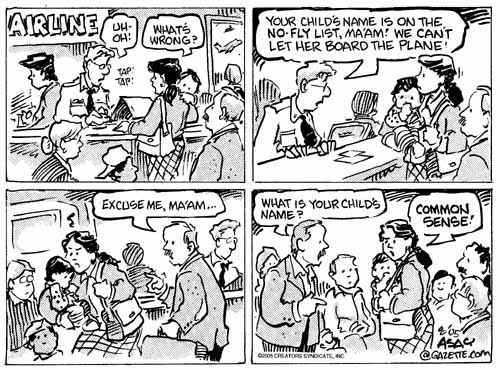
Apparently, the no-fly-list has been recently used as an access control measure at the Deutsche Bank's NYC's office according to the DealBreaker :

"We hear Deutsche Bank’s super-suped-up security extends beyond just the beefy armed guards patrolling the street outside its headquarters at 60 Wall. Yesterday apparently a consultant who was scheduled to attend a meeting at the bank was denied entry because his name appears on the federal “no fly” list. “It was the most intense security I've seen, except for maybe the Israeli consulate,” a source who was present when the consultant was denied entry tells DealBreaker."

While that's a very unpragmatic paranoia, a U.S congresswoman seems to have recently experienced the "no-fly-list trip" too :

"Sanchez said her staff had booked her a one-way ticket from Boise, Idaho to Cincinnati through Denver. Her staff, however, was prevented from printing her boarding pass online and were also blocked from printing her boarding pass at an airport kiosk. Sanchez said she was instructed to check in with a United employee, who told her she was on the terrorist watch list. The employee asked her for identification, Sanchez recalled. "I handed over my congressional ID and he started laughing and said, 'I'm going to need an ID that has your birthday on it,'" Sanchez said in a phone interview with The Associated Press. The employee used Sanchez's birth date to determine that she was not the same Loretta Sanchez listed in the database and she was able to board her flight, she said."

Bureaucrats don't just slow down innovation and take credit for it, but when they also fall down from a window it takes a week for them to hit the ground.

Monday, November 13, 2006

Jihadi PSYOPS - CIA Attacks on Terrorist Websites

Last week, the Internet Haganah reported on rumors around jihadist forums, namely, that the CIA has been attacking jihadi web sites.

Now while this is totally untrue -- the CIA would rather be monitoring instead of shuting them down, or shut them down only after they've gathered enough info -- it's a good example of twisting the facts to improve the productivity and self-esteem of the jihadists supposed to strike back.

Bill Gates on Traffic Acquisition and Internet Bubbles

Confused Bill Gates, but a regularly attacked one too. A rather predictable comment given he's not the only one selling the chewing gums and the soaps this time, so keep on bubbling folks. Think mature Web 2.0, think Semantic web, or at least dare to envision -- Microsoft wishes the Internet was never invented, unless of course they could sell you the license to use it.

"There are a hundred YouTube sites out there," Gates said during an interview with a group of journalists in Brussels before a speech to European lawmakers. "You never know. It's very complicated in terms of what are the business models for these sites." Some of them, including sites that offer Web-based word processing and search engines, are being promoted by their creators and analysts as possible competitors to makers of retail packaged software like Microsoft. "We're back kind of in Internet-bubble era in terms of people thinking: 'O.K., traffic. We want traffic. We want traffic,'" Gates said. "There are still some areas where it is unclear what's going to come out of that."

The very basics of Internet marketing which transform branding into communication, segments into communities for instance doesn't necessarily mean that traffic is the cornerstone of E-business. Eyeballs, thus participants marely visitors converted into revenue sources speak for themselves. Win-win-win business models need no comment. Once you get the traffic, boy, what wonders are there for you to discover, sense and profitably respond to. But then again, keep in mind that search and online video represent a tiny portion of the overal Internet user's activities. Don't look for the next Google, or the next YouTube, look beyond.

Having R&D centers on enemy territories creates more job opportunities, and improves Microsoft's comfortability with its stakeholders :

"Microsoft said that it would invest $7.8 billion globally in research and development this year, about 15 percent of sales, and it plans to spend $500 million in Europe next year. Microsoft operates its main European research center on the campus of Cambridge University in England, with other research offices in Denmark and Ireland."

While it's also cheaper to operate them in Europe than in the U.S, money cannot buy innovation and many other things, so don't get too excited but learn how to surf tidal waves, the ones Bill Gates himself predicted back in 1995.

Related posts:
5 things Microsoft can do to secure the Internet, and why it wouldn't?
Microsoft in the Information Security Market
Microsoft's OneCare Penetration Pricing Strategy