You know Dilbert, don't you? I find this cartoon a very good representation of what is going on in the emerging market for software vulnerabilities, and of course, its OTC trade practices -- total miscommunication and different needs and opinions. While different opinions and needs provoke quality discussion and I understand the point that everyone is witnessing that something huge is happening, "so why shouldn't I?", but at the bottom line, it's so obvious that there isn't any sort of mission or social welfare goal to be achieved, that everyone is commercializing what used to be the "information wants to be free" attitude.
Weren't software vulnerabilities supposed to turn into a commodity given the number of people capable and actually discovering them, where "windows of opportunities" get the highest priority as a con? That is, compared to commercializing vulnerability research, empowering researchers to the skies, and turning vulnerabilities into an IP, totally decentralizing the current sources of information, and fueling the growth of underground models, as it's obvious that for the time being vulnerabilities and their early acquirement seems to be where the $ is. What do you think?
Technorati tags :
Security, Vulnerabilities, 0day, 0bay, Dilbert
Friday, March 17, 2006
"Successful" communication


 Independent Security Consultancy, Threat Intelligence Analysis (OSINT/Cyber Counter Intelligence) and Competitive Intelligence research on demand. Insightful, unbiased, and client-tailored assessments, neatly communicated in the form of interactive reports - because anticipating the emerging threatscape is what shapes the big picture at the end of the day. Approach me at dancho.danchev@hush.com
Getting paid for getting hacked
In the middle of February, Time Magazine ran a great article on Cyberinsurance or "Shock Absorbers", and I feel this future trend deserves a couple of comments, from the article :
"As companies grow more dependent on the Internet to conduct business, they have been driving the growing demand for cyber insurance. Written premiums have climbed from $100 million in 2003 to $200 million in 2005, according to Aon Financial Services Group. The need for cyberinsurance has only increased as hacker move away from general mischief to targeted crimes for profit. Insurers offer two basic types of cyber insurance: first-party coverage will help companies pay for recovery after an attack or even to pay the extortion for threatened attacks, while third-party coverage helps pay legal expenses if someone sues after a security breach. Demand for insurance is also driven by laws in over twenty states that require companies to notify consumers if a breach compromises their personal data. However, prevention is still the top priority for most companies, since loss of critical data to competitors would do damage beyond the payout of any policy."
Cyber insurance seems to be an exciting business with a lot of uncertainty compared to other industries with more detailed ROIs, as I feel the information security one is missing a reliable ROSI model. I once blogged about why we cannot measure the real cost of cybercrime, and commented the same issue with the "FBI's 2005 Computer Crime Survey - what's to consider?". Don't get me wrong, these are reliable sources for various market indicators, still the situation is, of course, even worse.
But how do you try to value security at the bottom line?
Bargaining with security, and negotiating its cost is projectable and easy to calculate, but whether security is actually in place or somehow improved, seems to be a second priority -- bad bargaining in the long-term, but marketable one in the short one.
Going back to the article, I hope there aren't any botnet herders reading this, especially the first-party coverage point. To a certain extend, that's a very pointless service, as it fuels the growth of DDoS extortion, as now it's the insurer having to pay for it, meaning there're a lot of revenue streams to be taken by the cybergang. While covering the expenses of extortion attempts is very marketable, it clearly highlights how immature the current state of the concept really is. Something else to consider, is that a lot of companies reasonably take advantage of MSSPs with the idea to forward risk/outsource their security to an experienced provider, and most importantly, budget with their security spending. And while the California's SB 1386 is important factor for growth of the service given the 20 states participating, with the number of stolen databases from both, commercial, educational and military organizations, insurers will start earning a lot of revenues that could have been perhaps spent in security R&D -- which I doubt they would spend them on, would they?
UPDATE:
The post has just appeared at Net-Security.org - "Getting paid for getting hacked", as well as LinuxSecurity.com - "Getting paid for getting hacked"
Related resources :
Cyber-Insurance Revisited
Economics and Security Resource Page
WEIS05 WorkShop on Economics and Information Security - papers and presentations
Valuing Security Products and Patches
The New Economics of Information Security
Safety at a Premium
Cyber Insurance and IT Security Investment Impact on Interdependent Risk
Valuing Security Products and Patches
Network Risks, Exposures and Solutions
Technorati tags :
Security, ROSI, Cyber Insurance, Economics
"As companies grow more dependent on the Internet to conduct business, they have been driving the growing demand for cyber insurance. Written premiums have climbed from $100 million in 2003 to $200 million in 2005, according to Aon Financial Services Group. The need for cyberinsurance has only increased as hacker move away from general mischief to targeted crimes for profit. Insurers offer two basic types of cyber insurance: first-party coverage will help companies pay for recovery after an attack or even to pay the extortion for threatened attacks, while third-party coverage helps pay legal expenses if someone sues after a security breach. Demand for insurance is also driven by laws in over twenty states that require companies to notify consumers if a breach compromises their personal data. However, prevention is still the top priority for most companies, since loss of critical data to competitors would do damage beyond the payout of any policy."
Cyber insurance seems to be an exciting business with a lot of uncertainty compared to other industries with more detailed ROIs, as I feel the information security one is missing a reliable ROSI model. I once blogged about why we cannot measure the real cost of cybercrime, and commented the same issue with the "FBI's 2005 Computer Crime Survey - what's to consider?". Don't get me wrong, these are reliable sources for various market indicators, still the situation is, of course, even worse.
But how do you try to value security at the bottom line?
Bargaining with security, and negotiating its cost is projectable and easy to calculate, but whether security is actually in place or somehow improved, seems to be a second priority -- bad bargaining in the long-term, but marketable one in the short one.
Going back to the article, I hope there aren't any botnet herders reading this, especially the first-party coverage point. To a certain extend, that's a very pointless service, as it fuels the growth of DDoS extortion, as now it's the insurer having to pay for it, meaning there're a lot of revenue streams to be taken by the cybergang. While covering the expenses of extortion attempts is very marketable, it clearly highlights how immature the current state of the concept really is. Something else to consider, is that a lot of companies reasonably take advantage of MSSPs with the idea to forward risk/outsource their security to an experienced provider, and most importantly, budget with their security spending. And while the California's SB 1386 is important factor for growth of the service given the 20 states participating, with the number of stolen databases from both, commercial, educational and military organizations, insurers will start earning a lot of revenues that could have been perhaps spent in security R&D -- which I doubt they would spend them on, would they?
UPDATE:
The post has just appeared at Net-Security.org - "Getting paid for getting hacked", as well as LinuxSecurity.com - "Getting paid for getting hacked"
Related resources :
Cyber-Insurance Revisited
Economics and Security Resource Page
WEIS05 WorkShop on Economics and Information Security - papers and presentations
Valuing Security Products and Patches
The New Economics of Information Security
Safety at a Premium
Cyber Insurance and IT Security Investment Impact on Interdependent Risk
Valuing Security Products and Patches
Network Risks, Exposures and Solutions
Technorati tags :
Security, ROSI, Cyber Insurance, Economics
Independent Security Consultancy, Threat Intelligence Analysis (OSINT/Cyber Counter Intelligence) and Competitive Intelligence research on demand. Insightful, unbiased, and client-tailored assessments, neatly communicated in the form of interactive reports - because anticipating the emerging threatscape is what shapes the big picture at the end of the day. Approach me at dancho.danchev@hush.com
Thursday, March 16, 2006
Old physical security threats still working
In "The Complete Windows Trojans Paper" that I released back in 2003 (you can also update yourself with some recent malware trends!) I briefly mentioned on the following possibility as far as physical security and malware was concerned :
"Another way of infecting while having physical access is the Auto-Starting CD function. You've probably noticed that when you place a CD in your CDROM, it automatically starts with some setup interface; here's an example of the Autorun.inf file that is placed on such CD's:
[autorun]open=setup.exeicon=setup.exe So you can imagine that while running the real setup program a trojan could be run VERY easily, and as most of you probably don't know about this CD function they will get infected and won't understand what happened and how it's been done. Yeah, I know it's convenient to have the setup.exe autostart but security is what really matters here, that's why you should turn off the Auto-Start functionality by doing the following: Start Button -> Settings -> Control Panel ->System -> Device Manager -> CDROM -> Properties -> Settings"
and another interesting point :
"I know of another story regarding this problem. It's about a Gaming Magazine that used to include a CD with free demo versions of the latest games in each new edition. The editors made a contest to find new talents and give the people programming games the chance to popularise their productions by sending them to the Editors. An attacker infected his game with a new and private trojan and sent it to the Magazine. In the next edition the "game" appeared on the CD and you can imagine the chaos that set in."
Things have greatly changed for the last three years, while it may seem that global malware outbreaks are the dominant trend, slow worms, 0day malware and any other "beneath the AVs radar" concepts seem to be the next pattern.
It's "great" to find out that age-old CD trick seems to be fully working, whereas I can't reckon someone was saying "Hello World" to WMF's back then! TechWorld wrote a great article two days ago titled "Workers duped by simple CD ruse", an excerpt :
"To office workers trudging to their cubicles, the promotion looked like a chance at sweet relief from the five-day-a-week grind. By simply running a free CD on their computers, they would have a chance to win a vacation. But the beguiling morning giveaway in London's financial district last month was more nefarious than it appeared. When a user ran the disc, the code on it prompted a browser window that opened a Web site, Chapman said. The site then tried to load an image from another Web site, Chapman said."
While we can argue how vulnerable to security theats and end user is these days, compared to physical security ones, there are lots of cases pointing out the targeted nature of attacks, and the simple diversification of attack methods from what is commontly accepted as current trend. My point is that if you believe the majority of threats are online based ones, someone will exploit this attitude of yours and target you physically.
And while I feel the overall state of physical security in respect to end users and their workstations has greatly improved with initiatives such as ensuring the host's integrity and IPSs, what you should consider taking care of is - who is capable of peeping behind your back and what effect may it have on any of your projects? 3M's Privacy Filters are a necessity these days, and an alternative to the obvious C.H.I.M.P. (monitor mirror). Be aware!
UPDATE - this post recently appeared at LinuxSecurity.com - Old physical security threats still working
More resources on physical security can also be found at :
19 Ways to Build Physical Security into a Data Center
Securing Physical Access and Environmental Services for Datacenters
CISSP Physical Security Exam Notes
Physical Security 101
SANS Reading Room's Physical Security section
Technorati tags :
Security, Physical Security, Workplace
"Another way of infecting while having physical access is the Auto-Starting CD function. You've probably noticed that when you place a CD in your CDROM, it automatically starts with some setup interface; here's an example of the Autorun.inf file that is placed on such CD's:
[autorun]open=setup.exeicon=setup.exe So you can imagine that while running the real setup program a trojan could be run VERY easily, and as most of you probably don't know about this CD function they will get infected and won't understand what happened and how it's been done. Yeah, I know it's convenient to have the setup.exe autostart but security is what really matters here, that's why you should turn off the Auto-Start functionality by doing the following: Start Button -> Settings -> Control Panel ->System -> Device Manager -> CDROM -> Properties -> Settings"
and another interesting point :
"I know of another story regarding this problem. It's about a Gaming Magazine that used to include a CD with free demo versions of the latest games in each new edition. The editors made a contest to find new talents and give the people programming games the chance to popularise their productions by sending them to the Editors. An attacker infected his game with a new and private trojan and sent it to the Magazine. In the next edition the "game" appeared on the CD and you can imagine the chaos that set in."
Things have greatly changed for the last three years, while it may seem that global malware outbreaks are the dominant trend, slow worms, 0day malware and any other "beneath the AVs radar" concepts seem to be the next pattern.
It's "great" to find out that age-old CD trick seems to be fully working, whereas I can't reckon someone was saying "Hello World" to WMF's back then! TechWorld wrote a great article two days ago titled "Workers duped by simple CD ruse", an excerpt :
"To office workers trudging to their cubicles, the promotion looked like a chance at sweet relief from the five-day-a-week grind. By simply running a free CD on their computers, they would have a chance to win a vacation. But the beguiling morning giveaway in London's financial district last month was more nefarious than it appeared. When a user ran the disc, the code on it prompted a browser window that opened a Web site, Chapman said. The site then tried to load an image from another Web site, Chapman said."
While we can argue how vulnerable to security theats and end user is these days, compared to physical security ones, there are lots of cases pointing out the targeted nature of attacks, and the simple diversification of attack methods from what is commontly accepted as current trend. My point is that if you believe the majority of threats are online based ones, someone will exploit this attitude of yours and target you physically.
And while I feel the overall state of physical security in respect to end users and their workstations has greatly improved with initiatives such as ensuring the host's integrity and IPSs, what you should consider taking care of is - who is capable of peeping behind your back and what effect may it have on any of your projects? 3M's Privacy Filters are a necessity these days, and an alternative to the obvious C.H.I.M.P. (monitor mirror). Be aware!
UPDATE - this post recently appeared at LinuxSecurity.com - Old physical security threats still working
More resources on physical security can also be found at :
19 Ways to Build Physical Security into a Data Center
Securing Physical Access and Environmental Services for Datacenters
CISSP Physical Security Exam Notes
Physical Security 101
SANS Reading Room's Physical Security section
Technorati tags :
Security, Physical Security, Workplace
Independent Security Consultancy, Threat Intelligence Analysis (OSINT/Cyber Counter Intelligence) and Competitive Intelligence research on demand. Insightful, unbiased, and client-tailored assessments, neatly communicated in the form of interactive reports - because anticipating the emerging threatscape is what shapes the big picture at the end of the day. Approach me at dancho.danchev@hush.com
Wednesday, March 15, 2006
Security vs Privacy or what's left from it
My latest privacy related posts had to do with "The Future of Privacy = don't over-empower the watchers!" and "Data mining, terrorism and security" in respect to the the still active TIA and the hopes for the effectiveness out of data mining. While these are important topics I feel every decent citizen living in the 21st century should be aware of -- many still "think conspiracies" than real-life scenarios. At the bottom line, privacy violations for the sake of your security and civil liberties are a common event these days!
Today, I came across an article "Google must capitulate to DoJ, says judge" in relation to the DoJ's subpoena trying to get access to random sites and searches in order to justify its statement that anti-porn filters do not protect young children online.
The NYtimes is also a running a story on this. What I truly liked is US District Judge James Ware's comment that he was reluctant to give the Justice Department everything it wanted because of the "perception by the public that this is subject to government scrutiny" when they type search terms into Google.com, that's right, but you would be also right to conclude that such requests would turn into a habit given Google's data aggregation power. It's s a complex process to run the world's most popular search engine when everyone wants to take a bite from you, at least they have hell of motto to sort of guide them in future situations like this, but is it?
This time it's a misjudged online porn request that gets approved, next time, it would be Google against the terrorists, again, for the sake of your Security, one backed up by a little bit of glue as on the majority of occasions!
Technorati tags :
Privacy, Google, Search Engine
Today, I came across an article "Google must capitulate to DoJ, says judge" in relation to the DoJ's subpoena trying to get access to random sites and searches in order to justify its statement that anti-porn filters do not protect young children online.
The NYtimes is also a running a story on this. What I truly liked is US District Judge James Ware's comment that he was reluctant to give the Justice Department everything it wanted because of the "perception by the public that this is subject to government scrutiny" when they type search terms into Google.com, that's right, but you would be also right to conclude that such requests would turn into a habit given Google's data aggregation power. It's s a complex process to run the world's most popular search engine when everyone wants to take a bite from you, at least they have hell of motto to sort of guide them in future situations like this, but is it?
This time it's a misjudged online porn request that gets approved, next time, it would be Google against the terrorists, again, for the sake of your Security, one backed up by a little bit of glue as on the majority of occasions!
Technorati tags :
Privacy, Google, Search Engine
Independent Security Consultancy, Threat Intelligence Analysis (OSINT/Cyber Counter Intelligence) and Competitive Intelligence research on demand. Insightful, unbiased, and client-tailored assessments, neatly communicated in the form of interactive reports - because anticipating the emerging threatscape is what shapes the big picture at the end of the day. Approach me at dancho.danchev@hush.com
Friday, March 10, 2006
DVD of the Weekend - The Immortals
The Lawnmower Man : Beyond Cyberspace was among the several other classic techno thrillers I was watching and mostly remembering pleasant times from the past. I actually got in touch with SFAM from the CyberpunkReview.com, and intend to contribute with another point of view to his initiative I highly recommend you to keep an eye on.
This weekend, I want to recommend you one of the best European film productions ever, namely Enki Bilal's adaptation of his Nikopol Trilogy - The Immortals.
Here's an excerpt from a review, and another one :
"New York City, year 2095. A floating pyramid has emerged in the skies above, inhabited by ancient Egyptian Gods. They have cast judgment down upon Horus, one of their own. Now he must find a human host body to inhabit, and search for a mate to continue his own life. Below, a beautiful young woman with blue hair, blue tears and a power even unknown to her, wanders the city in search of her identity. Reality in this world has a whole new meaning as bodies, voices and memories converge with Gods, mutants, extra-terrestrials and mortals."
The Matrix did shock, and set a new benchmark by combining Hollywood's passion for entertainment, and Japan's culture, still, European productions such as the 5th Element, and The Immortals, are on my hall of fame for effects and the stories themselves. Enjoy it!
Technorati tags :
Lone Gunmen, The Outher Limits, Lawnmower Man, Immortals, Enki Bilal, Nikopol Trilogy, Techno Thriller, Cyberpunk
This weekend, I want to recommend you one of the best European film productions ever, namely Enki Bilal's adaptation of his Nikopol Trilogy - The Immortals.
Here's an excerpt from a review, and another one :
"New York City, year 2095. A floating pyramid has emerged in the skies above, inhabited by ancient Egyptian Gods. They have cast judgment down upon Horus, one of their own. Now he must find a human host body to inhabit, and search for a mate to continue his own life. Below, a beautiful young woman with blue hair, blue tears and a power even unknown to her, wanders the city in search of her identity. Reality in this world has a whole new meaning as bodies, voices and memories converge with Gods, mutants, extra-terrestrials and mortals."

The Matrix did shock, and set a new benchmark by combining Hollywood's passion for entertainment, and Japan's culture, still, European productions such as the 5th Element, and The Immortals, are on my hall of fame for effects and the stories themselves. Enjoy it!
Technorati tags :
Lone Gunmen, The Outher Limits, Lawnmower Man, Immortals, Enki Bilal, Nikopol Trilogy, Techno Thriller, Cyberpunk
Independent Security Consultancy, Threat Intelligence Analysis (OSINT/Cyber Counter Intelligence) and Competitive Intelligence research on demand. Insightful, unbiased, and client-tailored assessments, neatly communicated in the form of interactive reports - because anticipating the emerging threatscape is what shapes the big picture at the end of the day. Approach me at dancho.danchev@hush.com
Tuesday, March 07, 2006
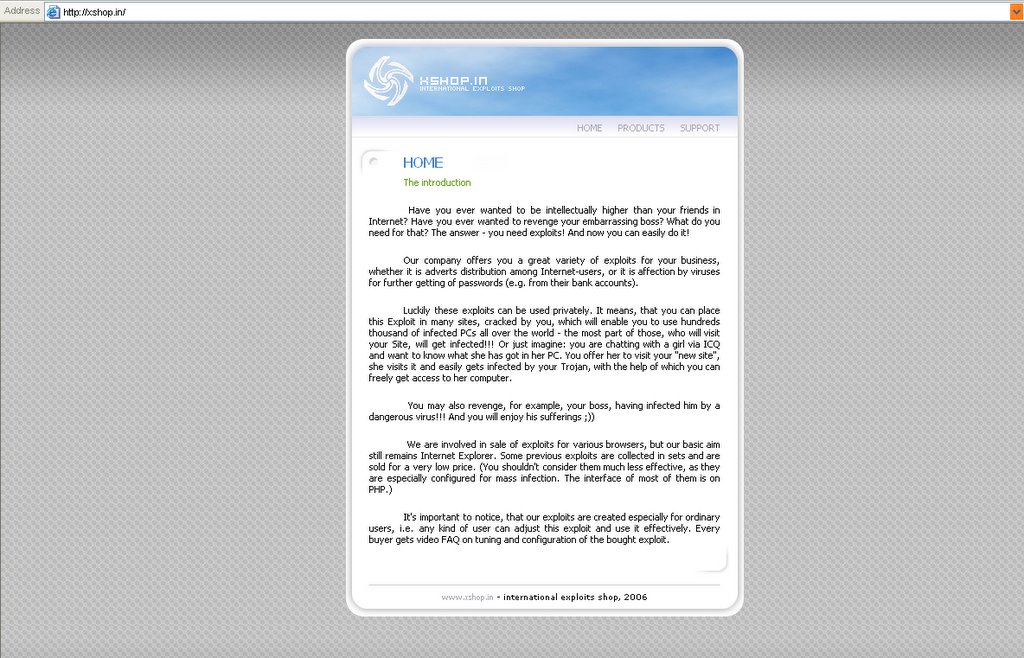
Where's my 0day, please?
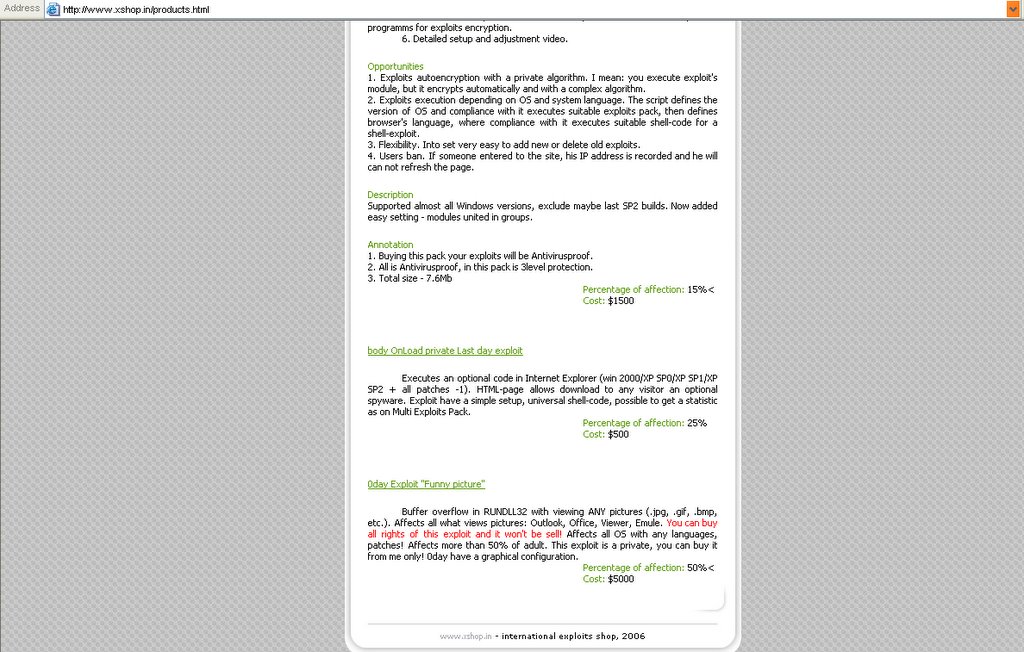
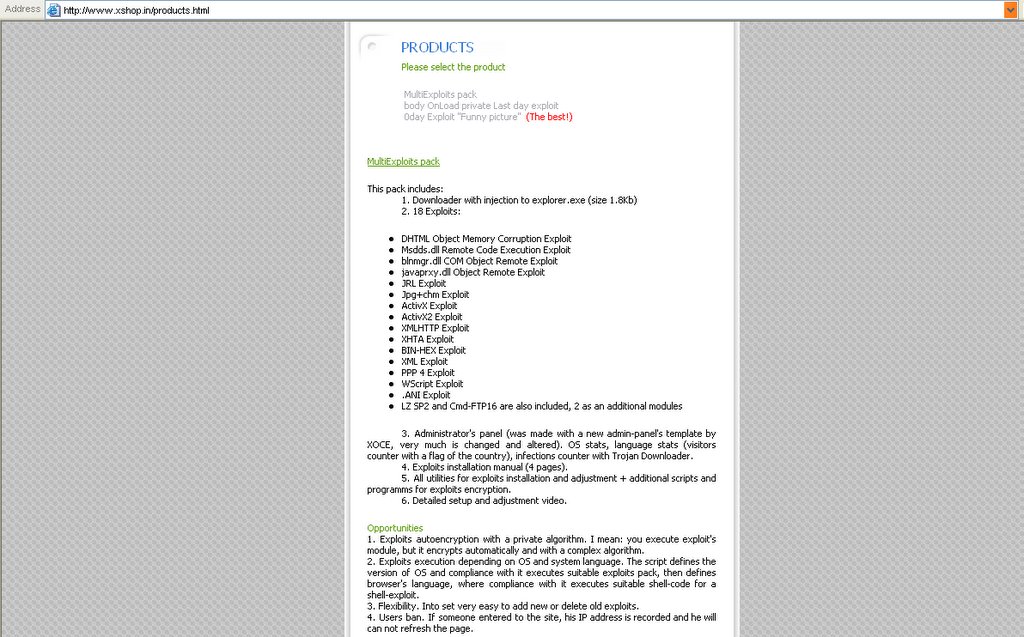
A site I was recently monitoring disappeared these days, so I feel it's about time I blog on this case. I have been talking about the emerging market for software vulnerabilities for quite some time, and it's quite a success to come across that the concept has been happening right there in front of us. Check out the screenshots. The International Exploits Shop I came across to looks like this :
It appears to be down now, while it has simply changed its location to somewhere else. Google no longer has it cached, and the the only info on this wisely registered .in domain, can be found at Koffix Blocker's site.
A lot of people underestimate the power of the over-the-counter(OTC), market for 0day security vulnerabilities. Given that there isn't any vulnerabilities auction in place that would provide a researcher with multiple proposals, and the buyers with a much greater choice or even social networking with the idea to possibly attract skilled HR, the seller is making personal propositions with the idea to get higher exposure from the site's visitors. Whoever is buying the exploit and whatever happens with it doesn't seem to bother the seller in this case.
As there's been already emerging competition between different infomediaries that purchase vulnerabilities information and pay the researchers, researchers themselves are getting more and more interested in hearing from "multiple parties". Turning vulnerability research, and its actual findings into an IP, and offering financial incentives is tricky, and no pioneers are needed in here!
There's been a lot of active discussion among friends, and over the Net. I recently came across a great and very recent research entitled "Vulnerability markets - what is the economic value of a zero-day exploit?", by Rainer Boehme, that's worth the read. Basically, it tries to list all the market models and possible participants, such as :
Bug challenges
- Bug challenges are the simplest and oldest form of vulnerability markets, where the producer offers a monetary reward for reported bugs. There are some real-world examples for bug challenges. Most widely known is Donald E. Knuth’s reward of initially 1.28 USD for each bug in his TEX typesetting system, which grows exponentially with the number of years the program is in use. Other examples include the RSA factoring challenge, or the shady SDMI challenge on digital audio watermarking
Bug auctions
-Bug auctions are theoretical framework for essentially the same concept as bug
challenges. Andy Ozment [9] first formulated bug challenges in the terms of auction theory,
in particular as a reverse Dutch auction, or an open first-price ascending auction. This allowed him to draw on a huge body of literature and thus add a number of eciency enhancements to the original concept. However, the existence of this market type still depends on the initiative of the vendor
Vulnerability brokers
-Vulnerability brokers are often referred to as “vulnerability sharing circles”. These clubs are
built around independent organizations (mostly private companies) who oer money for new vulnerability reports, which they circulate within a closed group of subscribers to their security alert service. In the standard model, only good guys are allowed to join the club
-Cyber Insurance
Cyber-insurance is among the oldest proposals for market mechanisms to overcome the security market failure. The logic that cures the market failure goes as follows: end users demand insurance against financial losses from information security breaches and insurance companies sell this kind of coverage after a security audit. The premium is assumed to be adjusted by the individual risk, which depends on the IT systems in use and the security mechanisms in place.
Let's try define the market's participants, their expectations and value added through their actions, if any, of course.
Buyers
-malicious (E-criminals, malware authors, competitors, political organization/fraction etc.)
-third party, end users, private detectives, military, intelligence personnel
-vendors (either through informediary, or directly themselves, which hasn't actually happened so far)
Sellers
-reputable
-newly born
-questionable
-does it matter at the bottom line?
Intermediaries
-iDefense
-ZeroDayInitiative-Digital Armaments
Society
-Internet
-CERT model - totally out of the game these days?
As iDefense simply had to restore their position in this emerging market developed mainly by them, an offer for $10,000 was made for a critical vulnerability as defined by Microsoft. I mean, I'm sort of missing the point in here. Obviously, they are aware of the level of quality research that could be sold to them.
Still I wonder what exactly are they competing with :
- trying to attract the most talented researchers, instead of having them turn to the dark side? I doubt they are that much socially oriented, but still it's an option?
- ensuring the proactive security of its customers through first notifying them, and them and then the general public? That doesn't necessarily secures the Internet, and sort of provides the clientele with a false feeling of security, "what if" a (malicious) vulnerability researcher doesn't cooperate with iDefense, and instead sells an 0day to a competitor? Would the vendor's IPS protect against a threat like that too?
- fighting against the permanent opportunity of another 0day, gaining only a temporary momentum advantage?
- improving the company's clients list through constant collaboration with leading vendors while communication a vulnerability in their software products?
A lot of research publications reasonably argue that the credit for the highest social-welware return goes to a CERT type of a model. And while this is truly, accountability and providing a researcher with the highest, both tangible, and intangible reward for them is what also can make an impact. As a matter of fact, is blackmailing a nasty option that could easily become reality in here, or I'm just being paranoid?
To conclude, this very same shop is definitely among the many other active out there for sure, so, sooner or later we would either witness the introduction of a reputable Auction based vulnerabilities market model, or continue living with windows of opportunities, clumsy vendors, and 0day mom-and-dad shops :) But mind you, turning vuln research into IP and paying for it would provide enough motiviation for an underground 0bay as well, wouldn't it?
14.03.2006
OSVDB's Blog - Where's my 0day, please?
OSVDB's Blog - Vulnerability Markets
11.03.2006
LinuxSecurity.com - Where's my 0day, please?
FIRST - Where's my 0day, please?
10.03.2006 - Sites that picked up the story :
Net-Security.org - Where's my 0day, please?
MalwareHelp.org- The International Exploits Shop: Where's my 0day, please?
Security.nl - Internationale Exploit Shop levert 0days op bestelling
WhiteDust.net - Where's my 0day, please?
Reseaux-Telecoms.net - Danchev sur l'Achat de failles
Informit Network - 0-Days for Sale
09.03.2006 - Two nice articles related to the issue appeared yesterday as well, "Black market thrives on vulnerability trading", from the article :
"Security giant Symantec claims that anonymous collusion between hackers and criminals is creating a thriving black market for vulnerability trading. As criminals have woken up to the massive reach afforded to their activities thanks to the Internet, hackers too are now able to avoid risking prison sentences by simply selling on their findings. Graeme Pinkney, a manager at Symantec for trend analysis, told us: 'People have suddenly realised that there's now a profit margin and a revenue stream in vulnerabilities... There's an element of anonymous co-operation between the hacker and criminal.'"
and "The value of vulnerabilities", a quote :
“ There are no guarantees, and therefore I think it would be pretty naive to believe that the person reporting the issue is the only one aware of its existence. That in itself is pretty frightening if you think about it. "
Technorati tags:
Security, 0day, 0bay, Vulnerabilities, Exploits, iDefense, ZeroDayInitiative, Digital Armaments
It appears to be down now, while it has simply changed its location to somewhere else. Google no longer has it cached, and the the only info on this wisely registered .in domain, can be found at Koffix Blocker's site.
A lot of people underestimate the power of the over-the-counter(OTC), market for 0day security vulnerabilities. Given that there isn't any vulnerabilities auction in place that would provide a researcher with multiple proposals, and the buyers with a much greater choice or even social networking with the idea to possibly attract skilled HR, the seller is making personal propositions with the idea to get higher exposure from the site's visitors. Whoever is buying the exploit and whatever happens with it doesn't seem to bother the seller in this case.
As there's been already emerging competition between different infomediaries that purchase vulnerabilities information and pay the researchers, researchers themselves are getting more and more interested in hearing from "multiple parties". Turning vulnerability research, and its actual findings into an IP, and offering financial incentives is tricky, and no pioneers are needed in here!
There's been a lot of active discussion among friends, and over the Net. I recently came across a great and very recent research entitled "Vulnerability markets - what is the economic value of a zero-day exploit?", by Rainer Boehme, that's worth the read. Basically, it tries to list all the market models and possible participants, such as :
Bug challenges
- Bug challenges are the simplest and oldest form of vulnerability markets, where the producer offers a monetary reward for reported bugs. There are some real-world examples for bug challenges. Most widely known is Donald E. Knuth’s reward of initially 1.28 USD for each bug in his TEX typesetting system, which grows exponentially with the number of years the program is in use. Other examples include the RSA factoring challenge, or the shady SDMI challenge on digital audio watermarking
Bug auctions
-Bug auctions are theoretical framework for essentially the same concept as bug
challenges. Andy Ozment [9] first formulated bug challenges in the terms of auction theory,
in particular as a reverse Dutch auction, or an open first-price ascending auction. This allowed him to draw on a huge body of literature and thus add a number of eciency enhancements to the original concept. However, the existence of this market type still depends on the initiative of the vendor
Vulnerability brokers
-Vulnerability brokers are often referred to as “vulnerability sharing circles”. These clubs are
built around independent organizations (mostly private companies) who oer money for new vulnerability reports, which they circulate within a closed group of subscribers to their security alert service. In the standard model, only good guys are allowed to join the club
-Cyber Insurance
Cyber-insurance is among the oldest proposals for market mechanisms to overcome the security market failure. The logic that cures the market failure goes as follows: end users demand insurance against financial losses from information security breaches and insurance companies sell this kind of coverage after a security audit. The premium is assumed to be adjusted by the individual risk, which depends on the IT systems in use and the security mechanisms in place.
Let's try define the market's participants, their expectations and value added through their actions, if any, of course.
Buyers
-malicious (E-criminals, malware authors, competitors, political organization/fraction etc.)
-third party, end users, private detectives, military, intelligence personnel
-vendors (either through informediary, or directly themselves, which hasn't actually happened so far)
Sellers
-reputable
-newly born
-questionable
-does it matter at the bottom line?
Intermediaries
-iDefense
-ZeroDayInitiative-Digital Armaments
Society
-Internet
-CERT model - totally out of the game these days?
As iDefense simply had to restore their position in this emerging market developed mainly by them, an offer for $10,000 was made for a critical vulnerability as defined by Microsoft. I mean, I'm sort of missing the point in here. Obviously, they are aware of the level of quality research that could be sold to them.
Still I wonder what exactly are they competing with :
- trying to attract the most talented researchers, instead of having them turn to the dark side? I doubt they are that much socially oriented, but still it's an option?
- ensuring the proactive security of its customers through first notifying them, and them and then the general public? That doesn't necessarily secures the Internet, and sort of provides the clientele with a false feeling of security, "what if" a (malicious) vulnerability researcher doesn't cooperate with iDefense, and instead sells an 0day to a competitor? Would the vendor's IPS protect against a threat like that too?
- fighting against the permanent opportunity of another 0day, gaining only a temporary momentum advantage?
- improving the company's clients list through constant collaboration with leading vendors while communication a vulnerability in their software products?
A lot of research publications reasonably argue that the credit for the highest social-welware return goes to a CERT type of a model. And while this is truly, accountability and providing a researcher with the highest, both tangible, and intangible reward for them is what also can make an impact. As a matter of fact, is blackmailing a nasty option that could easily become reality in here, or I'm just being paranoid?
To conclude, this very same shop is definitely among the many other active out there for sure, so, sooner or later we would either witness the introduction of a reputable Auction based vulnerabilities market model, or continue living with windows of opportunities, clumsy vendors, and 0day mom-and-dad shops :) But mind you, turning vuln research into IP and paying for it would provide enough motiviation for an underground 0bay as well, wouldn't it?
14.03.2006
OSVDB's Blog - Where's my 0day, please?
OSVDB's Blog - Vulnerability Markets
11.03.2006
LinuxSecurity.com - Where's my 0day, please?
FIRST - Where's my 0day, please?
10.03.2006 - Sites that picked up the story :
Net-Security.org - Where's my 0day, please?
MalwareHelp.org- The International Exploits Shop: Where's my 0day, please?
Security.nl - Internationale Exploit Shop levert 0days op bestelling
WhiteDust.net - Where's my 0day, please?
Reseaux-Telecoms.net - Danchev sur l'Achat de failles
Informit Network - 0-Days for Sale
09.03.2006 - Two nice articles related to the issue appeared yesterday as well, "Black market thrives on vulnerability trading", from the article :
"Security giant Symantec claims that anonymous collusion between hackers and criminals is creating a thriving black market for vulnerability trading. As criminals have woken up to the massive reach afforded to their activities thanks to the Internet, hackers too are now able to avoid risking prison sentences by simply selling on their findings. Graeme Pinkney, a manager at Symantec for trend analysis, told us: 'People have suddenly realised that there's now a profit margin and a revenue stream in vulnerabilities... There's an element of anonymous co-operation between the hacker and criminal.'"
and "The value of vulnerabilities", a quote :
“ There are no guarantees, and therefore I think it would be pretty naive to believe that the person reporting the issue is the only one aware of its existence. That in itself is pretty frightening if you think about it. "
Technorati tags:
Security, 0day, 0bay, Vulnerabilities, Exploits, iDefense, ZeroDayInitiative, Digital Armaments
Independent Security Consultancy, Threat Intelligence Analysis (OSINT/Cyber Counter Intelligence) and Competitive Intelligence research on demand. Insightful, unbiased, and client-tailored assessments, neatly communicated in the form of interactive reports - because anticipating the emerging threatscape is what shapes the big picture at the end of the day. Approach me at dancho.danchev@hush.com
Subscribe to:
Comments (Atom)