Monday, November 13, 2006

Bill Gates on Traffic Acquisition and Internet Bubbles

Confused Bill Gates, but a regularly attacked one too. A rather predictable comment given he's not the only one selling the chewing gums and the soaps this time, so keep on bubbling folks. Think mature Web 2.0, think Semantic web, or at least dare to envision -- Microsoft wishes the Internet was never invented, unless of course they could sell you the license to use it.

"There are a hundred YouTube sites out there," Gates said during an interview with a group of journalists in Brussels before a speech to European lawmakers. "You never know. It's very complicated in terms of what are the business models for these sites." Some of them, including sites that offer Web-based word processing and search engines, are being promoted by their creators and analysts as possible competitors to makers of retail packaged software like Microsoft. "We're back kind of in Internet-bubble era in terms of people thinking: 'O.K., traffic. We want traffic. We want traffic,'" Gates said. "There are still some areas where it is unclear what's going to come out of that."

The very basics of Internet marketing which transform branding into communication, segments into communities for instance doesn't necessarily mean that traffic is the cornerstone of E-business. Eyeballs, thus participants marely visitors converted into revenue sources speak for themselves. Win-win-win business models need no comment. Once you get the traffic, boy, what wonders are there for you to discover, sense and profitably respond to. But then again, keep in mind that search and online video represent a tiny portion of the overal Internet user's activities. Don't look for the next Google, or the next YouTube, look beyond.

Having R&D centers on enemy territories creates more job opportunities, and improves Microsoft's comfortability with its stakeholders :

"Microsoft said that it would invest $7.8 billion globally in research and development this year, about 15 percent of sales, and it plans to spend $500 million in Europe next year. Microsoft operates its main European research center on the campus of Cambridge University in England, with other research offices in Denmark and Ireland."

While it's also cheaper to operate them in Europe than in the U.S, money cannot buy innovation and many other things, so don't get too excited but learn how to surf tidal waves, the ones Bill Gates himself predicted back in 1995.

Related posts:
5 things Microsoft can do to secure the Internet, and why it wouldn't?
Microsoft in the Information Security Market
Microsoft's OneCare Penetration Pricing Strategy

Thursday, November 09, 2006

The Nuclear Grabber Toolkit

In case you're unaware of Nuclear Grabber's existence -- Babelfish it --WebSense commented on it in their latest "Security Trends - first half of 2006 report" :

"Another toolkit example is Nuclear Grabber, which allows an attacker to sit on a real banking site and grab data from electronic forms. Like WebAttacker, this tool is available on Russian websites. The cost of Nuclear Grabber is a hefty $3,000."

It's actually "3250 USD for a server size of 50-53kb" as the site says -- perceived pricing and profit margins greed thankfully ruin its popularity from my point of view. Advanced form grabbers like this one are always very ugly -- tavarish chto vui being so knowledgeable, yet so malicious messing up with the entry barriers in this space?!

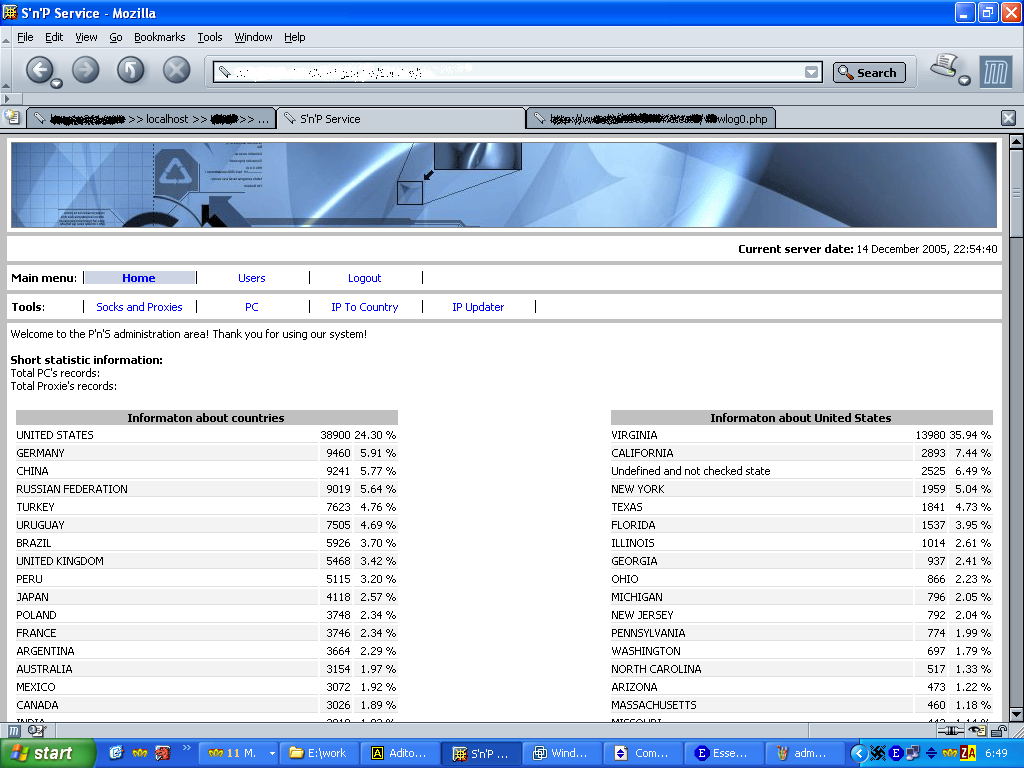
Full scale automation in action, quite some infected folks geolocated already. Going to wash my hands now..

All Your Electromagnetic Transmissions Are Belong To Us

This is worth mentioning, as while you try not to talk about these locations for as long as someone doesn't start blowing the whistle too loud, all you really need is someone to pass by and feel the hyper-sensitive harassment due to Trimingham's ELINT capabilities -- and news articles keep coming about this particular case.

"The Ministry of Defence has admitted that a fault at a radar dome was responsible for causing electrical problems with dozens of cars. Engines and lights cut out and speedometer dials swung up to 150mph as motorists drove past the dome. At the time the MoD said there was no guarantee that the Trimingham radar on the north Norfolk coast was the cause."

Read some of the memories of a serviceman that was stationed there during the 60s :

"Another story that might be of interest relates to the time that a Russian trawler went aground at Skaw. The indications were that it was an Elint (Electronic intelligence gathering) vessel as the crew hid what they were doing from an RAF Shackleton which flew overhead as part of the search and rescue mission. Whether there was any spying equipment on board is debatable. In any event, the Unst folk did well in "liberating" fishing nets and sundry bits and pieces including the steering wheel, which was subsequently returned to the Russians. However, two RAF lads ­ a steward and a cook ­ found signals, maps and other papers in the skipper's cabin, some of this hidden under his mattress. They brought these back to me and our station intelligence officer had a look at them. By chance he was a Russian linguist and was able to provide a summary of what was in the documents before they were forwarded to the RAF intelligence staff at the Ministry of Defence. One of the documents proved extremely valuable to the Navy but what amazed them was that the translated summary had been done by an RAF flying officer on Unst."

You may also be interested in going through a table that "includes all military sites which have significant intelligence-gathering or analysis capability with official US presence; these are the sites which have figures for numbers of US and UK personnel".

Trimingham's radar dome courtesy of munkt0n, and Flickr's Radars group.

Related posts:
Why's that radar screen not blinking over there?
Achieving Information Warfare Dominance Back in 1962

Tuesday, November 07, 2006

The Blogosphere and Splogs

Just read Technorati's latest "State of the Blogosphere, October, 2006" presented with in-depth visual stats on the 57 million blogs they're currently tracking, and yes, all the splogs they're fighting to filter. Worth taking your time to go through the post, and you may also be interested in finding how come my ROI out of blogging is so positive these days.

"As we’ve said in the past, some of the new blogs in our index are Spam blogs or 'splogs'. The good news is Technorati has gotten much better at preventing these kinds of blogs from getting into our indexes in the first place, which may be a factor in the slight slowing in the average of new blogs created each day.

The spikes in red on the chart above shows the increased activity that occurs when spammers create massive numbers of fake blogs and try to get them into our indexes. As the chart shows, we’ve done a much better job over the last quarter at nearly eliminating those red spikes. While last quarter I reported about 8% of new blogs that get past our filters and make it into the index are splogs, I’m happy to report that that number is now more like 4%. As always, we’ll continue to be hyper-focused on making sure that new attacks are spotted and eliminated as quickly as possible.


My gut feeling is that since we're better at dealing with Spam now, even some of the blue areas in last quarter's graph were probably accountable to spam, which would mean that rather than the bumpy ride shown above, we're actually seeing a steady increased (but slower) growth of the blogosphere. Hopefully we'll be able to have a more detailed analysis of these issues next quarter."

Meanwhile, the splogfigher is doing an amazing job of analyzing and coming up with exact splog URLs -- I'm reposting so that third-parties of particular interest reading here take a notice -- and week ago came up with 150,000 splogs, notice the dominating blogging platform? Blogspot all the way!

"I see that Google has been deleting quite a large number of splogs but even then they are on average about 20% effective. What that means is if a single spammer creates 1000 splogs, Google will eventually delete at most about 200 of them leaving 800 alone. Obvously this is rather poor percentage and hopefully my efforts will bump up that figure close to 90% and above.

20061030_1.txt - 19401 splogs
20061030_2.txt - 4332 splogs
20061030_3.txt - 8936 splogs
20061030_4.txt - 8794 splogs
20061030_5.txt - 18912 splogs
20061030_6.txt - 5158 splogs
20061030_7.txt - 70755 splogs
20061030_8.txt - 1182 splogs
20061030_9.txt - 11410 splogs
20061030_10.txt - 968 splogs
20061030_11.txt - 1584 splogs
Here is a tarball of all splog list files listed above: 20061030.tar.gz"

Obviously, spammers are exploiting Blogspot's signup process, and I really feel it's about time Google starts tolerating more errors with users having trouble reading a sophisticated CAPTCHA, compared to its current too user-friendly and easily defeated one. They can balance for sure. Something else to consider, take for example the splogs collected for May, and whole the splogfighter is pointing out on the engineered 404s and Google's efforts in removing them, I was able to verify content response from over 200 splogs reported back then, take cigar-accessories-2008.blogspot.com for instance -- anyone up for crawling the lists and clustering the results? Once the signup process is flawed, not even the wisdom of crowds flagging splogs can help you.

Another recommended and very recent analysis "Characterizing the Splogosphere" is also full of juicy details, and statistical info on the emerging problem. Spammers are anything but old-fashioned.

Friday, November 03, 2006

Delicious Information Warfare - Friday

Wish I could blog everything I read and makes me an impression but that's not the point. The point is to emphasize on the big picture, and find the balance between information overload and information underload.

01. North Korea, Turkmenistan, Eritrea the worst violators of press freedom - Journalists in North Korea, Eritrea, Turkmenistan, Cuba, Burma and China are still risking their life or imprisonment for trying to keep us informed. to FreeSpeech Censorship

02. When North Korea Falls - The furor over Kim Jong Il’s missile tests and nuclear brinksmanship obscures the real threat: the prospect of North Korea’s catastrophic collapse. How the regime ends could determine the balance of power in Asia for decades. The likely winner? China to Geopolitics

03. U.S. revives terror data mining - In response to concerns about the program's privacy and civil liberties implications, Congress in 2003 cut all funding for it, but research continued in different agencies, funded by classified appropriations for Pentagon intelligence agencies. to Intelligence Terrorism

04. Singapore Slings Censorship - StarHub Cable Vision of Singapore is being fined $6,350 for showing footage of lesbian sex and bondage during episodes of the reality program "Cheaters." to Censorship Singapore

05. Googlers Worldwide - Number of Google employees 2004-2006. to Google

06. Can IPS Alleviate The Botnet Problem? - Next-Generation IPS devices bring a number of extra benefits, and solve many of the botnet problems. When deployed at the network edge, IPS devices can see all traffic entering and exciting the network. to Security Malware Botnet IPS

07. Abu Ghraib Photos, Videos To Come - The ACLU has sought the release of 87 photos and four videotapes taken at the prison as part of an October 2003 lawsuit demanding information on the treatment of detainees in U.S. custody and the transfer of prisoners to countries known to use torture. to Military PSYOPS

08. 'Censorship' controversy? Sometimes it's just part of the ad campaign - NBC and the CW network had refused to run ads in which the singer Natalie Maines refers to President George W. Bush with an expletive and as "dumb." to Censorship Advertising

09. Rutkowska: Anti-Virus Software Is Ineffective - Stealth malware researcher Joanna Rutkowska discusses her interest in computer security, the threat from rootkits and why the world is not ready for virtual machine technology. to Malware Interview

10. Under Fire, Soldiers Kill Blogs - Some of the web's more popular "milblogs" -- blogs maintained by present or former active duty military personnel -- are going quiet following a renewed push by U.S. military officials to scan sites for security risks. to Blog Military OPSEC

11. Is Google Evil? - Internet privacy? Google already knows more about you than the National Security Agency ever will. to Google Privacy

12. Google Earth Update of Eyeballs 1 - ECHELON's Global Stations - Sebana Seca Echelon Station, Pine Gap Echelon Station, Geraldton Echelon Station, Misawa Echelon Station, Kunia Echelon Station, Waihopai Echelon Station. to OSINT ECHELON Intelligence SIGINT

13. U.N. blasts Cisco, others on China cooperation - "It's the same equipment that we sell in every country around the world in which we sell equipment," said Art Reilly, Cisco's senior director for strategic technology policy. "There is no differentiation." to Censorship China Microsoft Google Yahoo Cisco

14. GAO: Better coordination of cybersecurity R&D needed - DOD officials told GAO that the department provided about $150 million to its cybersecurity research programs in fiscal 2005. to Security

15. The Reinvention Of Martha Stewart - Stewart no longer has total control over the brand she built. She still owns the bulk of the company's stock and holds 92% of the voting power--prompting speculation that she may one day take it private--but she can't dictate the agenda. to Branding

16. Raytheon Announces Revolutionary New 'Cockpit' For Unmanned Aircraft - "We took the best-of-breed technologies from the gaming industry and coupled them with 35-years Raytheon UAS command and control expertise and developed a state-of-the-art universal cockpit built around the operator". to Military UAV

17. The Tangram Intelligence Program - The Tangram program makes no distinction between intentional and deliberate acts to avoid detection versus the consequences of spotty collection and reporting of intelligence. to Intelligence TIA Tangram

18. Intellipedia - a Classified Wiki - Intellipedia is a classified wiki that runs on JWICS, the top-secret network Intelink that links the 16 agencies that comprise the U.S. intelligence community. It is not accessible to the public. to Intelligence Wikipedia

19. China: We don't censor the Internet. Really - We have hundreds of journalists in China, and some of them have legal problems. It has nothing to do with freedom of expression. to Censorship China FreeSpeech

20. Ratings Table of EU and Leading Surveillance Societies - This year Privacy International took the decision to use the report as the basis for a ranking assessment of the state of privacy in all EU countries together with eleven benchmark countries. to Privacy Surveillance 1984

21. Watch a live spam bot in action - Take a peek with me into one trojan’s junkmail activities. The following account is happening as I type, and shows that some image spam is not unique even though it appears to be random. to Malware Bots Spam

22. OS X proof of concept virus -Macarena - OSX.Macarena is a proof of concept virus that infects files in the current folder on the compromised computer. to Malware MAC

23. American Leadership and War - Which presidents and political parties were responsible for America's deadliest wars? Republicans, Democrats, or the Founding Fathers? This map answers our question by illustrating the history of American conflict from the Revolutionary War to Iraq. to Military War Leadership

24. Diebold slams HBO Hacking Democracy documentary - According to Diebold, 40 per cent of votes this November will be recorded electronically with its own machines accounting for 40 per cent of that market. to Security Diebold Voting

Wednesday, November 01, 2006

FAS's Immune Attack Game

Professor Falken would have loved this one. The Federation of American Scientists recently released their report from the Summit on Educational Games, and an upcoming educational game :

"Immune Attack is a first person strategy PC video game that teaches immunological principles through entertaining game play. The protagonist, a teenaged prodigy with a unique condition in which the immune system is “present, yet non-functional”, must pilot a microscopic nanobot to save his own life. He must teach his semi-functional immune system to fight off diseases and bacterial/viral infections by programming individual cell types. This programming is accomplished through the successful completion of various educational minigames, each of which teach a central immunology principle and, once completed, confer added ability to the selected cell type."

Here're two more reports you may find informative on the future of learning through games -- the game addicts still got a chance.