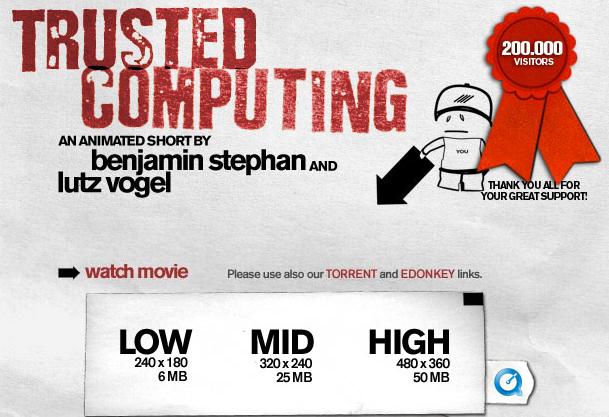
 Great opinionated introduction to the topic. Trusted computing isn't the panacea of total security simply because there can never be 100% secure OS or a device, unless of course you put so much security layers in place to end up with zero usability, so what's it gonna be? Insecurities are a commodity, but security and usability issues are always a matter of viewpoint, so don't act as if you can provide 100% security, because what you're actually offering is a marginal thinking while proposing a solution.
Thursday, November 30, 2006
A Movie About Trusted Computing
Great opinionated introduction to the topic. Trusted computing isn't the panacea of total security simply because there can never be 100% secure OS or a device, unless of course you put so much security layers in place to end up with zero usability, so what's it gonna be? Insecurities are a commodity, but security and usability issues are always a matter of viewpoint, so don't act as if you can provide 100% security, because what you're actually offering is a marginal thinking while proposing a solution.

 Independent Security Consultancy, Threat Intelligence Analysis (OSINT/Cyber Counter Intelligence) and Competitive Intelligence research on demand. Insightful, unbiased, and client-tailored assessments, neatly communicated in the form of interactive reports - because anticipating the emerging threatscape is what shapes the big picture at the end of the day. Approach me at dancho.danchev@hush.com
Wednesday, November 29, 2006
CIA Personality Quiz
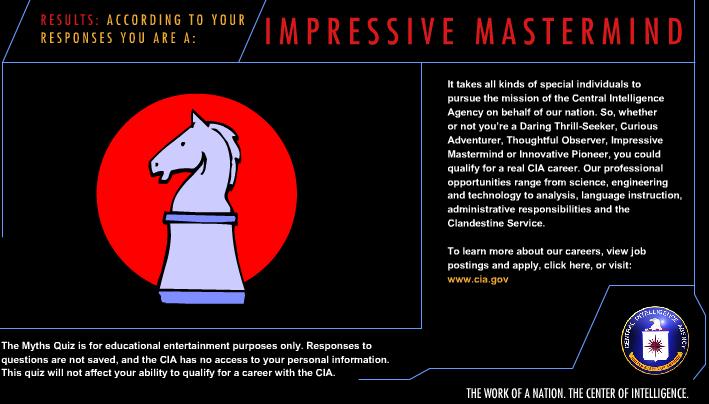 An impressive mastermind is what I got as a type of personality, quite a bit of suspicious flattery isn't it?
I feel the quiz is more of an ice-breaker, and it's hell of an amusing one as a matter of fact. Hint to the CIA's HR department - promise to show the ones who make it up for a final interview a randomly chosen analyst's collection of secret UFO files, and see your conversion rates skyrocketing. Then explain them the basics of access programs based on classification and why they have to perform better. Arbeit macht access to secret UFO files as a factor for productivity, cute.
More comments from another wannabe secret AGent.
Independent Security Consultancy, Threat Intelligence Analysis (OSINT/Cyber Counter Intelligence) and Competitive Intelligence research on demand. Insightful, unbiased, and client-tailored assessments, neatly communicated in the form of interactive reports - because anticipating the emerging threatscape is what shapes the big picture at the end of the day. Approach me at dancho.danchev@hush.com
Video of Birds Attacking an Unmanned Aerial Vehicle (UAV)
 Mother Nature on the basics of asymmetric warfare :
"However, on one flight, a test Raven attracted the attention of two nearby crows, who initially squawked a territorial warning at the UAV. Unsuprisingly undeterred by the warnings, the UAVs carried on on their descent and were subsequently attacked by the crows. See the video clip below.
The UAVs were required to remain at low altitude for the duration of each sortie, airspace above the city forming part of the western approaches to Brisbane International airport."
And no, don't even think on speculating of terrorists training divisions of crows to attack, or early warn of UAVs flying around the birds' air space, unless of course your wild imagination prevails.
Independent Security Consultancy, Threat Intelligence Analysis (OSINT/Cyber Counter Intelligence) and Competitive Intelligence research on demand. Insightful, unbiased, and client-tailored assessments, neatly communicated in the form of interactive reports - because anticipating the emerging threatscape is what shapes the big picture at the end of the day. Approach me at dancho.danchev@hush.com
Monday, November 27, 2006
How to Fake Fingerprints
 With all the buzz of fingerprinting this and that, fingerprint these instructions on how copy and fake fingerprints :
"In order to fake a fingerprint, one needs an original first. Latent fingerprints are nothing but fat and sweat on touched items. Thus to retrieve someone elses fingerprint (in this case the fingerprint you want to forge) one should rely on well tested forensic research methods. Which is what's to be explained here."
Bow to the CCC's full disclosure shedding more light on a common sense insecurity. While it can be tackled by both ensuring the quality of the fingerprinting process, and by technological means such as adding extra layers or cross-referencing through different databases, multiple-factor authentication's benefits are proportional with their immaturity and usability issues. Fancy? For sure. Cutting-edge security? Absolutely from a technological point of view. But when fingerprints start getting more empowerment and integration within our daily lifes, malicious parties would have already taken notice, and again be a step ahead of the technological bias on fingerprinting. Coming up with new identities may indeed end up as a commodity neatly stored in a central database, or perhaps ones collected from elsewhere.
Independent Security Consultancy, Threat Intelligence Analysis (OSINT/Cyber Counter Intelligence) and Competitive Intelligence research on demand. Insightful, unbiased, and client-tailored assessments, neatly communicated in the form of interactive reports - because anticipating the emerging threatscape is what shapes the big picture at the end of the day. Approach me at dancho.danchev@hush.com
Global Map of Security Incidents and Terrorist Events
 Outstanding project demonstrating the benefits of open source intelligence positioned on Google Maps while providing you with the very latest global security and suspicious events in categories such as :
- Airport/Aviation Incidents
- Arson/Fire Incidents
- Biological Incidents/ Threats/ Anthrax Hoaxes etc
- Bomb Incidents/Explosives/ Hoax Devices
- Chemical Incident
- Dam Incident
- Radiation Incidents/ Smuggling/ Proliferation
- Chemical Attack
- Other Suspicious Activity
- Shipping/Maritime/Ports/Cargo/Waterways Security
- Assassination/ Assassination Attempt
- Railways/Train Stations
- Bus Stations/ Bus Security/ Bus Related Incidents
- Bridge / Tunnel Incidents and Security
- Shootings / Sniper Incidents/ Etc
- Terrorist Arrests/Captured/Killed Locations
No more "slicing the threat on pieces", now you can see the big picture for yourself.
Independent Security Consultancy, Threat Intelligence Analysis (OSINT/Cyber Counter Intelligence) and Competitive Intelligence research on demand. Insightful, unbiased, and client-tailored assessments, neatly communicated in the form of interactive reports - because anticipating the emerging threatscape is what shapes the big picture at the end of the day. Approach me at dancho.danchev@hush.com
To Publish a Privacy Policy or Not to Publish a Privacy Policy
 Here's an article arguing that "publishing a privacy statement may be more harmful than not publishing one"only if enforcement, implementation and monitoring don't intersect as they should :
"This case demonstrates a complication relating to companies' claiming that they have security measures to protect their end users' privacy. Large, established companies, like Eli Lilly, understand this issue but may still have problems ensuring compliance to their privacy policy. But many emerging companies immediately post their claimed privacy policies on their company websites. These companies often fail to assess the potential risks, burdens and liabilities associated with publishing a privacy policy. They do not realize that publishing a privacy statement may be more harmful than not publishing one."
Privacy exposure assessments still remain rather unpopular among leading companies, and compliance with industry specific requirements for processing and storing personal information continue indirectly replacing what a Chief Privacy Officer would have done in a much more adaptive manner. Can we that easily talk about Total Privacy Management (TPM), the way talk about Total Quality Management (TQM) as an internal key objective for strengthening a company's reputation as a socially-oriented one? It would definitely turn into a criteria for the stakeholders, and a differentiating point for any company in question in the long term. The future of privacy? Don't over-empower the watchers or you'll have the entire data aggregation model of our society used against your rights for the sake of protecting you from "the enemy or the threat of the day".
You may also find some comments from a previous post on "Examining Internet Privacy Policies" relevant to the topic :
"Accountability, public commitment, or copywriters charging per word, privacy policies are often taken for fully enforced ones, whereas the truth is that actually no one is reading, bothering to assess them. And why would you, as by the time you've finished you'll again have no other choice but to accept them in order to use the service in question -- too much personal and sensitive identifying information is what I hear ticking. That's of course the privacy conscious perspective, and to me security is a matter of viewpoint, the way you perceive it going beyond the basics, the very same way you're going to implement it -- Identity 2.0 as a single sign on Web is slowly emerging as the real beast."
Independent Security Consultancy, Threat Intelligence Analysis (OSINT/Cyber Counter Intelligence) and Competitive Intelligence research on demand. Insightful, unbiased, and client-tailored assessments, neatly communicated in the form of interactive reports - because anticipating the emerging threatscape is what shapes the big picture at the end of the day. Approach me at dancho.danchev@hush.com
Subscribe to:
Comments (Atom)