Sunday, December 10, 2006

Current State of Internet Jihad

Very good article on various geopolitical issues related to the Middle East vs the West, and most importantly an overview of the current state of online jihad. Excluding webcasts, video howto's, and video games as a commodity in the big picture, what's left at the bottom line is easily accessible open source intelligence, and tactical warfare practices such as this one :

"Some of the techniques of evasion are disarmingly simple. Rather than send emails, some jihadists simply write and save draft emails, storing them in an account with a password that's known to other members of the cell. Because they are never actually sent, they can't be detected by intelligence agencies."

Can you intercept an email that's never been sent? And what if a legitimate user's account end up as a dead box? Moreover, the article points out to the recently released Technical Mujahid magazine :

"Raisman points to a recent publication by the al-Fajr group, another communications arm of al-Qaeda and its fellow travellers. He said it contained a very sophisticated manual on internet security, how to avoid hackers, secure personal files and ensure any computer that is captured is of little value to Western authorities."

Going through the magazine itself as I indeed obtained a copy and will publish a summary of it anytime now, there's nothing really that very sophisticated to be afraid of, unless you know nothing about installing a virtual machine, or what triangulation is all about.

A handy summary of the article and things to keep in mind :

- There are over 5000 militant Islamic websites, up from less than a dozen in 1998 -- these are only the static ones compared to hundreds more temporary campaign ones

- They are an extremely effective way for terrorist groups to plan operations, recruit followers, raise funds and distribute propaganda -- centralization of forces and services is exactly what a terrorist organization isn't into. Diversification and autonomous management for the sake of improving the continuity of the site in operation is what really matter, namely you'll have the propaganda platform spreading online details on how to donate cash on a site that's been set up for this purpose only. By the time there's been a leak in the "good guys" covert competitive intelligence efforts, the donation site will dissapear and reappear somewhere else, while the central propaganda platform remains fully active. Take the other perspective, if the "bad guys" are aware the "good guys" are reading, they may logically leave a decoy to later on analyze how it's being processed and disinform on what may seem a very decent first-hand information gathered through open source intelligence.

- Their mastery of the web could extend to cyber-terrorism, such as disabling the communication systems that underpin key sectors such as banking and energy -- any government's single biggest mistake is stereotyping about cyberterrorism, namely that it's the offensive use of cyberterrorism to worry about, whereas the defensive, or passive concepts are already maturing.

- Western agencies are almost powerless to stop the jihadists' internet activities -- of course they aren't, and stopping compared to monitoring is totally wrong, the enemy's location you know is better than the enemy's location you don't know.

- Western governments have been very slow to respond and are only now turning their attention to combating the potent "story" promulgated over the internet -- they wouldn't be that very slow in responding if they actually knew how many people read and got brainwashed by it, thus what conversion rate can we talk about from a reader, to collaborator, to wannabe terrorist, come up with metrics and raise eyebrows.


Friday, December 08, 2006

Censoring Seductive Child Behaviour

define:seductive
define:unaware
define:immature
define:maturing

"Covert pedophilia in the Victorian society". Is that a good line, or is that a good line? Censorship as a matter of viewpoint - as of recently Globe and Mail want you to purchase the article without realizing the click-through rates for both, Doubleclick serving the ads at their site and them, if it were distributing it for free, but anyway guess they should have told Google either :

"The Legards' central thesis is that the debate over children and sexual imagery has been dominated and distorted by two opposing myths: one is "the quasi-religious conception of childhood innocence," which involves "the irrational denial of childhood sexuality"; the other is "the ideology" of the artist as someone "possessing mystical abilities and unique rights" that should not be constrained by the state."

After thoughtcrime and intention-crime policing, it's about time behaviour-policing starts taking place, now wouldn't that be truly outrageous? Something no one is again going to do anything about, thinking he's either the only one seeing it, or perhaps prefers to keep playing in his own corner?

Anyway, discussions like these should only happen after the real problem, with real child porn online gets solved. And that wouldn't happen by fighting the distribution channels as they're too many to control and police, but by making sure the production stage never happens at the first place.

Another article on the topic "Clothed Child Porn Online?". By the way, are you finally seduced now? A rocket scientist doesn't seem to be, throughout the "decade of dedicating downloading". Such a collection can now definitely acts as a new digitally fingerprinted database to keep track of.

Censoring Seductive Child Behaviour

define:seductive
define:unaware
define:immature
define:maturing

"Covert pedophilia in the Victorian society". Is that a good line, or is that a good line? Censorship as a matter of viewpoint - as of recently Globe and Mail want you to purchase the article without realizing the click-through rates for both, Doubleclick serving the ads at their site and them, if it were distributing it for free, but anyway guess they should have told Google either :

"The Legards' central thesis is that the debate over children and sexual imagery has been dominated and distorted by two opposing myths: one is "the quasi-religious conception of childhood innocence," which involves "the irrational denial of childhood sexuality"; the other is "the ideology" of the artist as someone "possessing mystical abilities and unique rights" that should not be constrained by the state."

After thoughtcrime and intention-crime policing, it's about time behaviour-policing starts taking place, now wouldn't that be truly outrageous? Something no one is again going to do anything about, thinking he's either the only one seeing it, or perhaps prefers to keep playing in his own corner?

Anyway, discussions like these should only happen after the real problem, with real child porn online gets solved. And that wouldn't happen by fighting the distribution channels as they're too many to control and police, but by making sure the production stage never happens at the first place.

Another article on the topic "Clothed Child Porn Online?". By the way, are you finally seduced now? A rocket scientist doesn't seem to be, throughout the "decade of dedicating downloading". Such a collection can now definitely acts as a new digitally fingerprinted database to keep track of.

Thursday, December 07, 2006

Symantec's Invisible Burglar Game

Cheers to Symantec's PR folks for coming up with such an entertaining promotion of Norton 360, so that "if everything gets too much hit the spacebar to activate the Norton 360 force field to destroy everything in sight."

Good one!

Try the infamous Airport security flash game too, and search everyone for exploding toothpastes, and other dangerous substances as they become dangerous throughout the game.

Symantec's Invisible Burglar Game

Cheers to Symantec's PR folks for coming up with such an entertaining promotion of Norton 360, so that "if everything gets too much hit the spacebar to activate the Norton 360 force field to destroy everything in sight."

Good one!

Try the infamous Airport security flash game too, and search everyone for exploding toothpastes, and other dangerous substances as they become dangerous throughout the game.

Thursday, November 30, 2006

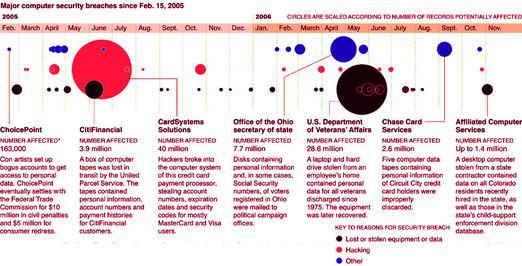
A Chart of Personal Data Security Breaches 2005-2006

Following my previous post on "Personal Data Security Breaches - 2000/2005", you may also find this "Chart of Security Breaches for 2005 - 2006" worth taking a look at -- lost or stolen equipment with data dominate the threatscape.

With the eye-popping big bubbles, and hundreds of thousands of people exposed due to the centralized and insecure nature of storing and processing their information, ask yourself why would an attacker ever bother to initiate a network level attack against a data aggregator nowadays? Consider the other perspective when it comes to data security breaches, namely "To report, or not to report?" a breach, and how is an organization supposed to report when they're not ever aware that personal information has already been exposed.
Take your time to go through a very good resource keeping track of all reported data security breaches and notice the most common patterns for yourself.