Delicious Information Warfare - Friday

0
November 03, 2006
Wish I could blog everything I read and makes me an impression but that's not the point. The point is to emphasize on the big picture, and find the balance between information overload and information underload.

01. North Korea, Turkmenistan, Eritrea the worst violators of press freedom - Journalists in North Korea, Eritrea, Turkmenistan, Cuba, Burma and China are still risking their life or imprisonment for trying to keep us informed. to FreeSpeech Censorship

02. When North Korea Falls - The furor over Kim Jong Il’s missile tests and nuclear brinksmanship obscures the real threat: the prospect of North Korea’s catastrophic collapse. How the regime ends could determine the balance of power in Asia for decades. The likely winner? China to Geopolitics

03. U.S. revives terror data mining - In response to concerns about the program's privacy and civil liberties implications, Congress in 2003 cut all funding for it, but research continued in different agencies, funded by classified appropriations for Pentagon intelligence agencies. to Intelligence Terrorism

04. Singapore Slings Censorship - StarHub Cable Vision of Singapore is being fined $6,350 for showing footage of lesbian sex and bondage during episodes of the reality program "Cheaters." to Censorship Singapore

05. Googlers Worldwide - Number of Google employees 2004-2006. to Google

06. Can IPS Alleviate The Botnet Problem? - Next-Generation IPS devices bring a number of extra benefits, and solve many of the botnet problems. When deployed at the network edge, IPS devices can see all traffic entering and exciting the network. to Security Malware Botnet IPS

07. Abu Ghraib Photos, Videos To Come - The ACLU has sought the release of 87 photos and four videotapes taken at the prison as part of an October 2003 lawsuit demanding information on the treatment of detainees in U.S. custody and the transfer of prisoners to countries known to use torture. to Military PSYOPS

08. 'Censorship' controversy? Sometimes it's just part of the ad campaign - NBC and the CW network had refused to run ads in which the singer Natalie Maines refers to President George W. Bush with an expletive and as "dumb." to Censorship Advertising

09. Rutkowska: Anti-Virus Software Is Ineffective - Stealth malware researcher Joanna Rutkowska discusses her interest in computer security, the threat from rootkits and why the world is not ready for virtual machine technology. to Malware Interview

10. Under Fire, Soldiers Kill Blogs - Some of the web's more popular "milblogs" -- blogs maintained by present or former active duty military personnel -- are going quiet following a renewed push by U.S. military officials to scan sites for security risks. to Blog Military OPSEC

11. Is Google Evil? - Internet privacy? Google already knows more about you than the National Security Agency ever will. to Google Privacy

12. Google Earth Update of Eyeballs 1 - ECHELON's Global Stations - Sebana Seca Echelon Station, Pine Gap Echelon Station, Geraldton Echelon Station, Misawa Echelon Station, Kunia Echelon Station, Waihopai Echelon Station. to OSINT ECHELON Intelligence SIGINT

13. U.N. blasts Cisco, others on China cooperation - "It's the same equipment that we sell in every country around the world in which we sell equipment," said Art Reilly, Cisco's senior director for strategic technology policy. "There is no differentiation." to Censorship China Microsoft Google Yahoo Cisco

14. GAO: Better coordination of cybersecurity R&D needed - DOD officials told GAO that the department provided about $150 million to its cybersecurity research programs in fiscal 2005. to Security

15. The Reinvention Of Martha Stewart - Stewart no longer has total control over the brand she built. She still owns the bulk of the company's stock and holds 92% of the voting power--prompting speculation that she may one day take it private--but she can't dictate the agenda. to Branding

16. Raytheon Announces Revolutionary New 'Cockpit' For Unmanned Aircraft - "We took the best-of-breed technologies from the gaming industry and coupled them with 35-years Raytheon UAS command and control expertise and developed a state-of-the-art universal cockpit built around the operator". to Military UAV

17. The Tangram Intelligence Program - The Tangram program makes no distinction between intentional and deliberate acts to avoid detection versus the consequences of spotty collection and reporting of intelligence. to Intelligence TIA Tangram

18. Intellipedia - a Classified Wiki - Intellipedia is a classified wiki that runs on JWICS, the top-secret network Intelink that links the 16 agencies that comprise the U.S. intelligence community. It is not accessible to the public. to Intelligence Wikipedia

19. China: We don't censor the Internet. Really - We have hundreds of journalists in China, and some of them have legal problems. It has nothing to do with freedom of expression. to Censorship China FreeSpeech

20. Ratings Table of EU and Leading Surveillance Societies - This year Privacy International took the decision to use the report as the basis for a ranking assessment of the state of privacy in all EU countries together with eleven benchmark countries. to Privacy Surveillance 1984

21. Watch a live spam bot in action - Take a peek with me into one trojan’s junkmail activities. The following account is happening as I type, and shows that some image spam is not unique even though it appears to be random. to Malware Bots Spam

22. OS X proof of concept virus -Macarena - OSX.Macarena is a proof of concept virus that infects files in the current folder on the compromised computer. to Malware MAC

23. American Leadership and War - Which presidents and political parties were responsible for America's deadliest wars? Republicans, Democrats, or the Founding Fathers? This map answers our question by illustrating the history of American conflict from the Revolutionary War to Iraq. to Military War Leadership

24. Diebold slams HBO Hacking Democracy documentary - According to Diebold, 40 per cent of votes this November will be recorded electronically with its own machines accounting for 40 per cent of that market. to Security Diebold Voting Continue reading →

FAS's Immune Attack Game

0
November 01, 2006
Professor Falken would have loved this one. The Federation of American Scientists recently released their report from the Summit on Educational Games, and an upcoming educational game :

"Immune Attack is a first person strategy PC video game that teaches immunological principles through entertaining game play. The protagonist, a teenaged prodigy with a unique condition in which the immune system is “present, yet non-functional”, must pilot a microscopic nanobot to save his own life. He must teach his semi-functional immune system to fight off diseases and bacterial/viral infections by programming individual cell types. This programming is accomplished through the successful completion of various educational minigames, each of which teach a central immunology principle and, once completed, confer added ability to the selected cell type."

Here're two more reports you may find informative on the future of learning through games -- the game addicts still got a chance.
Continue reading →

Proof of Concept Symbian Malware Courtesy of the Academic World

0
November 01, 2006
Know your enemy to better predict his moves and future strategies as Symbian malware optimization is getting the necessary attention from the academic community :

"The University of Santa Barbara's software group released the source code for their proof of concept 'Feakk' worm that was developed by Paul Haas in March 2005. The worm uses SMS to send a hyperlink to its target. The targeted user then has to visit the hyperlink and download and acknowledge three sets of prompts in order for the worm to install, at which point it will immediately start to run in the background. It will scan the user's contact list and send a message to each contact (including the recipients' names) and will also scan for new contacts at certain intervals.

Upon installation, the worm checks for a contact with the first name "HACKME." If this isn't found the worm will exit. If it is found, then the worm sends itself to every mobile number it finds in the user's contact list. The author did not write a payload because this was for demonstration purposes only and it should be noted that it can be removed via the "Uninstall List."

While malware authors will turn the concept into a commodity, it doesn't exploit a speficic OS vulnerability, thus the possibility of large scale outbreaks doesn't really exist at all. In a previous post I commented on some future developments related to the penetration of mobile devices in our daily lifes and the trust factor assuming whoever holds the handset is actually the one using it :

"Malware authors indeed have financial incentives to futher continue recompling publicly available PoC mobile malware source code, and it's the purchasing/identification features phones, opening a car with an SMS, opening a door with an SMS, purchasing over an SMS or direct barcode scanning, mobile impersonation scams, harvesting phone numbers of infected victims, as well as unknowingly interacting with premium numbers are the things about to get directly abused -- efficiently and automatically."

Digitally fingerprinting mobile malware may be marketable, but it's rather useless as we've seen in the past compared to basic user awareness.

I feel the University of Santa Barbara's software group are very much on the right track, conducting research on OS and application specific vulnerabilities, as they've released quite some interesting papers during 2006 :

Advanced Attacks Against PocketPC Phones
PocketPC MMS - Remote Code Injection/Execution Vulnerability and Denial-of-Service
Vulnerability Analysis of MMS User Agents
Security of Smart Phones
Using Labeling to Prevent Cross-Service Attacks Against Smart Phones Continue reading →

Fake Search Warrant Generator

0
October 30, 2006
In response to Christopher Soghoian's home raid -- the masked superhero by night -- a fake search warrant generator was just released :

"for district courts all across the United States with the intent of improving national security by reducing the amount of time it takes for our public guardians to create search warrants."

Sarcasm's most effective when having a point. Continue reading →

Greetings Professor Falken

0
October 29, 2006
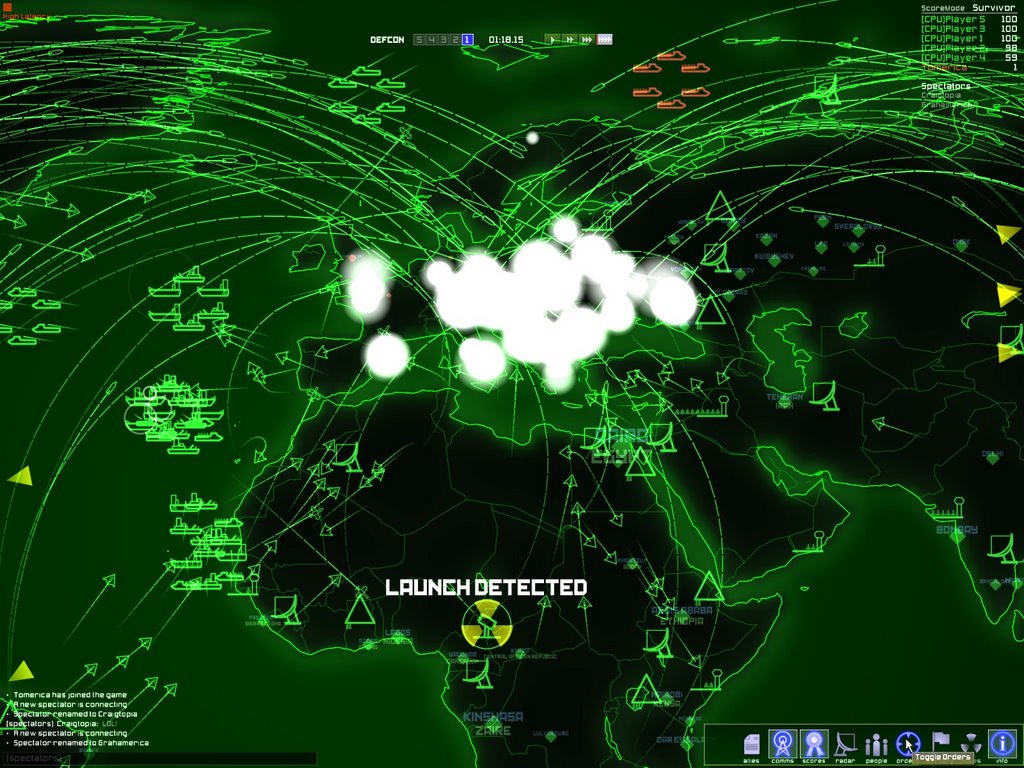
The classic that originally started the war dialing generation seems to never fade, and its core idea of simulating a Global Thermonuclear War has motivated the authors of Defcon - The Game to come up with a fully realistic representation of it. I recently took the time to play around with it -- it's so compact you can even play it on a removable media --, and I must say I never enjoyed seeing my missile projections and the sound effects out of my launches. The trailer speaks for itself!

Rule number one of thermonuclear war, launch your ICBMs as soon as you hear the Defcon 1 alert, or you risk lossing your silos due to the AIs "shooting into the dark" or conducting reconnaissance, however, keep one silo -- each has 10 ICBMs reaching anywhere on the map -- as you wouldn't be able to hit the biggest cities by the time you don't neutralize the surrounding air-defense. Submarines are sneaky and very powerful with each holding 5 missiles, but firing occures if the target is within range so make sure you position yourself where you should be. Sea and air-to-air battles are very common and there aren't any land conflicts at all. Make sure you don't fire from numerous submarines simultaneously, as if there's a figher in the air it will detect and attack the submarrine. On the other hand, use fighters to distract the air-defense firing at them while your ICBMs pass through and reach their target.

If I were to descibe the WarGames simulation in two words, that would be, tense and very addictive. Moreover, you don't need a multi-million game or movie budget to make an impression, as this game, and "The Day After" do. Goodbye Europe -- alliances are a powerful force given you convince some AIs to ally with you, but at the end there could be only one winner. Continue reading →

Face Recognition on 3G Cell Phones

0
October 29, 2006
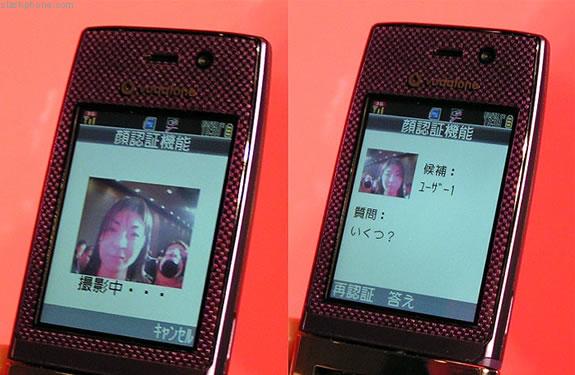
Face recognition isn't just done at home courtesy of MyHeritage.com, but on-the-go with yet another release of face recognition authentication for cell phones by a leading mobile operator in Japan :

"Security features include biometric authentication (user's face) and compatibility with DoCoMo's Omakase Lock™ remote locking service, as well as the Data Security Service™ for backing up phonebooks and other important data on a network server. The model can function as an e-wallet, timecard and personal identification card for accessing restricted areas."

The concept has been around for quite some time, but with Japan representing one of the most mature markets for mobile devices -- right after South Korea -- the feature would briefly gain popularity and acceptance. The interesting part is the security vs usability issue as if the face recognition doesn't provide perfect results in every environment and under external factors such as darkness or even brightness, by the time the technology matures, a secret question to further authenticate or good old PIN code would do the work.

Here's a very well sorted library of various research on the topic, and an interesting service that's sharing a stolen phone's photos.
Continue reading →

Real-Time Spam Outbreak Statistics

0
October 28, 2006
Following my previous posts on "Real-Time PC Zombie Statistics", and "Email Spam Harvesting Statistics", you may also find WatchGuard's recently released real-time spam outbreak statistics entertaining :

"Once in a while as I'm getting flooded with some particularly repititious spam bomb, I wonder whether other networks are receiving the same dumb stuff. And occasionally, I wonder where it originated from.

Both questions are readily answered with a nifty Web utility provided by the CommTouch Detection Center. [Full disclosure: WatchGuard's spamBlocker product is powered by a license with CommTouch.] The utility shows a map of the world, with red spots indicating the approximate location of new spam outbreaks. If you hover your cursor over any of the red zones, a popup box shows the subject lines of the most recently detected spam. It's an easy, instant way to verify whether an email you received is part of a spampaign."

Naturally, the stats are only limited to the vendor's sensor network worldwide, whereas you still get the chance to feel the dynamics of spam outbreaks worldwide. I often speculate -- and got the case studies proving it -- that the more pressure is put on spammers, phishers and malware authors, the higher would their consolidation become. For the time being, spammers are mostly utilizing the cost-effective one-to-many communication model, and their ROI -- where the investment is in renting infected zombie PCs -- is positive by default without them even segmenting, targeting and actually reaching the most gullible audience. If spammers change this model, it would mean a much faster email services worldwide, but for the time being, number of messages sent compared to basic marketing practices seems to be the benchmark.

Spammers got the "contact points", malware authors the platform and the payload, and phishers the social engineering "know-how", I find spammers missing so badly these days -- the trade off for delivering the spam through content obfuscation is the quality of the message itself. Trouble is, they'll soon realize that marriage is better than the divorce and unite forces given the pressure.

UPDATE: "Bot nets likely behind jump in spam" discusses the consolidation, or the possibility for services on demand. Via Sunbelt's blog. Continue reading →

ShotSpotter - Gunshot Sensors Network

0
October 26, 2006
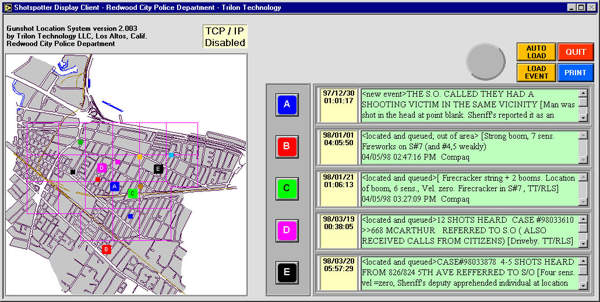
ShotSpotter is :

"a network of noise sensors that identifies and pinpoints gunfire. Over the past few weeks, the technology has guided police to three homicides in Southeast Washington, and in one case officers got there rapidly enough to make an arrest.

ShotSpotter complements 48 surveillance cameras installed in many city neighborhoods. But unlike the cameras, which are checked after the fact, ShotSpotter gets word to police as soon as bullets start flying -- in many cases before anyone has a chance to call 911. Over the past two months, the sensors, roughly the size of coffee cans, have been hidden atop buildings in many sections of Southeast Washington."

Innovative, but how well is it performing when it comes to filtering a three cars synchronized gangsta rap music, and the not so fashionable, but adaptive use of silencers? It makes me think on the possibility of disinformation by criminals knowing someone's listening and responding to gunshots. On the other hand, it could have ever wider acceptance in a war zone acting as an early warning system.

UPDATE: Techdirt's comments on the system. Continue reading →

Ms. Dewey on Microsoft and Security

0
October 26, 2006
She sure knows "all these little ones and zeroes", and your social security number altogether. I like the idea, reminds of the futuristic holograms of Einstein acting as interactive Wikipedia which when asked about WWII starts projecting battles -- she's thinking way too long, but as she pointed out she's just a chick in front of your computer. Continue reading →

What are you Looking at?

0
October 26, 2006
You piece of EyeBall surveillance camera! Continue reading →

The Surveillance System About to Get Overloaded

0
October 24, 2006
I wounder would they later on publicly announce "Hall of Fame/Shame" of the most regular drinkers, and actually use to data to fuel growth in local anti-drinking initiatives based on the most "affected" regions? Beer fingerprints to go UK-wide :

"The government is funding the roll out of fingerprint security at the doors of pubs and clubs in major English cities. Funding is being offered to councils that want to have their pubs keep a regional black list of known trouble makers. The fingerprint network installed in February by South Somerset District Council in Yeovil drinking holes is being used as the showcase."

Use a public WC - Big Brother's peeping, have a beer - it's on Big Brother's bill, and if this isn't a total abuse of technology and tax payer's money to spy on them, what is? A system like this would be useless to local bartenders, to be honest their experience for spotting the drunken monkeys or knowing them would prove invaluable in this case. From another perspective, these trouble makers, given they don't trash the place, are actually among the major consumers there.

The article makes a good point through - if pubs and clubs get extra monitoring, domestic violance increases, so would you install CCTVs at home to prevent it through the "psychological effect" as well? Continue reading →

China's Information Security Market

0
October 24, 2006
China's information security market is very much into the introduction stage, with perimeter based defenses acting as the main security solutions purchased there :

"Statistics shows that the size of China information security market arrived at RMB 1080 million Yuan in Q2 2006, 21.35% higher than the same period of last year, and 6.93% more than Q1. In Q2 2006, sales revenue of firewall products was RMB 474 million Yuan, and anti-virus software is RMB 305 million Yuan. Figure2 demonstrates different security products market shares. Figure3 and Figure 4 list major vendors of firewall software and anti-virus software, respectively."

It's perhaps the perfect timing for you to find reliable channel partners and position yourself on the local market that's about to attract even more government attention with the ongoing networking of China, thus a more foreign-business-friendly security market than it is today. Among the most recent, and free of course, research on the security market in China I often find myself coming back to is Yan Liu's thesis on the current and future market trends. From an investor's or analyst's point of view, you may also find The Global State of Information Security in 2006 a very informative and rich on visual materials survey. Continue reading →

Detecting Malware Time Bombs with Virtual Machines

0
October 24, 2006
Back in June, details on an event that happened during 2002 started emerging, namely UBS bank's employee use of a logic bomb on the internal network that naturally had the type of insider empowerment it needed to spread :

"According to prosecutors, shortly after Duronio created the code in late 2001, he quit his job and banked thousands in "put" options against UBS, in which he would profit if the company's stock price declined by March 15, 2002, as a result of the attack he had allegedly set to launch against computer systems on March 4. Prosecutors said that "within an hour or so" of walking out the door from UBS, Duronio was at a securities office buying "puts" against UBS. The mail fraud charges relate to confirmation of purchases of the puts that were sent through the U.S. Postal Service. The damage caused by the malicious code impaired trading at the firm that day, hampering more than 1,000 servers and 17,000 individual work stations. The attack cost UBS about $3 million to assess and repair, said Assistant U.S. Attorney V. Grady O'Malley. "It took hundreds of people, thousands of man hours and millions of dollars to correct," O'Malley told jurors."

And while this isn't the last time logic bombs are used -- examples during the 80's -- it's important to note how flexible that type of malware could be, going way beyond the most common trigger - a specific date and time.

The authors of "Detecting Malware Timebombs with Virtual Machines" conducted research on automated early warning system to shorten the time necessary to estimate the exact timetable of a malware in question :

"Worms, viruses, and other malware can be ticking bombs counting down to a specific time, when they might, for example, delete files or download new instructions from a public web server. We propose a novel virtual-machine-based analysis technique to automatically discover the timetable of a piece of malware, or when events will be triggered, so that other types of analysis can discern what those events are. This information can be invaluable for responding to rapid malware, and automating its discovery can provide more accurate information with less delay than careful human analysis."

It successfully analyses Code Red, Klez, MyParty, Blaster, CME-24 and speculates on the future of the automated process. Worth reading and rethinking is the Internet's infected population actually the zombies, or aren't they the ones who still haven't been awakened? Continue reading →

A Cost-Benefit Analysis of Cyber Terrorism

0
October 18, 2006
What would the ROI be for a terrorist organization wanting to take advantage of cyberterrorism, and how would they measure it?

Provocative perspective trying to emphasize on the minimal resources required to develop a cyberterrorism platform, with very interesting assessments of various financial issues and possible casualties. "A Cost-Benefit Analysis of Cyber Terrorism" tries to answer:

"Would cyberterrorism be a viable option for terrorists? This article addresses these questions assuming that a hypothetical terrorist group, interested in adding cyberterrorism to its arsenal, de-cides to engage in a cost-benefit analysis to assess the payoffs and investment re-quired by such a new endeavor. The conclusions are that cyberterrorism is not a very efficient substitute for more traditional tools like bombs. It is more effective for the terrorists to exploit information infrastructures to fight a “war of ideas,” spreading their beliefs and points of view."

While the publication is released two years ago, it has recently come to the global attention that Hezbollah aren't exactly the type of cave-hiding individuals, ones fully realizing the concept of outsourcing instead of re-inventing the wheel. While attacks on the critical infrastructure, namely frontal cyberterrorism attacks are still priority number one, and the possible scenarios already tested numerous times, this "cyberterrorism myopia" created many other dimensions of the concept.

What went beneath the radar and consequently evolved?
- online radicalization, propaganda, communication, recruitment, education, and fund-raising actually produce the "traditional terrorists"
- PSYOPS twisting the very foundations of the religion for the sake of a cause
- religious extremism started targeting more easily influenced/brainwashed youngsters while CCTVs were installed on the hot spots, and new IDs when homegrown terrorists make the news
- Hezbollah using U.S hosting companies since 1998
- OSINT backed PSYOPS improving the truthfulness of the statements

Keep on reading and data mining. Continue reading →

The Stereotyped Beauty Model

0
October 18, 2006
If women/girls didn't hate each other so much, they could rule the world. Nice ad counter-attacking the entire "chickness ad model". Feels like Unilever got so successful promoting it, so that now they have to reposition themselves as a socially oriented company, not masters of Photoshop whose virtual creations directly influence McDonald's business model. Continue reading →

Registered Sex Offenders on MySpace

0
October 17, 2006
Should you be filtering online predators, prosecuting them, or monitoring their activities to analyze and model the behaviour of the rest of them? Seems like Kevin Poulsen's been data mining MySpace using the Department of Justice's National Sex Offender Register, and the results are a Caught by Code MySpace Predator :

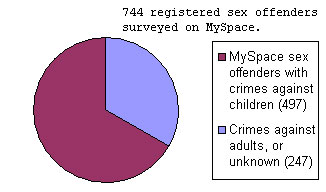
"The automated script searched MySpace's 1 million-plus profiles for registered sex offenders -- and soon found one that was back on the prowl for seriously underage boys.Excluding a handful of obvious fakes, I confirmed 744 sex offenders with MySpace profiles, after an examination of about a third of the data. Of those, 497 are registered for sex crimes against children. In this group, six of them are listed as repeat offenders, though Lubrano's previous convictions were not in the registry, so this number may be low. At least 243 of the 497 have convictions in 2000 or later."

These findings indicate the offenders' confidence in MySpace's inability to take the simplest measure - match the publicly accessible data with its database - just in case. It's also worth mentioning that according to a recently released comScore analysis "more than half of MySpace visitors are now age 35 or older", and that according to their analysis, Facebook, and Xanga have much younger audiences, namely represent a top target for online predators.

The most important issues however, remain the moment when a kid losses the communication with its "folks", and the huge amount of information kids share on any social networking site, thus unconsciously creating more contact points for the online predator.

Internet Safety for Kids - a presentation for adults, is full with handy tips for educating and building awareness on the problem. Continue reading →

CIA's In-Q-Tel Investments Portfolio

0
October 16, 2006
In a previous post "Aha, a Backdoor!" I discussed the "exemption" of publicly traded companies from reporting to the SEC the usual way, and particularly their investments related to national security. The strategy is visionary enough to act a major incentive factor for companies to both, innovate, and supply the homeland security and defense markets.

However, publicly obtainable data can still reveal historical developments:

"A relatively unknown branch of the CIA is investing millions of taxpayer dollars in technology startups that, together, paint a map for the future of spying. Some of these technologies can pry into the personal lives of Americans not just for the government but for big businesses as well.

The CIA's venture capitalist arm, In-Q-Tel, has invested at least $185 million in startups since 1999, molding these companies' products into technologies the intelligence community can use.

More than 60 percent of In-Q-Tel’s current investments are in companies that specialize in automatically collecting, sifting through and understanding oceans of information, according to an analysis by the Medill School of Journalism. While In-Q-Tel has successfully helped push data analysis technology ahead, implementing it within the government for national security remains a challenge, and one of In-Q-Tel’s former CEOs, Gilman Louie, has concerns about whether privacy and civil liberties will be protected."

In a related Red Herring article, In-Q-Tel points out that :

We don’t just invest in equity of companies,” said Scott Yancey, the firm’s interim chief executive. “That’s kind of the hallmark of who we are in terms of being the strategic investor.”

Observers said the payments don’t fit with the typical venture model.

“To the extent that In-Q-Tel incentivizes its portfolio companies or employees otherwise, it sounds like from an outsider’s point of view that they’ve needed to create some artificial incentives that wouldn’t otherwise be necessary in a traditional venture model,” said Scott Joachim, a partner with the law firm Drinker, Biddle, & Reath."


The Intelligence Community realizes that innovation will come from outsiders working for insiders, and with "more than 130 technology solutions to the intelligence community", CIA's In-Q-Tel seems to have made quite some sound investments.

A true angel investor in the "silent war". And yes, even you can submit a business plan looking for seed capital -- and a "tail" to ensure you're developing in the right direction? Continue reading →

Observing and Analyzing Botnets

0
October 16, 2006
Informative and rich on visual materials, research presenting a "A Multifaceted Approach to Understanding the Botnet Phenomenon"

"Throughout a period of more than three months, we used this infrastructure to track 192 unique IRC botnets of size ranging from a few hundred to several thousand infected end-hosts. Our results show that botnets represent a major contributor to unwanted Internet traffic—27% of all malicious connection attempts observed from our distributed darknet can be directly attributed to botnetrelated spreading activity. Furthermore, we discovered evidence of botnet infections in 11% of the 800,000 DNS domains we examined, indicating a high diversity among botnet victims. Taken as a whole, these results not only highlight the prominence of botnets, but also provide deep insights that may facilitate further research to curtail this phenomenon."

Botnets' security implications are often taken as a phenomenon, whereas this is not the case as distributed computing concepts have been around for decades. Some interesting graphs and observations in this research are :

- Breakdown of scan-related commands seen on tracked botnets during the measurement period
- The percentage of bots that launched the respective services (AV/FW Killer) on the victim machines
- Distribution of exploited hosts extracted from the IRC tracker logs

What botnet masters will definitely optimise :
- disinformation for number and geolocation of infected hosts
- alternative and covert communication channels compared to stripped, or encrypted IRC sessions
- rethink of concept of performance vs stealthiness
- rethinking how to retain the infected nodes, compared to putting more efforts into infecting new ones
- for true competitiveness, vulnerabilities in anti-virus solutions allowing the code to remain undetected for as long as possible
- synchronization with results from popular test beds such as VirusTotal for immediate reintroduction of an undetected payload

The future of malware stands for solid ecosystem and diversity, whereas, both, researchers, the Pentagon, and malware authors are actively benchmarking and optimising malware, each having seperate objectives to achieve.

Go through a previous post "Malware Bot Families, Technology and Trends" in case you want to find out more about botnet technologies, and update yourself with the most recent case of DDoS extortion. Continue reading →

Hunting the Hacker - Documentary

0
October 14, 2006
Here's a recently released documentary -- in Russian -- entitled "Охота на хакера", or Hunting the Hacker, discussing IT security, cyber crime, malware authors, onlie scams etc. It also features Eugene Kaspersky commenting on various trends. Don't forget, Russian hackers and Eastern European ones are not just responsible for the sky-rocketing cyber-crime cost "projections", but for the global warming effect as well. I often come across biased comments on wrongly structured research questions such as : "Who are the best hackers in respect to nationalities?", where it should have been formulated as "How vibrant is the IT security landscape, so that the changing dominance lifecycle of a nation could be measured at a particular moment in time?"

True hackers don't have nationalities, they're citizens of the world. Download or stream it from Google Video. Continue reading →