Thursday, September 14, 2006

Internet PSYOPS - Psychological Operations

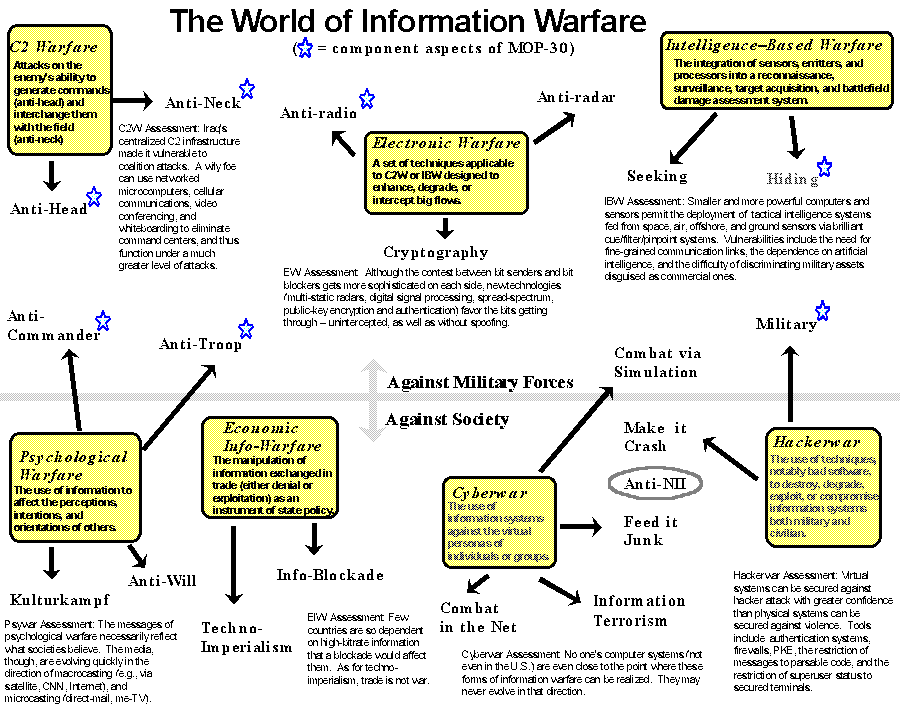
Psychological operations or PSYOPS is an indirect use of information warfare methods to deceive, shape and influence the behavior and attitude of the targeted audience -- military marketers with greater access to resources and know-how. The Internet acting as a global-reaching, cost-effective platform for dissemination of a message, rumor, lie, inside information is directly influencing the evolution of the concept.

You may find this research conducted back in 2001, still relevant on the basics of psychological operations and propaganda online. A brief summary of The Internet and Psychological Operations :

"As an information medium and vehicle of influence, the Internet is a powerful tool, in both open societies as well as in those whose only glimpse of the outside world is increasingly viewed and shaped through webpages, E-mail, and electronic chat rooms. Moreover, the sword cuts both ways, as unconstrained (legally, socially, politically) adversaries find the Internet an effective vehicle for influencing popular support for their cause or inciting the opposite against the U.S. or its interests. Consequently, the realm of military psychological operations (PSYOP) must be expanded to include the Internet. Just as obvious is the need for action to remove or update current policy and legal constraints on the use of the Internet by military PSYOP forces, allowing them to embrace the full range of media, so that the U.S. will not be placed at a disadvantage. Although current international law restricts many aspects of PSYOP either through ambiguity or noncurrency, there is ample legal room for both the U.S. and others to conduct PSYOP using modern technology and media such as the Internet. Existing policy and legal restrictions, however, must be changed, allowing military PSYOP forces to both defend and counter adversarial disinformation and propaganda attacks which impact on the achievement of military objectives. By examining this issue, I hope to highlight the importance of the Internet for PSYOP and foment further discussion."

Undoubtedly, Abu Ghraib's fiasco is among the most relevant cases of unintentional PSYOPS in reverse, where the leak's echo effect would continue to spell sskepticism towards what democracy really is. And while there're indeed legal issues to consider when using such operations, what is legal and illegal in times of war is questionable.

Some basic examples:
- your web sites spread messages of your enemies
- sms messages and your voice mail say you're about to lose the war
- your fancy military email account is inaccessible due to info-warriors utilizing the power of the masses, thus script kiddies to distract the attention
- you gain participation, thus support
- you feel like Johnny Mnemonic taking the elevator to pick up the 320 GB of R&D data when a guerilla info-warrior appears on the screen and wakes you up on your current stage of brainwashing
- starting from the basics that the only way to ruin a socialist type of government is to introduce its citizens to the joys of capitalism -- it always works
- hacktivism - traffic acquisition plus undermining confidence
- propaganda - North Korea is quite experienced
- self-serving news items, commissioned ones
- achieving Internet echo as a primary objective
- introducing biased exclusiveness
- stating primary objectives as facts that have already happened
- impersonation

The evolution of online PSYOPS is on its way and is actively utilized by both adversaries, and everyone in between, it's entirely up to you to be either objective, or painfully subjective.


Wednesday, September 13, 2006

Prosecuting Defectors and Appointing Insiders

In the year 2006, those who control Russia's energy reserves control a huge portion of the world's energy market -- renewable energy is the future. And as you can imagine they're for sure not controlled by some newly born Russian millionaires -- a great benchmark for how vibrant a country's economy or level of corruption really is. Seems like the long-term effects of a planned economy are still a political doctrine, and the invisible hand of the market is still short enough to feel the Russian energy sector as Russian intelligence chief's son has been named adviser to oil company chairman :

"A son of the head of Russia's main intelligence agency has been named an adviser to the chairman of state oil company OAO Rosneft, the daily newspaper Kommersant reported Wednesday, citing an unidentified source on Rosneft's board of directors. Andrei Patrushev, the 25-year-old son of Federal Security Service (FSB) director Nikolai Patrushev, had previously been an FSB official himself, working in the department that keeps tabs on the Russian oil industry, according to Kommersant."

The courage to rise above shown by Mikhail Khodorkovsky has its own butterfly effect, and it's so easily predictable one. Here's a Google bomb for you -- it means enemy of the people. Here's another. Враг народа or a vivid protectionist?

Malware on Diebold Voting Machines

Continuing the previous post on "How to Win the U.S Elections" seems like malware is indeed diebold voting machines compatible -- related videos.

The main findings of the study are:

- Malicious software running on a single voting machine can steal votes with little if any risk of detection. The malicious software can modify all of the records, audit logs, and counters kept by the voting machine, so that even careful forensic examination of these records will find nothing amiss. We have constructed demonstration software that carries out this vote-stealing attack.

- Anyone who has physical access to a voting machine, or to a memory card that will later be inserted into a machine, can install said malicious software using a simple method that takes as little as one minute. In practice, poll workers and others often have unsupervised access to the machines.

- AccuVote-TS machines are susceptible to voting-machine viruses — computer viruses that can spread malicious software automatically and invisibly from machine to machine during normal pre- and post-election activity. We have constructed a demonstration virus that spreads in this way, installing our demonstration vote-stealing program on every machine it infects.

- While some of these problems can be eliminated by improving Diebold's software, others cannot be remedied without replacing the machines' hardware. Changes to election procedures would also be required to ensure security.


IP enabled, Windows running ATM's with anti-virus, IPv6 enabled fridges with anti-virus, smart phones with anti-virus, Play Stations with anti-virus, birds as early warning systems for an epidemic, so where's my signature, dude?

Vulnerabilities in Emergency SMS Broadcasting

There's been a recent test of emergency cell phone alert in the Netherlands -- original article was here -- and while broadcasting supposidly reaches the largest number of people in the surrounding area, timing and countless number of factors also matter :

"Cell phones throughout a downtown hotel beeped simultaneous Tuesday with an alert: there is a suspicious package in the building. It was a drill, run by Dutch authorities testing an emergency "cell broadcasting" system that sends a text message to every mobile phone in a defined area. Representatives from 21 national governments, New York City and the U.S. Federal Emergency Management Agency, or FEMA, watched the signal go out to cell phones throughout the Sofitel hotel in Amsterdam. About half the people in the building then followed instructions and evacuated. "We want to see what worked and what didn't," said David Webb, of FEMA's Urban Search and Rescue Program. "The EU (European Union) is really leading the way with this technology."

What if :

- Even in case that key emergency personal were to use a seperate communication network, radio for instance, broadcasting to anyone accepting could result in significant delays, and even though the message is sent, it doesn't mean it would take advantage of the momentum

- cell phone jammers are often used by hotels to preserve the unique atmosphere and undisturbed conference meetings can prove contradictive, excluding the fact that the parties supposidly plotting the attack don't use one by themselves

- despite the fact that one in five will pick up their mobile during sex, how many obsessively check for newly arrived sms messages?

- how would a tourist know how the successfully authenticate the local authories at the first place, in case of emergencies watch out for an sms from 010101, now I assume you know how easily I can sms you from the same number and impersonate the number

- what should the user be mostly aware of be aware of, mobile malware, SMSishing, or "call this 0 900 or else I won't tell you where's the attack" type of messages

- from a multilingual point of view, will it be using English by default, and how many would be still enjoying their meals while everyone's leaving

Great idea, but it may prove challenging to evaluate the actual results in a timely manner. Sent doesn't mean received or read on time, even actioned upon.

Recommended reading:
SMS disaster alert and warning systems - don't do it !
Revisiting SMS during Disasters
Concept Paper on Emergency Communications during Natural Disasters
Exploiting Open Functionality in SMS- Capable Cellular Networks
The Role of Mobiles in Disasters and Emergencies