Wednesday, November 01, 2006

FAS's Immune Attack Game

Professor Falken would have loved this one. The Federation of American Scientists recently released their report from the Summit on Educational Games, and an upcoming educational game :

"Immune Attack is a first person strategy PC video game that teaches immunological principles through entertaining game play. The protagonist, a teenaged prodigy with a unique condition in which the immune system is “present, yet non-functional”, must pilot a microscopic nanobot to save his own life. He must teach his semi-functional immune system to fight off diseases and bacterial/viral infections by programming individual cell types. This programming is accomplished through the successful completion of various educational minigames, each of which teach a central immunology principle and, once completed, confer added ability to the selected cell type."

Here're two more reports you may find informative on the future of learning through games -- the game addicts still got a chance.


Proof of Concept Symbian Malware Courtesy of the Academic World

Know your enemy to better predict his moves and future strategies as Symbian malware optimization is getting the necessary attention from the academic community :

"The University of Santa Barbara's software group released the source code for their proof of concept 'Feakk' worm that was developed by Paul Haas in March 2005. The worm uses SMS to send a hyperlink to its target. The targeted user then has to visit the hyperlink and download and acknowledge three sets of prompts in order for the worm to install, at which point it will immediately start to run in the background. It will scan the user's contact list and send a message to each contact (including the recipients' names) and will also scan for new contacts at certain intervals.

Upon installation, the worm checks for a contact with the first name "HACKME." If this isn't found the worm will exit. If it is found, then the worm sends itself to every mobile number it finds in the user's contact list. The author did not write a payload because this was for demonstration purposes only and it should be noted that it can be removed via the "Uninstall List."

While malware authors will turn the concept into a commodity, it doesn't exploit a speficic OS vulnerability, thus the possibility of large scale outbreaks doesn't really exist at all. In a previous post I commented on some future developments related to the penetration of mobile devices in our daily lifes and the trust factor assuming whoever holds the handset is actually the one using it :

"Malware authors indeed have financial incentives to futher continue recompling publicly available PoC mobile malware source code, and it's the purchasing/identification features phones, opening a car with an SMS, opening a door with an SMS, purchasing over an SMS or direct barcode scanning, mobile impersonation scams, harvesting phone numbers of infected victims, as well as unknowingly interacting with premium numbers are the things about to get directly abused -- efficiently and automatically."

Digitally fingerprinting mobile malware may be marketable, but it's rather useless as we've seen in the past compared to basic user awareness.

I feel the University of Santa Barbara's software group are very much on the right track, conducting research on OS and application specific vulnerabilities, as they've released quite some interesting papers during 2006 :

Advanced Attacks Against PocketPC Phones
PocketPC MMS - Remote Code Injection/Execution Vulnerability and Denial-of-Service
Vulnerability Analysis of MMS User Agents
Security of Smart Phones
Using Labeling to Prevent Cross-Service Attacks Against Smart Phones

Monday, October 30, 2006

Fake Search Warrant Generator

In response to Christopher Soghoian's home raid -- the masked superhero by night -- a fake search warrant generator was just released :

"for district courts all across the United States with the intent of improving national security by reducing the amount of time it takes for our public guardians to create search warrants."

Sarcasm's most effective when having a point.

Sunday, October 29, 2006

Greetings Professor Falken

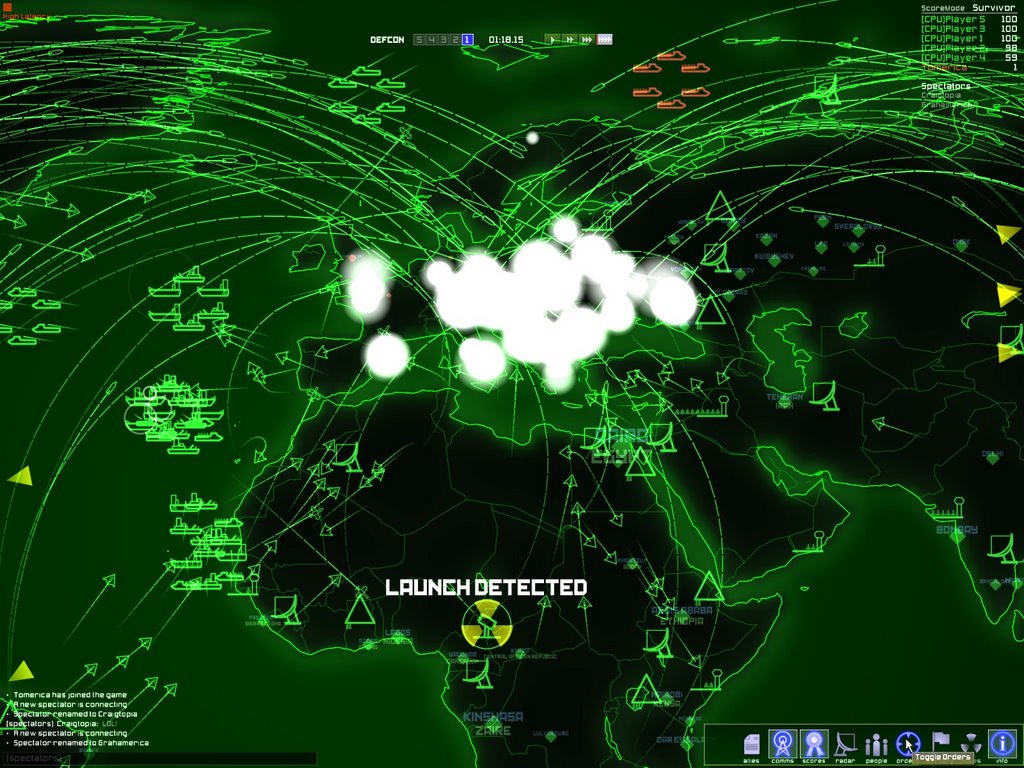
The classic that originally started the war dialing generation seems to never fade, and its core idea of simulating a Global Thermonuclear War has motivated the authors of Defcon - The Game to come up with a fully realistic representation of it. I recently took the time to play around with it -- it's so compact you can even play it on a removable media --, and I must say I never enjoyed seeing my missile projections and the sound effects out of my launches. The trailer speaks for itself!

Rule number one of thermonuclear war, launch your ICBMs as soon as you hear the Defcon 1 alert, or you risk lossing your silos due to the AIs "shooting into the dark" or conducting reconnaissance, however, keep one silo -- each has 10 ICBMs reaching anywhere on the map -- as you wouldn't be able to hit the biggest cities by the time you don't neutralize the surrounding air-defense. Submarines are sneaky and very powerful with each holding 5 missiles, but firing occures if the target is within range so make sure you position yourself where you should be. Sea and air-to-air battles are very common and there aren't any land conflicts at all. Make sure you don't fire from numerous submarines simultaneously, as if there's a figher in the air it will detect and attack the submarrine. On the other hand, use fighters to distract the air-defense firing at them while your ICBMs pass through and reach their target.

If I were to descibe the WarGames simulation in two words, that would be, tense and very addictive. Moreover, you don't need a multi-million game or movie budget to make an impression, as this game, and "The Day After" do. Goodbye Europe -- alliances are a powerful force given you convince some AIs to ally with you, but at the end there could be only one winner.