Monday, November 27, 2006

To Publish a Privacy Policy or Not to Publish a Privacy Policy

Here's an article arguing that "publishing a privacy statement may be more harmful than not publishing one"only if enforcement, implementation and monitoring don't intersect as they should :

"This case demonstrates a complication relating to companies' claiming that they have security measures to protect their end users' privacy. Large, established companies, like Eli Lilly, understand this issue but may still have problems ensuring compliance to their privacy policy. But many emerging companies immediately post their claimed privacy policies on their company websites. These companies often fail to assess the potential risks, burdens and liabilities associated with publishing a privacy policy. They do not realize that publishing a privacy statement may be more harmful than not publishing one."

Privacy exposure assessments still remain rather unpopular among leading companies, and compliance with industry specific requirements for processing and storing personal information continue indirectly replacing what a Chief Privacy Officer would have done in a much more adaptive manner. Can we that easily talk about Total Privacy Management (TPM), the way talk about Total Quality Management (TQM) as an internal key objective for strengthening a company's reputation as a socially-oriented one? It would definitely turn into a criteria for the stakeholders, and a differentiating point for any company in question in the long term. The future of privacy? Don't over-empower the watchers or you'll have the entire data aggregation model of our society used against your rights for the sake of protecting you from "the enemy or the threat of the day".

You may also find some comments from a previous post on "Examining Internet Privacy Policies" relevant to the topic :

"Accountability, public commitment, or copywriters charging per word, privacy policies are often taken for fully enforced ones, whereas the truth is that actually no one is reading, bothering to assess them. And why would you, as by the time you've finished you'll again have no other choice but to accept them in order to use the service in question -- too much personal and sensitive identifying information is what I hear ticking. That's of course the privacy conscious perspective, and to me security is a matter of viewpoint, the way you perceive it going beyond the basics, the very same way you're going to implement it -- Identity 2.0 as a single sign on Web is slowly emerging as the real beast."


How to Tell if Someone's Lying to You

Interactive slideshow providing ten tips on how to tell if someone's lying to you. These can of course be interpreted in different ways and applied under specific circumstances only. Some are very practical though :

01. Watch Body Language
02. Seek Detail
03. Beware Unpleasantness
04. Observe Eye Contact
05. Signs of Stress
06. Listen for the Pause
07. Ask Again
08. Beware Those Who Protest Too Much
09. Know Thyself
10. Work on Your Intuition

Two more I can add -- answering without being asked, and on purposely stating the possibility as a negative statement already. Here's the article itself, as well as several more handy tips on detecting lies. Don't forget - if someone's being too nice with you, it means they're beating you already.

Ear whisper courtesy of Cartoonstock.com

Monday, November 20, 2006

London's Police Experimenting with Head-Mounted Surveillance Cameras

Innovative, but a full scale violation of privacy -- what privacy with walking CCTVs nowadays?!

"The world draws ever-closer to the dystopia imagined in Hollywood blockbusters -- police in London are to be equipped with head-mounted cameras which will record everything in the direction the officer is looking. The tiny cameras are about the size of an AA battery and can record images of an extremely high quality.

Claimed to be a deterrent for anti-social behaviour, the first run of head-cams are being tested by eight Metropolitan beat officers this month. If successful, all police officers will eventually be equipped with a head camera.


These new 'robocops' add to the growing number of surveillance machines that peer at the public. Cynics argue that the logical progression of the police head-cam will be head-cameras that all citizens are required to wear. The video data would be relayed back to a central database where transgressions are recorded by a computer.
"

George Orwell is definitely turning upside down in his grave in the time of writing, and it's entirely up to you to come up with the possible scenarios for abusing this innovation -- The Final Cut too, has a good perspective.

Think that's not enough to raise your eyebrows? British Telecom is also about to "put thousands of spy camera recorders in its phone boxes and beam suspects mugshots to police. Cameras stationed on top of lampposts near the kiosks will send images to hidden digital video recorders inside the booths. Suspects photos will then be messaged almost instantly to hand-held digital assistants used by police and emergency services."

Issues to keep in mind:
- No more tax payers' money wasted on CCTVs to only cover the blind spots introduced by the old ones, now you have the "walking CCTVs" taking care
- Face and voice recognition, as well as parabolic type of remote listening capabilities will be the next milestones to reach
- Data collected would prove invaluable to ongoing investigations, and you know, "computers never lie" so digitally introducing minor motives here and there becomes a handy weakness
- More entertaining reality shows will follow for the purpose of communicating the value of the cameras to the general public
- Someone will sooner or later find a way to jam the stream

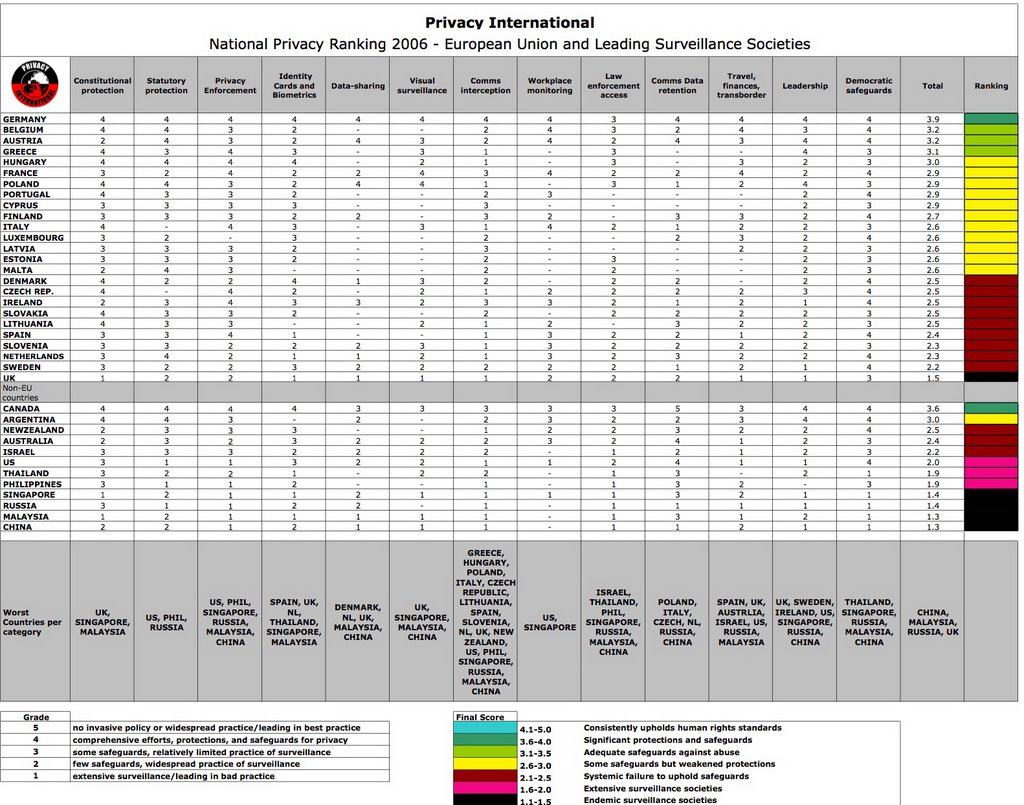
There's a saying about not looking anyone straight into the eyes on the mean streets of New York, guess the same applies to not looking straight into the eyes of London's police anymore. Every country needs an EFF of its own, especially the U.K these days. To illustrate what I have in mind, EPIC's listing the U.K at the top of the leading EU surveillance societies, and you may also find the U.K's opinion on its state of total surveillance, informative as well.

Finger-mounted keyboard chick courtesy of Kittytech.

Tuesday, November 14, 2006

Widener University Forensics Course

Just noticed that the reading materials for the course are also listing my "Steganography and Cyber Terrorism Communications" post. Looks nice!