Fake Yahoo Greetings Malware Campaign Circulating

0
April 16, 2008
The persistence of certain botnet masters cannot remain unnoticed even if you're used to going through over a dozen active malware campaigns per day, in this case it's their persistence that makes them worth assessing and profiling. The botnet which I assesed in February, the one that was crunching out phishing emails and using the infected hosts for hosting the pages, and parking the phishing domains, is still operational this time starting a fake Yahoo Greetings malware campaign by spamming the cybersquatted domains and enticing the user into updating their flash player with a copy of Backdoor.Agent.AJU.

Upon visiting www4.yahoo.american-greeting.com.tag38.com/ecards/view.pd.htm it redirects to www3.yahoo.americangreetings.com.id759.com/ecards/view.pd.htm

id759.com is currently responding to 24.161.232.218; 24.192.140.204; 68.36.236.67; 76.230.108.105; 83.5.203.163; 85.109.42.164; 216.170.109.206 and also to set45.net; service28.biz; setup36.com and serves the Backdoor.Agent :

www3.yahoo.americangreetings.com.id759.com/ecards/get_new_flashplayer .exe

Scanners Result : 12/31 (38.71%)
Suspicious:W32/Malware!Gemini; W32/Agent.Q.gen!Eldorado
File size: 44544 bytes
MD5...: fe97eb8c0518005075fd638b33d5b165
SHA1..: d7a4258e37ce0dab0f7d770d1a9d979e921be07b
SHA256: 138d31ae1bbdec215d980c7b57be6e624c2f2e1cacd3934b77f50be8adabfb97

"Backdoor.Agent.AJU is a malicious backdoor trojan that is capable to run and open random TCP port in a multiple instances attempting to connect to its predefined public SMTP servers. It then spams itself in email with a file attached in zip and password protected format. Furthermore, the password is included in the body of the email."

tag38.com is responding to 211.142.23.21, and is a part of a scammy ecosystem of other phishing and malware related domains responding to the same IP. And these are the related subdomains impersonating Yahoo Greetings within :

american-greeting.ca.xml52.com
www5.yahoo.american-greeting.ca.xml52.com
www9.yahoo.americangreeting.ca.www05.net
yahoo.americangreetings.com.droeang.net
yahoo.americangreetings.com.s8a1.psmtp.com
yahoo.americangreetings.com.s8a2.psmtp.com
yahoo.americangreetings.com.s8b1.psmtp.com
yahoo.americangreetings.com.s8b2.psmtp.com
yahoo.americangreetings.droeang.net
yahoo.americangreeting.ca.www05.net
www6.yahoo.american-greetings.com.www05.net

What you see when in a hurry is not what you get when you got time to look at it twice. This and the previous campaign launched by the same party is a great example of risk and responsibility forwarding, in this case to the infected party, so what used to be a situation where an infected host was sending spamming and phishing emails only, is today's malicious hosting infrastructure on demand. Continue reading →

Web Email Exploitation Kit in the Wild

0
April 16, 2008
XSS exploitation within the most popular Russian, and definitely international in the long-term, web email service providers is also embracing the efficiency mindset as a process. This web based exploitation kit is great example of customization applied to publicly known XSS vulnerabilities within a segmented set of web sites, email providers in this case.

The kit's pitch automatically translated :

"Ie script contains vulnerability to 15 - not the most popular Russian postal services (except
buy), and one of the largest foreign mail servers that provide free mail - mail.com. Three of the vulnerabilities work only under Internet Explorer, all the rest - under Internet Explorer and Opera.

The system also includes a 16 ready-to-use pages feykovyh authorization to enter the mail. Thus the use of the script is that you choose a template-XSS (code obhodyaschy security filters for your desired mail server) on which the attack would take place, complete field for a minimum of sending letters (sender, recipient, the subject, message) and choose Type of stuffing: 1) your own yavaskript code (convenient option to insert malicious code with iframe) 2) code, driving the victim to a page feykovuyu authorization. In the first case, the victim is in the browser's just a matter of your own scripte but in the second case, the victim is redirected to a page with false authorization, there enters its data, which logiruyutsya you, and sent back to his box. For the script is simple and free hosting with support for sendmail, php, but nonetheless you should be aware that for more kachetvennoy work will not prevent you buy a beautiful domain. Also appearing inexpensive paid updated as closing loopholes in the mail filters."

Automating the process of phishing by using the vulnerable sites as redirectors can outpace the success of the Rock Phish kit whose key success factor relies on diversity of the brands targeted whereas all the campaigns operate on the same IP.

Moreover, as we've seen recently, highly popular and high-profile sites whose ever growing web applications infrastructure continues to grow, still remain vulnerable to XSS vulnerabilities which were used in a successful blackhat SEO poisoning campaign by injecting IFRAME redirectors to rogue security applications in between live exploit URLs. In fact, Ryan Singel is also pointing out on such existing vulnerability at the CIA.gov, showcasing that spear phishing in times when phishers, spammers and malware authors are consolidating, can be just as effective for conducting cyber espionage, just as gathering OSINT through botnets by segmenting the infected population is. Why try to malware infect the high-profile targets, when they could already be malware infected?

Furthermore, XSS vulnerabilities within banking sites are also nothing new, and as always the very latest XSS vulnerabilities will go on purposely unreported by the time phishers move onto new ones. How about the customer service aspect given that this XSS exploitation kit is yet another example of a proprietary underground tool? If the XSS vulnerabilities aren't working, custom zero day XSS vulnerabilities within the providers can be provided to the customer. Commercializing XSS vulnerabilities is one thing, embedding the exploits in a do-it-yourself type of tool another, but positioning the kit as a efficient way for running your "Request an Email Account to be Hacked" business is entirely another, which is the case with the kit.

In 2008, is the infamous quote "Hack the Planet!" still relevant, or has it changed to "XSS the Planet!" already, perhaps even "Remotely File Include the Planet!"? Continue reading →

Malware and Exploits Serving Girls

0
April 15, 2008
Descriptive domains such as beautiful-and-lonely-girl dot com, amateur homepage looking sites, a modest photo archive of different girls, apparently amateur malware spreaders think that spamming these links to as many people as possible would entice them into visting the sites, thus infecting themselves with malware.

It all started with Lonely Polina, than came lonely Ms. Polinka, and now we have Victoria. And despite that Polina and Polinka are both connected in terms of the malware served, and the natural RBN connection in face of HostFresh, as well as the site template used, Victoria is an exception. Some details on the recently spammed campaign :

voena.net (199.237.229.158) is also responding to prettyblondywoman.com, where the exploit (WebViewFolderIcon setSlice) and the malware (Trojan-Spy.Win32.Goldun) are served from voena.net/incoming.php and voena.net/get.php, both with a high detection rate 27/32 (84.38%).

Individual homepages are dead, and this is perhaps where the social engineering aspect of the attack fails, all these girls for sure have their MySpace profiles up and running already, in between taking advantage of a popular photo sharing service. Continue reading →

Localized Fake Security Software

0
April 14, 2008
Would you believe that in times when top tier antivirus vendors are feeling the heat from the malware authors' DoS attacks on their honeyfarms, and literally cannot keep up with their releases, someone out there is using an antivirus scanner that doesn't really exist? It's one thing to promote fake security software in a one-to-many communication channel by using a single language in a combination with cybersquatted domains, and entirely another to do the same in different languages. Localization for anything malicious is already taking place, as originally anticipated as an emerging trend back in 2006. The following currently active fake security software scams are promoted in Dutch, French, German, Italian, and you don't get to download them until you hand out your credit card details, and once you do so, you'll end up in the same situation just like many other people did in the past. Some sample fake brands :

SpyGuardPro; PCSecureSystem; AntiWorm2008; WinSecureAv; MenaceRescue; PCVirusless; LifeLongPC; NoChanceForVirus; MenaceMonitor; TrojansFilter; TrojansFilter; LongLifePC; KnowHowProtection; BestsellerAntivirus; PCVirusSweeper; AVSystemCare; AVSecurityPlus; AVSecurityPlus; PCAssertor; PoseidonAntivirus; TrustedAntivirus; PCBoosterPro; DefensiveSystem; GoldenAntiSpy; AntiSpywareSuite; AntiMalwareShield; AntivirusPCSuite; AntivirusForAll; TrustedProtection; NoWayVirus; AntiSpywareConductor; AntiSpywareMaster; TurnkeyAntiVirus; YourSystemGuard;

Portfolio one :

alfaantivirus.com
antivirusalmassimo.com
farrevirus.com
fomputervagt.com
figitalerschutz.com
flmejorcuidado.com
ferramentantivirus.com
filterprogram.com
filtredevirus.com
geeninfectie.com
harddrivefilter.com
keineinfektionen.com
longueviepc.com
maseg.net
nonstopantivirus.com
pcantivirenloesung.com
pcsystemschutz.com
plutoantivirus.com
psbeveiligingssysteem.com
riendevirus.com
securepcguard.com
sekyuritikojo.com
sistemadedefensa.com
sumejorantivirus.com
totaltrygghet.com
viruscontrolleuer.com
viruswacht.com
votremeilleurantivirus.com
zeusantivirus.com

Portfolio two :

advancedcleaner.com
alltiettantivirus.com
antispionage.com
antispionagepro.com
antispypremium.com
antispywarecontrol.com
antispywaresuite.com
antiver2008.com
antivirusaskeladd.com
antivirusfiable.com
antivirusforall.com
antivirusforalla.com
antivirusfueralle.com
antivirusgenial.com
antivirusmagique.com
antivirusordi.com
antivirusparatodos.com
antiviruspcpakke.com
antiviruspcsuite.com
antiviruspertutti.com
antivirusscherm.com
antiworm2008.com
antiwurm2008.com
archivoprotector.com
avsystemcare.com
avsystemshield.com
barrevirus.com
bastioneantivirus.com
bestsellerantivirus.com
bortmedvirus.com
cerovirus.com
debellaworm2008.com
defensaantimalware.com
defensaantivirus.com
drivedefender.com
exterminadordevirus.com
fiksdinpc.com
mijnantivirus.com
mobileantiviruspro.com
norwayvirus.com
nowayvirus.com
pcantivirenloesung.com
plutoantivirus.com
viruscontrolleuer.com
zebraantivirus.com
zeusantivirus.com

Portfolio three :

pcsecuresystem.com
antiworm2008.com
winsecureav.com
menacerescue.com
pcvirusless.com
lifelongpc.com
nochanceforvirus.com
menacemonitor.com
trojansfilter.com
longlifepc.com
knowhowprotection.com
bestsellerantivirus.com
pcvirussweeper.com
antiespiadorado.com
avsecurityplus.com
apolloantivirus.com
pcassertor.com
menacesecure.com
poseidonantivirus.com
trustedantivirus.net
pcboosterpro.com
defensivesystem.com
goldenantispy.com
avsystemcare.com
trustedantivirus.com
antimalwareshield.com
avsystemcare.com
antiviruspcsuite.com
antivirusforall.com
trustedprotection.com
nowayvirus.com
pcantiviruspro.com
antispywareconductor.com
antispywaremaster.com
turnkeyantivirus.com
yoursystemguard.com

Just like a previous proactive incident response where I pointed out that these fake security applications are starting to appear as the final output in malicious campaigns injected
at high profile sites, ensuring that your customers or infrastructure cannot connect to these, will render current and upcoming massive IFRAME injected or embedded attacks pointless at least from the perspective of serving the rogue software.
Continue reading →

ICQ Messenger Controlled Malware

0
April 14, 2008
IM me a command, master - part two. Diversifying the command and control channels of malware is always in a permanent development phrase, with malware authors trying to adapt their releases in order for them to bypass popular detection mechanisms. IM controlled malware is a great example of such a development, and now that I've already covered a Yahoo Messenger controlled malware in previous post, it would be logical to come up with more evidence on alternative IM networks used as a main C&C interface, such as ICQ in this case. The ICQ controlled malware's pitch :


"With this program, you will always be able to access the necessary functions of your computer using ordinary ICQ. It has the opportunity to add their scripts and commands, thus becoming a universal tool for controlling the computer - it all depends on your imagination and skills. Through the program operations like the following can be run by default - viewing directories, displaying messages, lauching programs, killing processes, shutdown, view active windows, and much more."


Released primarily as a Proof of Concept, its source code is freely available which as we've already seen in the past results in more innovation added on behalf of those using the idea as a foundation for achieving their own malicious purposes.


The whole concept of abusing third-party communication applications for malware purposes, has always been there, in fact two years ago, there were even speculations that Skype could be used to control botnets. A fad or a trend? The lone malware author who's not embracing malicious economies of scale and looking for reliable and efficient ways to infect and control as many hosts as possible, is taking advantage of this, the rest are always looking for ways to port their botnets to a different C&C without loosing a single host in order to benefit from what a web application C&C can provide in respect to the old-fashioned IRCd command line commands. Continue reading →

Romanian Script Kiddies and the Screensavers Botnet

0
April 08, 2008
Shall we turn into zombies, and peek into the modest botnet courtesy of Romanian script kiddies, that are currently spamming postcard.scr greeting cards? Meet the script kiddies. This botnet is going nowhere mostly because knowing how to compile an IRC bot doesn't necessarily mean you posses a certain know-how, a know-how that experienced botnet masters have been outsourcing for years. Malware is obtained through links pointing to :

xhost.ro/filehost/phrame.php?action=saveDownload&fileId=15735
xhost.ro/filehost/phrame.php?action=editDownload&fileId=12923
xhost.ro/filehost/phrame.php?action=saveDownload&fileId=3656
xhost.ro/filehost/phrame.php?action=editDownload&fileId=10936

Scanners result : Result: 22/32 (68.75%)
Trojan.Zapchas.F; IRC/BackDoor.Flood; Backdoor.IRC.Zapchast
File size: 735139 bytes
MD5...: 015e5826084f2302b4b2c3237a62e244
SHA1..: 7d05949f6dfffdc58033c9d8b86210a9bd34897c

Sample traffic output :
"NICK Mq2kC01
USER las "" "pic.kauko.lt" :Px7aW6
USER las "" "Helsinki.FI.EU.Undernet.org" :Px7aW6
USERHOST Mq2kC01
NICK :Rk1zK50
AWAY :Eu te scuip in cap si'n gura, tu ma pupi in cur si'n pula =))!
MODE Mq2kC01 +i
ISON loverboy loveru SirDulce
JOIN #madarfakar
USER kzg "" "Helsinki.FI.EU.Undernet.org" :Ho5xI1
NICK :Vm3uF52
MODE Mq2kC01 +wx"

And in next couple of hours, the most interesting domain that joined the IRC channel was :

Ny2fW15 is fwuser@mails.legislature.maine.gov * Kg1jT7
Ny2fW15 on #madarfakar
Ny2fW15 using Noteam.Vs.undernet.org I'm too lazy to edit ircd.conf
Ny2fW15 is away: Eu te scuip in cap si'n gura, tu ma pupi in cur si'n pula =))!
Ny2fW15 has been idle 1min 31secs, signed on Fri Apr 04 12:05:17
Ny2fW15 End of /WHOIS list.

This botnet's futile attempt to scale is a great example of the growing importance of knowlege and experience empowered botnet masters, as a key success factor for sustainability, and also, basic understanding of economic forces, namely, when they're not making an investment there cannot be a return on investment on their efforts at the first place. Take a peek at the efficiency level of remote file inclusion achieved by another botnet, and at alternative botnet C&C channels courtesy of botnet masters realizing that diversity is vital. Continue reading →

Skype Spamming Tool in the Wild

0
April 07, 2008
Have you ever wondered what's contributing to the rise of instant messanging spam (SPIM), and through the use of which tools is the proccess accomplished? Take this recent proposition for a proprietary Skype Spamming Tool, and you'll get the point from a do-it-yourself (DIY) perspective. This proprietary tool's main differentiation factor is its wildcast capability, namely searching for John will locate and send mass authorization requests to all usernames containing John. So basically, by implementing a simple timeout limit, mass authorization requests are successfully sent. The more average the username provided, the more contacts obtained who will get spammed with anything starting from phishing attempts and going to live exploit URLs automatically infecting with malware upon visiting them.

There're, however, two perspectives we should distinguish as seperate attack tactics, each of which requires a different set of expertise to conduct, as well as different entry barries to bypass to reach the efficiency stage. If you find this DIY type of tool's efficiency disturbing in terms of the ease of use and its potential for spreading malware serving URLs, you should consider its logical super efficiency stage, namely the use of botnets for SPIMMING.

Will malware authors, looking for shorter time-to-infect lifecycles, try to replace email as infection vector of choice, with IM applications, which when combined with typosquatting and cybersquatting could result in faster infections based on impulsive social engineering attacks? Novice botnet masters looking for ways to set up the foundations of their botnet could, the pragmatic attacks will however, continue using the most efficient and reliable way to infect as many people as possible, in the shortest timeframe achievable - injecting or embedding malicious links at legitimate sites.

Related posts:
Uncovering a MSN Social Engineering Scam
MSN Spamming Bot
DIY Fake MSN Client Stealing Passwords
Thousands of IM Screen Names in the Wild
Yahoo Messenger Controlled Malware Continue reading →

The Cyber Storm II Cyber Exercise

0
April 03, 2008
I first blogged about the "Cyber Storm" Cyber Exercise aiming to evaluate the preparedness for cyber attacks of several governments two years ago, and pointed out that :

"Frontal attacks could rarely occur, as cyberterrorism by itself wouldn't need to interact with the critical infrastructure, it would abuse it, use it as platform. However, building confidence within the departments involved is as important as making them actually communicate with each other."

And while I'm still sticking to this statement, a year later I also pointed out that :

"In a nation2nation cyber warfare scenario, the country that's relying on and empowering its citizens with cyber warfare or CYBERINT capabilities, will win over the country that's dedicating special units for both defensive and offensive activities, something China's that's been copying attitude from the U.S military thinkers, is already envisioning."

Morever, Taiwan, too, copycating the U.S, performed a cyber warfare exercise codenamed "Hankuang No. 22" (Han Glory) in 2006 as well, fearing cyber warfare attacks from China.

The new "Cyber Storm" Cyber Exercise, is particularly interesting, especially the initiative to measure the response time to an OPSEC violation in the form of sensitive information leaking on blogs. A very ambitious initiative, given the many other distribution channels, which when combined in a timely manner make it virtually impossible to shut down and censor, the leaked material. What if it gets spammed? Moreover, what's a leak to some, is transparency into the process for others. Cyber Storm II is already a fact whatsoever :

"At a cost of roughly $6.2 million, Cyber Storm II has been nearly 18 months in the planning, with representatives from across the government and technology industry devising attack scenarios aimed at testing specific areas of weakness in their respective disaster recovery and response plans. 'The exercises really are designed to push the envelope and take your failover and backup plans and shred them to pieces,' said Carl Banzhof, chief technology evangelist at McAfee and a cyber warrior in the 2006 exercise. Cyber Storm planners say they intend to throw a simulated Internet outage into this year's exercise, but beyond that they are holding their war game playbooks close to the vest."

The main issue with this type of cyber exercises is that starting with wrong assumptions undermines a great deal of the developments that would follow. Cyber warfare is just an extension of the much broader information warfare as a concept, namely, Lawfare, Econonomic Warfare, PSYOPS, to ultimately end up in an unrestricted warfare stage. Subverting the enemy without fighting with him, that's what offensive cyber warfare is all about, even if you take people's information warfare concept as an example. It's a government tolerated/sponsored activity, whereas the government itself is suverting the enemy without fighting him, but forwarding the process to their collectivism minded citizens. The strong lose, since the adversary is abusing the most unprotected engagement point, thereby underminig the investments made into securing the most visible touch points. A couple of key points to consider in respect to the cyber exercise modelling weakness :

- White hats pretending to be black hats simply doesn't work
- Frontal attack against critical infrastructure is pointless, insiders are always there to "take care"
- Passive cyber warfare such as gathering OSINT and conducting espionage through botnets
- Cyber warfare tensions engineering through the use of stepping stones
- Stolen and manipulated data is more valuable than destroyed data
- Lack of pragmatic blackhat mentality scenario building intelligence capabilities
- Unrestricted Warfare must be first understood as a concept, than anticipated as the real threat

From a strategic perspective, securing and fortifying what you have control of is exactly what the bad guys would simply bypass in their attack process, among the first rules of unrestricted warfare is that there're no rules with the idea to emphasize on the adaptation and going a step beyond the adversary's defense systems in place.
Continue reading →

Quality and Assurance in Malware Attacks

0
April 02, 2008
The rise of multiple antivirus scanners and sandboxes as a web service, did not only increase the productivity level of researchers and utilized the wisdom of crowds concept by sharing the infected samples among all the participants courstesy of the crowds submitting them, it also logically contributed to the use of these freely available services by malware authors themselves. In fact, the low detection rate is often pointed out as the quality of the crypting service by the authors themselves while advertising their malware or crypting services. And when a popular piece of malware known as Shark introduced a built-in VirusTotal submission to verify the low detecting rate of the newly generated server, something really had to change - like it did.

At the beginning of 2008, VirusTotal which is among the most widely known and used such multiple antivirus scanner as a web service, decided to remove the "Do not distribute the sample" option, directly undermining the malware authors' logical option not to share their malware with anti virus vendors, but continue using the service. The multiple antivirus scanner as a web service is such a popular model, that there're several other such services available for free, with many other underground alternatives for internal Q&A purposes. But now that each and every possible service that comes with the malware product is starting to get commercialized, it is logical to question how would quality and assurance obsessed malware authors disintermediate the intermediary to actually break-even out of their investment in a malware campaign? Would they continue porting malware services to the Web, or would they take some of their Q&A activities offline?

In the past, there've been numerous underground initiatives to come up with an offline multiple virus scanners, and here are some examples courtesy of PandaSecurity's Xabier Francisco, and as you can see in the attached screenshot, development in this area is continuing, with the following anti virus scanners included within this all-in-one offline malware scanner :

"A-Squared, AntiVir, Avast; AVG Anti-Virus Free Edition, BitDefender, Clam Win, Dr.Web, eTrust; F-Prot, Kaspersky Antivirus 7, McAfee, Nod32; Norman, Norton, Panda, QuickHeal, Sophos, TrendMicro, VBA32"

Talking about reactive security, the concept of doing this has always been there, and will continue to evolve despite that the most popular online multiple anti virus scanning services started sharing all the infected samples between the anti virus vendors themselves. And now that malware authors are also starting to understand what behavior-based malware detection is, and how a host based firewall can prevent their malware from phoning back home, even though the host is already infected, the success rates of their malware campaigns is prone to improve even before they've launched the campaign.

When malware authors start embracing the OODA loop concept -- Observation, Orientation, Decision, Action -- things can get really ugly. Why haven't they done this yet? They Keep it Simple, and it seems to work just fine in terms of the ROI out of their actions. One thing's for sure - malware will start getting benchmarked against each and every antivirus solution and firewall before the campaign gets launched, in a much more efficient and Q&A structured approach than it is for the time being. Continue reading →

HACKED BY THE RBN!

0
April 01, 2008
The RBN 0wnZ 7th1$ Bl0g! April 1st, 2008, St.Petersburg, Russia. The Russian Business Network, an internationally renowned cyber crime powerhouse is proud to present its very latest malware cocktail by embedding live exploit URLs within one of the top ten blogs to be malware embedded due to their overall negative attitude regarding the RBN's operational activities. A negative attitude that's been nailing down the RBN's cyber coffin as early 2007, prompting us to hire extra personel, thereby increasing our operational costs.

Hijacked readers of this blog, executing the harmless to a VMware backed up PC setup files below, will not just strengthen our relationship by having your computer contact ours, but will also help us pay for the infrastructure we use to host these, and let us continue maintaining our 99% uptime even in times of negative attitude on a large scale against our business services.

How can you too, support the RBN, just like hundreds of thousands customers whose computers keep on connecting to ours already did? Do the following :

- Execute our very latest, small sized executable files and let them do their job

58.65.239.42/jdk7dx/ inst250.exe
58.65.239.42/jdk7dx/ alexey.exe
58.65.239.42/jdk7dx/ 6.exe
58.65.239.42/jdk7dx/ 1103.exe
58.65.239.42/jdk7dx/ eagle.exe
58.65.239.42/jdk7dx/ krab.exe
58.65.239.42/jdk7dx/ win32.exe
58.65.239.42/jdk7dx/ pinch.exe
58.65.239.42/jdk7dx/ ldig0031242.exe
58.65.239.42/jdk7dx/ 64.exe
58.65.239.42/jdk7dx/ system.exe
58.65.239.42/jdk7dx/ bhos.exe
58.65.239.42/jdk7dx/ bho.exe

- Once you've executed them, make sure you initiate an E-banking transaction right way. Do not worry, you don't to give us your banking details for the donation, we already have them, and will equally distribute your income by meeting our financial objectives

- Now that you're done transfering money, authenticate yourself at each every web service that you've ever been using. Trust is vital, and so that we've trusted you by providing you with our latest small sized executable files, it's your turn to trust us when asking you to do so

- Don't forget to plug-in any kind of writeble removable media once you've executed the files above as well, as we'd really like to deepen our relationship by storing them, and having them automatically execute themselves the next time you plug-in your removable media

- Sharing is what drives our business. Just like the way we've shared and trusted with by providing you with direct links to our executables, in exchange we know you wouldn't mind sharing some of that free hard disk space you have for our own distributed hosting purposes

Stop hating and start participating, join our botnet TODAY! Don't forget, diamonds degrade their quality, hosting services courtesy of the RBN are forever!

Sincerely yours,
"HostFresh" - RBN's Hong Kong subsidiary Continue reading →

Cybersquatting Symantec's Norton AntiVirus

0
April 01, 2008
For the purpose of what? Upcoming fraudulent activities, again courtesy of Interactivebrand's undercover domains portfolio having registered the following domains cybersquatting Norton AntiVirus, next to the PandaSecurity and McAfee ones I listed in a previous post :

antivirus-norton.org

norton-2007.org

norton-antivirus-2007.org
norton-virus-scan.org
nortonsecurityscan.org

norton-antivirus-2007.net

norton-antivirus-2008.net

norton2008.net
nortonantivirus2007.net
nortonantivirus2008.net
nortonsecurityscan.net
norton-2008.com
norton-antivirus2007.com

norton-virus-scan.com

nortonsecurity2008.com


Registed and again operated by :

Interactivebrands
Tech City:St-Laurent
Tech State/Province:Quebec
Tech Postal Code:H4L4V5
Tech Country:CA
Tech Phone:+1.5147332556
Tech FAX:+1.5147332533
Tech Email:admindns @ interactivebrands.com

Now that's a proactive response to another upcoming scam, an here are some comments on one of the domains. Continue reading →

UNICEF Too IFRAME Injected and SEO Poisoned

0
April 01, 2008
The very latest, and hopefully very last, high profile site to successfully participate in the recently exposed massive SEO poisoning, is UNICEF's official site. In fact the campaign is so successful, where successful means that each and every poisoned result loads the injected IFRAME using UNICEF.org as a doorway to pharmaceutical spam and scams, that one of the most prolific domains within the IFRAMES (highjar.info) is already returning "Bandwidth Limit Exceeded. The server is temporarily unable to service your request due to the site owner reaching his/her bandwidth limit. Please try again later" messages.

This is the perfect moment to point out that as of yesterday's afternoon the search engines that were indexing the SEO poisoned pages have implemented filters so that the malicious pages no longer appear in their indexes, thereby undermining the critical success factor for this campaign - hijacking search traffic. Case closed? At least for now, and even though the black hat SEO is taken care of the last time I checked, some of the sites originally mentioned, and many others still need to take care of the web application vulnerabilities.

Tracking this campaign in a detailed manner inevitably results in a quality actionable intelligence data, in between the added value out of the historical preservation of evidence. The malicious parties behind this know what they're doing, they've been doing it in the past, and will continue doing it, therefore it's extremely important to document what was going on at a particular moment in time. It's all a matter of perspective, some care about the type of vulnerability exploited, others care who's hosting the rogue security applications and the malware, others want to establish the RBN connection, and others want to know who's behind this. Virtual situational awareness through CYBERINT is what I care about.

Let's close the case by assessing UNICEF.org's IFRAME injection state as of yesterday's afternoon. What is highjar.info/error (75.127.104.26) anyway? Before it felt the "UNICEF effect" in terms of traffic, it used to be a "Easy SEO | A Coaching Site For BEGINNING webmasters". And the last time it was active, the injected redirect was forwarding to ravepills.com/?TOPQUALITY (69.50.196.63) and RavePills is what looks like a "legal alternative to Ecstasy" :

"On the other hand, Rave is the safest option available to you without the fear of nasty side-effects or a long time in jail. Rave gives you the same buzz that the illegal ones do but without any proven side-effects. It's absolutely non-addictive & is legal to possess in every country. Rave gives you the freedom to carry it anywhere you go as it also comes in a mini-pack of 10 capsules."

IFRAMES injected within UNICEF.org :

highjar.info (75.127.104.26)
viagrabest.info (81.222.139.184)
pharmacytop.net (216.98.148.6)
grabest.info

Now that the entire campaign received the necessary attention and raised awareness on its impact, let's move onto the next one(s), shall we? Continue reading →

A Commercial Web Site Defacement Tool

0
April 01, 2008
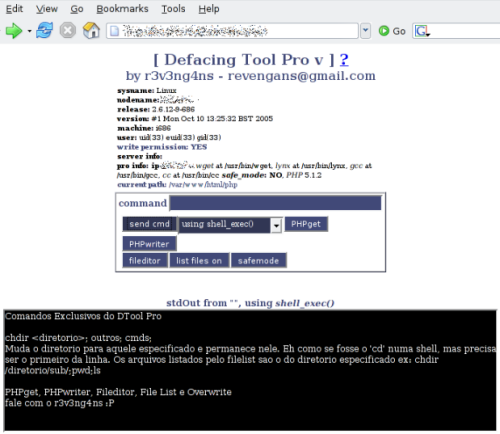
On the look for creative approaches to cash out of selling commodity tools and services, malicious parties within the underground economy continue applying basic market approaches to further commercialize what was once a tax free area. Commercial click fraud tools, managed spamming services and fast-fluxing on demand, botnets and DDoS attacks as a service, malware pitched as a remote access tool with limited functionality to prompt the user to buy the full version, malware crypting as a service, and the very latest indication for this trend is the availability of commercial web site defacement tools.

There's a common misunderstanding regarding web site defacement tools, namely that of a defacer on purposely targeting a specific domain. That's at least the way it used to be, before defacers started embracing the efficiency model, namely deface anyone, anywhere, than parse the successful defacements logs, come across a high profile site and make sure the entire defacers community knows that they've defaced it - well at least their automated web sites defacement tools did in a combination with remotely included web backdoors.

This particular commercial web site defacement tool's main differentiation factor compared to others is it's efficiency centered functionability, namely it has a built-in Zone-H defacement archive submission. Moreover, within the functions changelog we see :

"Choose number of perm folder to check it and go another site with out load all perm it cause to deface with more speed; Working back proxy and cache servers; Get Connect back with php in all servers that safe mode is Off ( with out need any command same as system() ; Auto Detect Open Command"

It is such kind of commercialization approaches of commodity goods that increase the market valuation of the underground economy in general, one thing for sure though - while certain parties are messing up with entry barriers making it damn easy to launch a phishing or a malware attack, others are trying to prove themselves as aspiring entrepreneurs. In the long-term, I'd rather we have defacers deface than consolidate with phishers, spammers and malware authors for the purpose of malware embedded attacks, hosting and sending of scams, a development that is slowly starting to take place despite my wishful thinking.

Related posts:
Continue reading →

Phishing Pages for Every Bank are a Commodity

0
March 31, 2008
A new phishing scam is currently in the wild, emails pretending to be from Bank of ****** were detected by *****, anti spam vendors are indicating a tremendous increase in phishing emails during the last quarter - phishing headlines as usual, isn't it? Phishing is logically supposed to increase, the convergence of phishing and bankers malware is already happening, segmentation of the emails database is only starting to take place, and it's not that a perticular brand is targeted more efficiently than other - they're all getting targeted. In 2008, phishing pages for each and every bank are a commodity, anyone can download them, modify them to have the stolen data forwarded to a third-party, backdoor them to have phishers scamming the phishers, facts that are shifting the emphasis on the segmentation, malicious economies of scale concept, the spamming process of phishing emails, and of course, the arms race between the targeted brands and the phishers in terms of catching up with each other's activities.

In the very same way, malware authors apply Quality and Assurance practices to their malware releases by sandboxing, making sure they have a low detection rate by scanning them with all the anti virus scanners available, as well as ensuring they'll phone back home through bypassing the most popular firewalls, phishers tend to put a lot of efforts into coming up with the very latest fake phishing pages of each and every brand or financial institution. What you see in the attached screenshot is a detailed description of the exact type of information the phishing page is capable of collecting, and when it was last updated. And while the question to some has to do with the number of people getting tricked by phishing emails, coming across such regularly updated repositories makes me think how many people are getting tricked by outdated phishing pages.

The logical questions follows - why would a phisher simply release the very latest phishing pages for a multitude of brands to be targeted in the wild for free, next to keeping them private for his very own private phishing purposes? Take web malware exploitation kits for instance, and the moment when once they turned into a commodity, they started getting used as a bargain in many other deals. In the phishing pages case, once the "product" is offered for free, the "service" in this case the possible segmentation and spamming as a process comes with a price tag.

And while someone's currently using these freely available phishing pages, others are selling them to those unaware that they're actually a commodity and come free, and someone else is using them in a bargain deal offering them as a bonus for purchasing another underground good or service to an uninformed bargain hunter again not knowing that what's offered as bonus is actually available for free - the dynamics of the underground economy in full scale.

Related posts:
RBN's Phishing Activities
Inside a Botnet's Phishing Activities
Large Scale MySpace Phishing Attack
Update on the MySpace Phishing Campaign
MySpace Phishers Now Targeting Facebook
DIY Phishing Kits
DIY Phishing Kit Goes 2.0
PayPal and Ebay Phishing Domains
Average Online Time for Phishing Sites
The Phishing Ecosystem
Assessing a Rock Phish Campaign
Taking Down Phishing Sites - A Business Model?
Take this Malicious Site Down - Processing Order..
209 Host Locked
209.1 Host Locked
66.1 Host Locked
Confirm Your Gullibility
Phishers, Spammers and Malware Authors Clearly Consolidating
The Economics of Phishing Continue reading →

The Epileptics Forum Attack

0
March 31, 2008
Now that's a weird example of a successful targeted attack abusing epileptics' photo sensitivity. Hackers post seizure causing flashing images at an Epileptics forum :

"Internet griefers descended on an epilepsy support message board last weekend and used JavaScript code and flashing computer animation to trigger migraine headaches and seizures in some users. The nonprofit Epilepsy Foundation, which runs the forum, briefly closed the site Sunday to purge the offending messages and to boost security. The incident, possibly the first computer attack to inflict physical harm on the victims, began Saturday, March 22, when attackers used a script to post hundreds of messages embedded with flashing animated gifs."

Mentioning the attack would mean nothing if I'm not to provide screenshots of the forum postings courtesy of user Pedrobear, and the actual seizure image used, which in the case of this attack was pics.ohlawd.net/img/seizure.gif. And if you think seizure.gif is mean, optical illusions such as this one can cause the same effects to everyone if you're to stare at it for more than five seconds. Continue reading →

Massive IFRAME SEO Poisoning Attack Continuing

0
March 28, 2008
Last week's massive IFRAME injection attack is slowly turning into a what looks like a large scale web application vulnerabilities audit of high profile sites. Following the timely news coverage, Symantec's rating for the attack as medium risk, StopBadware commenting on XP Antivirus 2008, and US-CERT issuing a warning about the incident, after another week of monitoring the campaign and the type of latest malware and sites targeted, the campaign is still up and running, poisoning what looks like over a million search queries with loadable IFRAMES, whose loading state entirely relies on the site's web application security practices - or the lack of.

What has changed since the last time? The number and importance of the sites has increased, Google is to what looks like filtering the search results despite that the malicious parties may have successfully injected the IFRAMEs already, thus trying to undermine the campaign, new malware and fake codecs are introduced under new domain names, and a couple of newly introduced domains within the IFRAMES themselves.

Keep it Simple Stupid for the sake efficiency is what makes the campaign relatively easy to track once you understand the importance of hot leads, and real-time assessments for the purpose of setting the foundation for someone else's upcoming piece of the puzzle in an OSINT manner. The main IPs within the IFRAMES acting as redirection points to the newly introduced rogue software and malware, remain the same, and are still active. The very latest high profile sites successfully injected with IFRAMES forwarding to the rogue security software and Zlob malware variants :

USAToday.com, ABCNews.com, News.com, Target.com, Packard Bell.com, Walmart.com, Rediff.com, MiamiHerald.com, Bloomingdales.com, PatentStorm.us, WebShots.com, Sears.com, Forbes.com, Ugo.com, Bartleby.com, Linkedwords.com, Circuitcity.com, Allwords.com, Blogdigger.com, Epinions.com, Buyersindex.com, Jcpenney.com, Nakido.com, Uvm.edu, hobbes.nmsu.edu, jurist.law.pitt.edu, boisestate.edu.

Which are the main IPs injected as IFRAME redirection points?

72.232.39.252
NetRange: 72.232.0.0 - 72.233.127.255
CIDR: 72.232.0.0/16, 72.233.0.0/17
NetName: LAYERED-TECH-
NetHandle: NET-72-232-0-0-1
Parent: NET-72-0-0-0-0
NetType: Direct Allocation
NameServer: NS1.LAYEREDTECH.COM
NameServer: NS2.LAYEREDTECH.COM
Comment: abuse@layeredtech.com

195.225.178.21
route: 195.225.176.0/22
descr: NETCATHOST (full block)
mnt-routes: WZNET-MNT
mnt-routes: NETCATHOST-MNT
origin: AS31159
notify: vs@netcathost.com
remarks: Abuse contacts: abuse@netcathost.com

89.149.243.201
inetnum: 89.149.241.0 - 89.149.244.255
netname: NETDIRECT-NET
remarks: INFRA-AW
admin-c: WW200-RIPE
tech-c: SR614-RIPE
changed: technik@netdirekt.de 20070619

89.149.220.85
inetnum: 89.149.220.0 - 89.149.221.255
netname: NETDIRECT-NET
remarks: INFRA-AW
admin-c: WW200-RIPE
tech-c: SR614-RIPE
changed: technik@netdirekt.de 20070619

Newly introduced malware serving domains upon loading the IFRAMES :

mynudedirect.com/3/5144 (216.255.186.107) loads mynudenetwork.com/flash2/?aff=5144 (85.255.120.203) which attempts to load mynudenetwork.com/load.php?aff=5144&saff=0&sid=3 where the malware is attempting to load upon accepting the ActiveX object :

Scanners Result: Result: 12/32 (37.5%)
Suspicious:W32/Malware!Gemini; W32/BHO.BVW
File size: 107536 bytes
MD5: e50f2c9874a128d4c15e72d26c78352c
SHA1: 91f8a0e2531ea63ce22d0c7f90e7366a78ebeb8a

Moreover gift-vip.net/images/index1.php (195.225.178.19) is still loading from the previous campaign, this time pointing to webmovies-b.com/movie/black/0/21/411/0/ (58.65.234.25), and of course, e.pepato.org/e/ads.php?b=3029 (58.65.238.59) :

Scanners Result: 2/32 (6.25%)
JS.Feebs.rv; JS/Feebs.gen2 @ MM
File size: 16098 bytes
MD5: 64bbd8ba8a0c9ce009d19f5b8c9d426e
SHA1: 1b313198ef140d2c74f36aa84c13afe9497865b6

We also have vipasotka.com/in.php?adv=5032&val=43c46ed2 (119.42.149.22) loading and redirecting to golnanosat.com/in.php?adv=5058&val=e32a412f (119.42.149.22)

Scanners Result : Result: 11/32 (34.38%)
Trojan.Crypt.AN; FraudTool.Win32.UltimateDefender.cm
File size: 61440 bytes
MD5: 5d83515199803e1fbcd3d2d8e0cd4ce5
SHA1: 4c1f0eba4be895cf3b018e41fa7f13523424874d

Last but not least is d08r.cn (203.174.83.55) a new domain introduced within the IFRAMES, which is also responding to, another scammy ecosystem :

07search.com
5m9h41.com
a666hosting.info
gzoe7w.com
l6q7x6.com
nashepivo.com
nbb3g1.com
sraly.com
uvilo.com
vmksxo.com
credits-counselor.com
hx0k21.com
mob-shop.net
smart-search.net

For the time being, Google is actively filtering the results, in fact removing the cached pages on number of domains when I last checked, the practice makes it both difficult to assess how many and which sites are actually affected, and of course, undermining the SEO poisoning, as without it the input validation and injecting the IFRAMEs would have never been able to attract traffic at the first place.

The attack is now continuing, starting two weeks ago, the main IPs behind the IFRAMES are still active, new pieces of malware and rogue software is introduced hosting for which is still courtesy of the RBN, and we're definitely going to see many other sites with high page ranks targeted by a single massive SEO poisoning in a combination with IFRAME injections. Which site is next? Let's hope not yours, as if you don't take care of your web application vulnerabilities, someone else will.

Related posts:
More High Profile Sites IFRAME Injected
More CNET Sites Under IFRAME Attack
ZDNet Asia and TorrentReactor IFRAME-ed
Rogue RBN Software Pushed Through Blackhat SEO
Massive RealPlayer Exploit Embedded Attack
Another Massive Embedded Malware Attack
Yet Another Massive Embedded Malware Attack
Massive Blackhat SEO Targeting Blogspot
Massive Online Games Malware Attack

Press coverage:
Symantec's Internet Threat Meter
Major Web sites hit with growing Web attack
Audit Your Web Server Lately?
Hackers expand massive IFrame attack to prime sites
Major Web Sites Hit with Growing Web Attack
Major Sites Hit with IFRAME Injection Attacks
Researcher - IFRAME Redirect Attacks Escalate
An Update to the IFRAME SEO Poisoning
Massive Web Server Hack
Massive IFRAME Continues to Hit Top Sites
Attackers booby-trap searches at top Web sites
Several Major Websites Affected By Major Iframe Attack
Web Security Scanning Is Paramount
SEO poisoning attack hits big sites; Can the defenses scale?
Hackers step up search results attack
Tale of the IFRAME Continues

Continue reading →

A Localized Bankers Malware Campaign

0
March 25, 2008
Just like the Targeted Spamming of Bankers Malware campaign that I exposed in November 2007, in this post I'll assess another targeted, but also localized to Portuguese campaign with a decent degree of cyber deception applied. It appears that the latest round has been spammed two days ago, but expanding their ecosystem reveals evidence of more bankers malware on behalf of the same malicious parties. What's particularly interesting about this campaign, is that they're using a hardcoded list of already breached email accounts of mostly Brazilian users, and using it as a foundation for the distribution of the malware under the clean IP reputation - which explains why the email makes it through anti-spam filters. The message impersonating Hotmail could have been easily outsourced as a translation process, as I've already pointed out in a previous post emphasizing on acquiring cultural diversity on demand for malicious malware, spam and phishing purposes. However, in this case it's more important to emphasize on the targeted nature of the campaign, and the use of a Russian free web space provider as a hosting provider for the malware.

Now on the cyber deception issue. Basically, you have a malware campaign targeting Portuguese speaking end users, that's been emailed using Brazilian mail servers through a set of hardcoded and already breached local email acounts, it's serving fake bank logins of a Portuguese bank, whereas the malicious parties are using a Russian free web space provider, front.ru in this case as a reliable and outsourced approach to host the malware malware. Is this an example of the maturing consolidation betweeen spammers, phishers and malware authors, or is someone trying to engineer cyber crime tensions? I'd go for the second, the command and control of this banker malware is hiding behind a fake image file, and is all in Portuguese, the way the emails where the stolen information or notifications per infection are descripted in Portuguese. Moreover, within several of the subdomains hosted at front.ru, there're also pages pushing bankers malware through a fake Apaixonado Big Brother Brazil 2008 pages. So you have a South American malicious party generating noise on behalf of Russia's overall bad reputation in respect to malware. Here are more details from this campaign :

Subject: Cancelamento de E-Mail
Message: "Ola usuario, informamos que no dia 24 de Marco de 2008, a Equipe Hotmail alterou o conteudo dos "Termos e Condicoes de uso" e por isso tem a obrigacao de comunicar este fato a todos os usuarios que utilizam frequentemente seu Windows Live ID. Seu Windows Live ID esta associado a sua conta Hotmail.com, caso nao aceite os novos "Termos e Condicoes de uso" podera perder sua conta. (Porque posso perder minha conta?) Li e aceito os termos e condicoes de uso Nao aceito os termos e condicoes de uso Atenciosamente, Equipe Hotmail"
Sent from: knight.bs2.com.br
Banker location: suport022.front.ru/flashcard/ list.exe

Scanners Result: 13/32 (40.62%)
TR/Spy.Banker.Gen; Trojan-Spy.Win32.Banker.JU
File size: 3339776 bytes
MD5: e00b1cd654b5b3fd5c8a1f5e71939a04
SHA1: cc11a030e868ece65769e177616cbebfb239bee6

It's also interesting to note that this campaign's been aiming to stay beneath the radar, not just by localizing the campaign itself and distributing the malware in a targeted nature, but by using a minimalistic spamming practices as you can see in the screenshot indicating a modest binary change in between three days or so. However, based on the identical mutex created by several different malware samples, and the free web space hosting provider used, I was able to locate more banker malwares created by the same malicious parties, again using front.ru as a hosting provider for more bankers malware under the following locations :

www-orkut-compronfiles-aspxuids-.front.ru/ lkjhgterri.com
www-orkut-compronfiles-aspxuids-.front.ru/ plugins.com
www-orkut-compronfiles-aspxuids-.front.ru/ remote.com
www-orkut-compronfiles-aspxuids-.front.ru/ pro.com
www-orkut-compronfiles-aspxuids.front.ru
www-orkut-comprofile-aspxuid.front.ru
albumfotos.front.ru/ winupdate.exe
gsnet.front.ru/ gm.exe
informes2000.front.ru/ robin.exe

The cute part is that the malicious parties behind it allow anyone to take a peek at the list of breached email accounts and the associated passwords due to the usual misconfiguration on their server, allowing me to come up with the C&Cs update locations, predefined message to be included within upcoming campaigns, and the email addresses used for internal purposes, like the following -

IPs used in the C&Cs hiding behind .jpg files :

75.125.251.36
75.125.251.38
75.125.251.40

The fake bank logins locations found within the configuration :

75.125.251.40/home/it/it.html
75.125.251.40/home/it/it2.html
75.125.251.40/home/it/iutb.html
75.125.251.40/home/br/bj1.html

Internal hardcoded email addresses :

receiver.guzano@ gmail.com
receiver.smtp@ gmail.com
ladrao.contatos@ gmail.com
urls.file@ gmail.com
receiver.guzano@ gmail.com

The bottom line, the campaign is well organized, primarily targeting Portuguese speaking end users, is being spammed from stolen email accounts, and has its malware hosted on a Russian free web space provider. Perhaps the only thing it's missing is a better segmented emails database that would have improved the success rate especially from a targeted perspective. As in the majority of malware campaigns, it's their common pattern that leads to the exposure of the entire ecosystem of who's who and what's what. Continue reading →

Cybersquatting Security Vendors for Fraudulent Purposes

0
March 20, 2008
Just like the creative typosquatting coming up with domain names spoofing the structure of PayPal and Ebay's web applications I covered in a previous post, this most recent example of cybersquatting is yet another example of how impersonating known and trusted brands can not only damage their reputation if the campaign's not taken care of fast enough, but can also result in actual adware infection. Who's getting targeted in this campaign? PandaSecurity, McAfee, Adobe Acrobat, and several other third party applications. It seems that IBSOFTWARE CYPRUS is keeping the entire domains portfolio undercover for the time being, with a great deal of these domains returning 403 forbidden messages. However, there are several domains that are actually serving the fake E-shops. This minimalistic approach on behalf of the malicious parties may have proved valuable if the domains were hosted on different IPs, however, they're all hosted on a single IP. The type of "pay us and we'll point you to the download location" scheme applied here is a bit moronic, in fact the template nature of the E-shop does not know what healthy competition means as you can see in the screenshot above. Here are the domains themselves :

PandaSecurity -
pandaantivirus2008.com
panda-antivirus-2008.com
pandasecurity2008.com
pandaantivirus-2008.com
panda-anti-virus.com
panda-2008.com
antivirus-panda-suite.com
panda-ib.com
panda-2008.com
panda-anti-virus.com
panda-antivirus-2007.com
panda-antivirus-2008.net
panda-bdl.com
panda-ib.com
panda-suite.com
pandaantivirus-2007.com
pandaantivirus-2008.com
pandaantivirus-ib.com
pandaantivirus2008.com
pandasecurity2008.com
pandashield.com
pandasuite2007.com
panda-bundle.com
pandabundle.com
pandasecuritysoftware.com
pandasecuritysoftware.net

McAfee -
mcafeepack.com
download-mcafee.com
mcafeebundle.com
mcafee-antivirus-2007.com
mcafee-internetsecurity.com
mcafee-suite.com
mcafee-suite2007.com
mcafeeantivirus2007.com
mcafeesuite-2007.com
mcafeesuite2007.com

Adobe Acrobat -
adobeacrobatreader-8.com
adobe-reader-it.com
acrobatdownload-ib.com
adobeacrobatpack.com
acrobat8download.com

Misc Cybersquatted software -
virusscan2007.com
virusscan2k7.com
virusscan2k8.com
virusscanxp.com
xp-secure.com
netdetectiveservices.info
download-ad-aware.com
antispyware-2007.com
antivirus-2007.com
netspyprotector.com
adwarepro.com
antispyware007.com
anti-virus-free.net
antivirus2k7.com
antivirus2k8.com
avastantivirus-pro.com
avg-antivirus-ib.com

What is Interactive Brands Inc?

"Interactive Brands is a privately held corporation formed by a team of experienced professionals who strive to offer the “ultimate” interactive shopping experience to internet users around the world. In partnership with the best software publishers, Interactive Brands develops unique and high value offers for the benefit of all computer users. In the spirit of giving the best shopping experience possible, Interactive Brands offers their clients access to a customer support center available by toll free number, email and live chat that covers any inquiry including: downloading, installing, using and any other questions regarding our products."

Interactive Brands Inc.
PO Box 178, St-Laurent, Quebec
H4L 4V5, Canada
Phone: : +1 (514) 733-2549
Fax: +1 514 733 2533

The billing center is located at panda-ib.com which loads b-softwares.com and bundlesmembersarea.com. 90% of the domains are hosted on a single IP - 63.243.188.82, however, the entire netblock is a scammy system by itself with several hundred more such cybersquatted domains.

Don't be cheap, if you're to buy any kind of software, do so through the official site, and cut the fraudulent intermediaries like the ones in this case. Read more about Interactive Brands at the Ripoff Report : Interactive Brands, Adaware-ib.com Rip-off; Report: Interactive Brands; Report: Interactive Brands. Lavasoft's and Avira's comments on the case as well.
Continue reading →