Hunting the Hacker - Documentary

0
October 14, 2006
Here's a recently released documentary -- in Russian -- entitled "Охота на хакера", or Hunting the Hacker, discussing IT security, cyber crime, malware authors, onlie scams etc. It also features Eugene Kaspersky commenting on various trends. Don't forget, Russian hackers and Eastern European ones are not just responsible for the sky-rocketing cyber-crime cost "projections", but for the global warming effect as well. I often come across biased comments on wrongly structured research questions such as : "Who are the best hackers in respect to nationalities?", where it should have been formulated as "How vibrant is the IT security landscape, so that the changing dominance lifecycle of a nation could be measured at a particular moment in time?"

True hackers don't have nationalities, they're citizens of the world. Download or stream it from Google Video. Continue reading →

The Return on Investment of Blogging

0
October 12, 2006
What's the return on investment (ROI) of blogging? Blogging for dollars is happening already, whereas this great post by Charlene Li emphasises on many more qualitative benefits and ways of measuring their progress, or slowed down performance :

"My colleague, Chloe Stromberg, and I have been interviewing companies about how they measure ROI and realized that we needed to throw the net wider – this is where you come in! The working idea is to create a framework for measuring the ROI of external blogging efforts for medium- and large-sized companies. Below is an outline of ingredients for the framework. Please help us by fleshing out sources, providing examples, and adding/editing our ROI factors – feel free to add comments to this post or to email us directly (if you’d prefer, we’ll keep specific numbers and examples confidential and use them only as background)."

What's my initial investment? It's time, and time doesn't really mean money, it means opportunities.

My ROI factors :
- visitors' retention
- blog stickiness
- average time spent
- echo-effect
- improved networking, communication with colleagues, friends, and of course, ordes of hypocrites
- successfully reaching, retaining, and informing predefined audiences
- differentiated content channel, barely links posting only
- third-party syndication
- self-preservation and self-awakening
- setting the foundation for my successful identity upload and immortality into cyberspace?

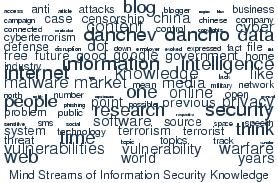
Cloud courtesy of the main blog index and density of the keywords.

Continue reading →

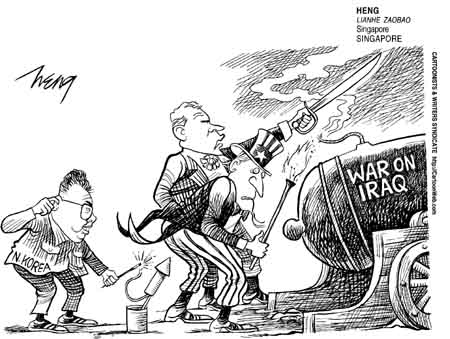
North Korea's Nuclear Testing Roundup

0
October 12, 2006
Way too much is happening right now, so here's are some of the articles, imagery and comments that made me an impression recently. Go through previous coverage on various North Korean developments in case you're interested.

Anyway, Who needs nuclear weapons anymore?!

Wikipedia
2006 North Korean nuclear test - full coverage, Wikipedia style

North Korea
Anti U.S Propaganda - 2004
U.S. commits over 170 aerial espionage in May: DPRK
U.S. Commits Over 180 Cases of Aerial Espionage against DPRK
U.S. Imperialists Commit Aerial Espionage Against North Korea
N Korea in 'US spy plane' warning
North Korea's grislyarms tests on babies
North Korea Condemns Japan for Militarization, Blames U.S. for Breakdown in Nuclear Talks
Photos from Yongbyon nuclear site
North Korea and Nuclear Weapons: The Declassified U.S. Record

Google Maps Imagery
North Korea Nuclear Test Site Eyeball

Commercial Satellite Imagery
The Nodong launch facility
Possible Nuclear Test SiteP'unggye-yok, (Kilju / Kilchu / Kisshu / Gilju)
Taepodong Missile Complex, North Korea -- very good resolution!

Recent Developments Coverage
Nork Nuclear Test : It's a Dud (UPDATED)
U.S "Dragnet" Hunts for Nuke Clues
Korea Nuke : A 'Fizzle'?
North Korea eases the heat on Iran - for now
Iran does not criticize North Korea's nuclear test, blames Washington
KGB had regularly told Russia on Pak-China-N-Korea nuke ties
Pentagon Assesses Responses, Including a Possible Blockade
U.S. opposed to raising S. Korea's surveillance alert: defense minister
Diverted Attention, Neglect Set the Stage for Kim's Move
Analysis: Should U.S. talk to N. Korea?

(Wrong) Speculations
CIA: North Korea Could Make 50 Nuclear Bombs a Year - 2002
CIA says North Korea missile can reach U.S. - 2003
North Korea's Nuclear Weapons: How Soon an Arsenal?

Interactives
North Korea Missile Range
North Korea nuclear test picture gallery
North Korea Nuclear Test photos

Russia
North Korea joins the nuclear club?
Radiation in Russia normal after N. Korean nuclear test - agency

China
China opposes millitary action against N. Korea
U.S. Congressman thanks China for informing U.S. of DPRK nuclear test

U.S
US missile defense said ready for N.Korea threat
Responding to North Korea
USA set to blockade North Korea and create defense complexes in space
North Korean test 'went wrong,' U.S. official says

In-depth Analysis
North Korea Conducts Nuclear Test Continue reading →

The History and Future of U.S. Military Satellite Communication Systems

0
October 12, 2006
Resourceful and visually rich retrospective on the developments related to the U.S. Military Satellite Communication Systems :

"Satellite communication has been a vital part of the United States military throughout the space age, beginning in 1946, when the Army achieved radar contact with the moon. In 1954, the Navy began communications experiments using the moon as a reflector, and by 1959, it had established an operational communication link between Hawaii and Washington, D.C. As the U.S. space program grew in the 1960s, the Department of Defense (DOD) began developing satellite communication systems that would address the special requirements of military operations. In addition to protection against jamming, these needs included the flexibility to rapidly extend service to new regions of the globe and to reallocate system capacity as needed."

And here's what the future -- NCW all the way -- has to offer :

"Military satellite communications (or milsatcom) systems are typically categorized as wideband, protected, or narrowband. Wideband systems emphasize high capacity. Protected systems stress antijam features, covertness, and nuclear survivability. Narrowband systems emphasize support to users who need voice or low-data-rate communications and who also may be mobile or otherwise disadvantaged (because of limited terminal capability, antenna size, environment, etc.)."

Communications and PSYOPS win wars, information overload though, doesn't. Continue reading →

China Targeting U.S Satellite - Laser Ranging or Demonstration of Power?

0
October 12, 2006
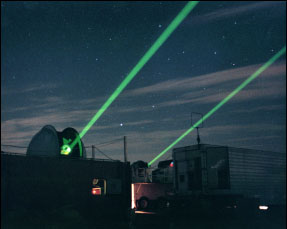
In previous posts "Is a Space Warfare Arms Race Really Coming?,"Weaponizing Space and the Emerging Space Warfare Arms Race", and "Anti-Satellite Weapons" I covered various developments and emerging trends in respect to space warfare. Last week, China supposedly conducted a jamming test on a U.S satellite, which is more of a satellite ping in order to analyze the response data, rather than jamming :

"The Defense Department remains tight-lipped about details, including which satellite was involved or when it occurred. The Pentagon's National Reconnaissance Office Director Donald Kerr last week acknowledged the incident, first reported by Defense News, but said it did not materially damage the U.S. satellite's ability to collect information. "It makes us think," Kerr told reporters.

The issue looms large, given that U.S. military operations have rapidly grown more reliant on satellite data for everything from targeting bombs to relaying communications to spying on enemy nations. Critical U.S. space assets include a constellation of 30 Global Positioning Satellites that help target bombs and find enemy locations. This system is also widely used in commercial applications, ranging from car navigation systems to automatic teller machines.

The Pentagon also depends on communications satellites that relay sensitive messages to battlefield commanders, and satellites that track weather in critical areas so U.S. troops can plan their missions.
"

What this really was is a rather common satellite ranging practice, thus determing the exact geocentric position of the U.S satellite and tracking it, which is a bit of a unethical move, but given there's no code of honor in space yet, it's more of a demonstration of ongoing R&D activities to me. Continue reading →

Luxury Vehicles on Demand

0
October 12, 2006
Sharing luxury vehicles among club members who got bored of their Rolls Royce and want to experiment?

Propositions like these are rather common for NYC and Las Vegas where people do crazy things on the top of their rich and bored euphoria -- and why not?! Ultimate ownership as a driving force, or tiny private moment with what you've always wanted, what would you chose?

"Demand is increasing for alternatives to traditional ownership of high-end cars. Membership clubs and organizations offering fractional luxury-car ownership are in their infancy, as are agencies that rent new-model supercars, but they are expanding. More and more exotic-car drivers are finding they don't spend enough time in their cars to justify owning them year-round and paying six-figure prices. If you're a Manhattan executive with a Lamborghini, you probably don't drive it to work each day. You might only use it on vacation. Or maybe you only bring out your Rolls-Royce. These are the kind of folks signing up. Another advantage of membership clubs is that instead of having to choose which car to buy, you can get a variety of different vehicles delivered in the course of a year. "It's a bit of an addictive thing," said Fuller. "Once you've driven a Ferrari and a Bentley and a Lamborghini and a Lotus, you ask, 'What's next on my hit list?'

It's interesting to note that the major car manufacturers suffering from over-supply and becoming even more insensitive to customers' preferences, are coming up with bargain deals when it comes to their most expensive jewels.

Customer perceived pricing and value on luxury cars and brands positioned as the fastest, hottest, and trend-setting vehicles, indeed play a crucial role in the profit margins here. Then again, building the ultimate beast and waiting for a middle class citizen to finally manage to fulfil his or her America dream isn't really what liquidity is all about. Ownership of luxury vehicles though, is still very concentrated.

Intimate moment with your very own precious, or car manufacturers looking for greater liquidity while potentially turning luxury into a commodity?

A trend definitely worth keeping an eye on, just make sure you join the club first. Continue reading →

The Insider's Guide to Georgia-Russia Espionage Case

0
October 12, 2006
An informative FAQ on the most recent nation-2-nation espionage case, David vs Goliath aka Georgia's counter-intelligence services spotting Russian military personnel performing HUMINT reconnaissance under Russia's umbrella. It answers the following questions :

- Russian spies in Georgia? I thought some of the folks in Atlanta looked a bit suspicious...
- So what's the problem this week?
- And did Georgia back down?
- What were four Russian military officers doing in Tblisi in the first place?
- Anything else they're unhappy about?
- Is the situation likely to escalate any further?

What happened actually? Russia is very interested in its post-soviet era "satellites" and their ongoing and upcoming activities with NATO, and yes, the U.S interest in breaking the ice by organizing various military exercises, even worse from Russia's point of view - opening military bases and a country's airspace to the U.S Air Force. Russia was basically underestimating Georgi's capabilities, sensitivity to the reconnaissance, and courage to go public with the findings if any, and later on acted as a wounded 800 pound gorilla feeling embarresed.

Meanwhile, who's been killing all these journalists -- 42 since 1992 -- acting as the society's watchdog, and was Anna Politkovskaya assassination on purposely done on Vladimir Putin's birthday to destabilize the public opinion on the government's capability to solve the case, and open up countless speculations on the similarities between Georgi Markov's case who was also killed on a puppet's birthday?

It's the typical Fox Mulder situation, he knows everything about you, you know everything about him, do something to him and make him a hero of a cause, so I feel organized crime isn't interested in Russia's social accountability and is destabilizing the process.

Related posts and resources:
Prosecuting Defectors and Appointing Insiders
A top level espionage case in Greece
India's Espionage Leaks
Intelligence
Espionage Continue reading →

Automated SEO Spam Generation

0
October 12, 2006
In a previous post "An Over-performing Spammer" I commented an impossible to both, read and detect scam message -- loading remote email images is both, an infection and privacy exposing vector. In case you also remember automated bots were also self-praising themselves over Ebay back in August.

Just noticed a good example ( http://hsbc-internet-banking.1st-results-links-resource-7.info/No-Anti-Virus-Software-No-E-Banking-For-You/ ) of automated SEO spam generated page out of my "No Anti-Virus Software, No E-banking For You" post :

"Welcome to the No Anti Virus Software No E Banking For You one stop website! We offer the best information, resources and links on this side of the planet, you will find no greater and more comprehensive source for all your No Anti Virus Software No E Banking For You needs! ONLY at our website, will you find every Top Quality information and knowledge resource website on the No Anti Virus Software No E Banking For You topic! Please Enjoy your stay at your #1 No Anti Virus Software No E Banking For You website, and do remember to bookmark, come again and tell all your friends!"

While it's amusing, Google seems to have already picked up the now dissapeared subdomain. I wonder when, and would Google utilize the "wisdom of crowds" concept when it comes to users signaling such search results the way it's already flaging blogs? From another perspective, web application vulnerabilities in domains Google's very found of have the potential to undermine any web site rating initiative. Such spam pages aren't the big problem, the big problem is an ecosystem that allows the author to take advantage of the "upcoming search traffic" on a topic while taking advantage of a marketing window of an event to abuse. Continue reading →

SCADA Security Incidents and Critical Infrastructure Insecurities

0
October 05, 2006
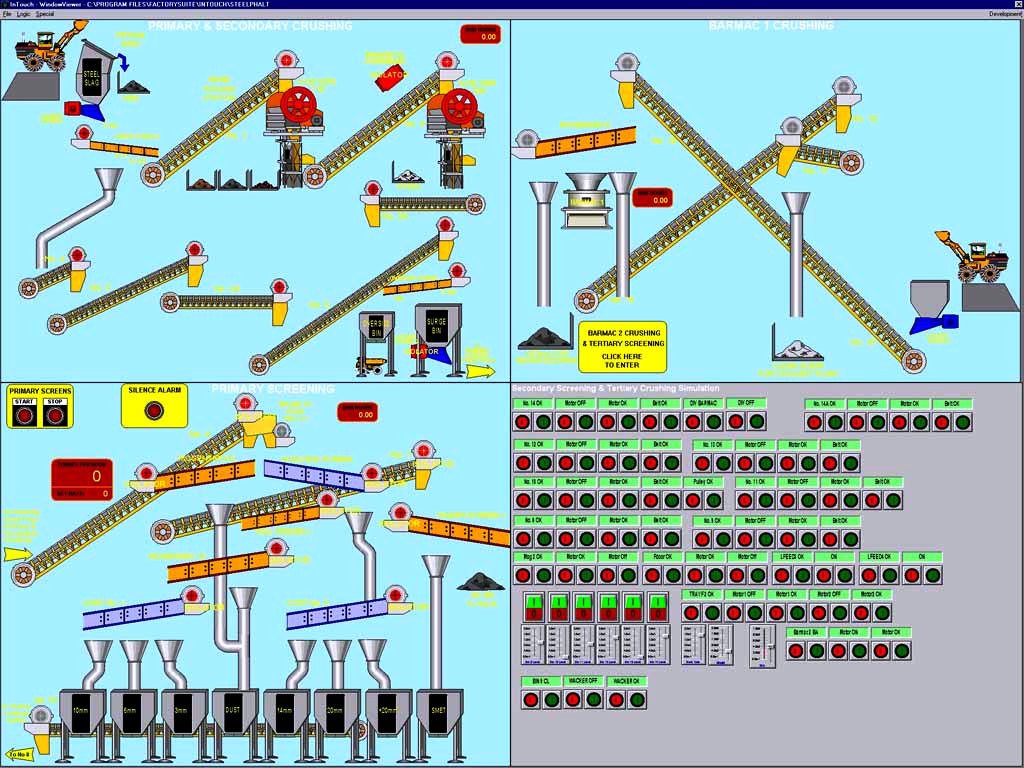
A decent article on the topic of the most hyped cyberterrorism threat of them all - direct attack on the critical infrastrcture of a country by attacking the SCADA devices -- despite increased connectivity and integration with third-party networks, for the time being misconfigurations and failures in maintainance make their impact. What is critical infrastructure anyway? In the days when it used to be a closed network, that is one isolated from the Internet and performance-obsessed top management, dealing with threats was benefiting from the controlled environment compared to the open Internet. Converging both infrastructures to maximize performance, project demand and supply, thus achieving cost-cutting and profits results in the basic truth that poluting the Internet would inevitably influence the what used to be closed critical infrastructure one -- and it already happened on several occasions. Incident in Australia :

"That was the case in Australia in April 2000. Vitek Boden, a former contractor, took control of the SCADA system controlling the sewage and water treatment system at Queensland's Maroochy Shire. Using a wireless connection and a stolen computer, Boden released millions of gallons of raw sewage and sludge into creeks, parks and a nearby hotel. He later went to jail for two years. Not surprisingly, U.S. companies are hesitant to talk about the security of their SCADA networks for fear they may give clues to hackers. But security consultants say problems with them are widespread. Allor's company, for instance, regularly does audits of SCADA systems at major installations such as power plants, oil refineries and water treatment systems.

Almost invariably, Allor said, the companies claim their SCADA systems are secure and not connected to the Internet. And almost invariably, he said, ISS consultants find a wireless connection that company officials didn't know about or other open doors for hackers. Realizing the growing threat, the federal government two years ago directed its Idaho National Laboratory to focus on SCADA security. The lab created the nation's first "test bed" for SCADA networks and began offering voluntary audits for companies."

And more security incidents courtesy of Filip Maertens - Cyber threats to critical infrastructures slides :

1992 -- Chevron -- Emergency system was sabotaged by disgruntled employee in over 22 states
1997 -- Worchester Airport -- External hacker shut down the air and ground traffic communication system for six hours
1998 -- Gazprom -- Foreign hackers seize control of the main EU gas pipelines using trojan horse attacks
2000 -- Queensland, Australia -- Disgruntled employee hacks into sewage system and releases over a million liters of raw sewage into the coastal waters
2002 -- Venezuela Port -- Hackers disable PLC components during a national unrest and general workers strike, disabled the country's main port
2003 -- U.S East Coast blackout -- A worm did not cause the blackout, yet the Blaster worm did significantly infect all systems that were related to the large scale power blackout
2003 -- Ohio Davis-Besse Nuclear Plant -- Plant safery monitoring system was shut down by the Slammer worm for over five hours
2003 -- Israel Electric Corporation -- Iran originating cyber attacks penetrate IEC, but fail to shut down the power grid using DoS attacks
2005 -- Daimler Chrysler -- 13 U.S manufacturing plants were shut down due to multiple internet worm infections (Zotob, RBot, IRCBot)
2005 -- International Energy Company -- Malware infected HMI system disabled the emergency stop of equipment under heavy weather conditions
2006 -- Middle East Sea Port -- Intrusion test gone wrong. ARP spoofing attacks shut down port signaling system
2006 -- International Petrochemical Company -- Extremist propaganda was found together with text files containing usernames & passwords of control systems

Go through the results of the Cyberstorm cyber exercise, and a previous post on The Biggest Military Hacks of All Time to grasp the big picture of what cyberterrorism and asymmetric warfare is all about. Continue reading →

Terrorist Letters and Internet Intentions

0
October 05, 2006
A juicy recently de-classified letter to Zarqawi courtesy of the Combating Terrorism Center, reveals possible intentions for Internet based communications :

"We advise you to maintain reliable and quick contact, with all the power you can muster. I am ready to communicate via the Internet or any other means, so send me your men to ask for me on the chat forum of Ana al-Muslim, or others. The password between us is that thing that you brought to me a long time ago from Herat. Then, after that, we would agree with them about e-mails, or you should instruct your men who are in the country that I live in to develop communications with us. We are ready to write to you and to consult with you regarding opinions anytime directly. “By the time, Surely man is at a loss, Except for those who believe and do good, and exhort one another to Truth, and exhort one another to patience."

Rather primitive suggestion compared to the alternatives, it sounds more of a loyal jihadist trying to demonstrate his determination of making an impact. The other day I came across to an article mentioning the possibility of "suicidal hackers", that is hackers who doesn't care whether they'll be caught or not in a possible information warfare scenario -- chinese hackers have been utilizing the power of masses, thus disinforming on the actual sophistication of the attack and directing the traceback efforts to script kiddies.

However, in this case that's an example of a suicidal jihadist.

Continue reading →

Filtering "Good Girls" and IM Threats

0
October 05, 2006
Respecting your kids' right to privacy while wanting to ensure you're aware of the type of people they IM with? Consider a recently launched initiative, IMSafer aims to filter, not spy on kids :

"Keeping children safe from predatory adults in online communication is a service in high demand, but in order for children to participate the parental control needs to be kept to a minimum. IMSafer is a service that launched today and promises to filter IM communication for conversation deemed potentially predatory. The company says it worked with law enforcement specialists to develop its filtering rules and some of them are quite interesting - the phrase “you’re a good girl” is believed to be common language for building a dominance/submission based relationship, for example. Only questionable excerpts from IM conversations will be shown to parents; the company hopes that this relative privacy will help buy-in from kids."

Yet, this is a great example of marginal thinking when it comes to detecting potential child abuse activities with respect to little princess's -- why not prince? -- right to digital privacy. Whereas in the spirit of Web 2.0, the concept is primarily driven by the collective wisdom of parents participating and shaping the service's database and increasing interactions, IMSafer has already predefined categories of alerts :

"1. Someone looking to make direct contact (i.e. coming to your house)
2. Someone looking to make indirect contact (i.e. calling a phone)
3. Personal information (i.e. phone numbers)
4. Obscene language
5. Specific and sexual references to body parts
6. Specific references to sexual acts
7. Anything related to pedophilia"

Issues to keep in mind :
- the differently perceived dangerous or offensive conversation by parents
- the presumption that the "predator" would be using the same username next time, thus establishing long-lasting reputation
- how kids feeling in the middle of a silent war with their parents could simply IM from another location, one without the software installed excluding the possibilities of bypassing it with nerdy talk or vulnerabilities and hacks appearing on-the-fly
- monitors IM only, thus email, IRC, and forums remain an option for further communication

Don't emphasize on spying, not even filtering, but on educating your kids, thus gaining their participation in the process of building awareness on what's are potentially dangerous IM activities. From another perspective, do bored or adventurous kids spend time chatting with strangers? I think boringness, loneliness, the lack of strong, even developed communications with their folks is the root of the problem. And yes, predators acting as online stalkers, thus improving their chances of utilizing a long-lasting conversation.

Related posts:
What's the potential of the IM security market? Symantec thinks big
"IM me" a strike order Continue reading →

Mark Hurd on HP's Surveillance and Disinformation

0
October 04, 2006
Straight from the source - HP's CEO, one that compared to Fiorina's qualitative approaches decided to shift the company's strategy to a quantitative internal benchmarking model -- one is always fulfilling the other and vice versa -- and he succeeded, but with today's competitive environment and seek for "the next big thing" some companies are sacrificing productivity for insider fears related investigations. Not that there aren't any, it's just that this particular case is nothing more than a bored top management employee sending signals to the press. Next time it would be a top floor hygiene COO's comments on how HP are definitely up to something given the late hour conference meetings, the press will quote as "an insider source leaked this to us" type of quotation :

"Now the question is do you pick up the document and turn to page whatever, or do you say, 'are you sure?' He says 'I'm sure.' So then you say, 'what are we going to do?' Now let me give you two thoughts. You could react by not confronting the problem. You talk about ethics. We've gone down the backward looking view. There's also the dimension that says, are you going to bury this or confront it. Pretty big question, right? And I want to make something clear. I only know of the facts around the one leak. I don't know, there's been a lot of speculation around tens of leaks, and they associate with this one person [Jay Keyworth, a longtime HP board member]. This fact was about one leak from this one person who is a really good guy in the sense of contributions he made to Hewlett Packard over many years.

So now you're confronted with data that says, great contributor, and the team is looking at Pattie [Then board chairman Patricia Dunn] and saying 'what are you going to do.' And I can tell you if you're looking down at this room as you're making a decision, my first reaction wasn't to say, 'hey Pattie, why don't you look backward at how the data was collected.' The stress was, how are you going to confront the fact that was being presented to you. You're going to do what?

Now to your point, knowing what we know now I wish we'd looked at a different set of facts. But even at that point, what had been done had been done. You'd have been reacting at that point in time. I don't want to shirk any of this. The buck stops with me. But you can't have a CEO of a company our size being the backstop. The thought that I'm going to catch everything -- revenue, costs, personnel decisions, investigations... you know the scale of this company."

Catch up with the case through a previous post on the topic, and keep on reading. Continue reading →

Government Data Mining Programs - Interactive

0
September 28, 2006
A very extensive visualization of various U.S government data mining programs :

"Individually, each piece of information gives only a small glimpse into people’s lives -- but over time, these bits of personal information can begin to reveal patterns. Such as the places they go, the products they buy, or perhaps the type of people they associate with.This pattern-recognition process is called “Data Mining” or sometimes “Knowledge Discovery.” Since September 11, the federal government -- especially intelligence and law enforcement agencies -- have turned to data mining programs to make sense of growing oceans of data. The end result isn’t always about discovering what people have done -- but what people might do tomorrow. What does a terrorist look like? What is the culmination of their credit, contacts, purchases and travel? Is it possible that you might share these similar patterns? Chances are at least some of these programs sift through personal information about you."

Go through the questionnaire for a specific case, directly on a program of interest and see its relationship with the rest, if any of course. Go through a previous post on Able Danger's Intelligence Unit Findings Rejected to find out more about the state of information sharing. Continue reading →

Satellite Imagery of Secret or Sensitive Locations

0
September 28, 2006
Continuing the Travel Without Moving Series, and a previous post on Open Source North Korean IMINT Reloaded, this collection of Google Earth, Google Maps, Local Live and Yahoo Maps versions of secret or sensitive locations is worth browsing through. Included coordinates for over 80 locations, for instance :

- Predator Drone Returning From Mission
- Predator Drones at Remote Airstrip
- Predator Drone Taking Off From Remote Airstrip
- TAGS 45 'Waters'
- M80 'Stiletto' Stealth Boat
- U-2 Being Readied For Mission
- Underground Hangars at Sunchon Airbase
- North Korean No-Dong Missile Assembly Building
- Former MI6/FCO high security SIGINT enclave at Poudon
- Former NSA/DoD satellite intercept site
- CIA 'Black Site' for terrorist interogations
- Russian Foreign Intelligence (SVR) Headquarters
- CFS Leitrim - Satellite Singal Interception station
- Russian Don-2NP Pill Box Radar
- Star Wars missile defense support site
- AN/FRD-10 Classic Bullseye Antenna
- Radomes on Fort Belvoir
- Northrop "Secret" Research Facility
- Classic Bullseye listening antenna array

As you will find out the data provided is a historical one -- the UAVs and B2s have already dissapeared for instance. Does the publicly obtainable imagery represent a threat to these locations? Not necessarily, as threats from which these facilities were supposed to be protected from have been replaced by ones requiring a different perspective. The dishes however, are still there, listening..

Related posts and resources:
Satellite
Defense
Military
Japan's Reliance on U.S Spy Satellites and Early Warning Missile Systems
Stealth Satellites Developments Source Book
Anti Satellite Weapons Continue reading →

NSA Mind Control and PSYOPS

0
September 28, 2006
Basics of recruiting, interrogations, brainwashing and PSYOPS on the foundations of Visual Hallucinations, Event-Triggered (conditional) Implant Delivery, and Complete Quiet Silence? Maybe, but this article is full of interesting concepts, consider however skipping the part on how the NSA brainwashed Curt Cobain :

"Curt Cobain of the musical group "Nirvana" was another victim of NSA brainwashing and was terminated by NSA. Cobain had started writing clues to the NSA activities into his music to communicate it to his music followers. He referred in music to the NSA as the "Friends inside his head". Once the NSA puts on the highest level of brainwashing pain, the subject expires quickly. Cobain used heroin to numb and otherwise slow the effect of the brainwashing."

He had different "friends".

Related resources:
Intelligence
NSA Continue reading →

Anti-Counterfeiting Technologies

0
September 28, 2006
Handy overview of various anti-counterfeiting technologies and where they're primarily used at, such as Holograms, Optically variable inks, Microlenticular technology, Special inks, Nanomarkers, and yes, RFID tags, but keep in mind that they used to be "covert" decades ago, but in the passports of some nowadays.

You might find a previous post "Pass the Scissors" worth reading as well. Continue reading →

Afterlife Data Privacy

0
September 27, 2006
Have you ever asked yourself what's going to happen with your digital data in case the worst happens, or most importantly, the pros and cons of privacy in such a situation?

Taking passwords to the grave is always be default, and while your email service provider may get socially engineered -- or have to comply with a court order -- under the excuse of emotional crisis, family relations, reconsider how you would like to have your (accounting) data handled :

"The situation poses a dilemma for e-mail providers that are pilloried by privacy rights advocates at the mere suggestion of sensitive data being exposed, at the same time they are expected to hand over the digital keys to family members when a customer dies. Last year, Yahoo was forced to provide access to the e-mail of a U.S. Marine killed in Iraq to his father, who got a court order in the matter. "The commitment we've made to every person who signs up for a Yahoo Mail account is to treat their e-mail as a private communication and to treat the content of their messages as confidential," said Yahoo spokeswoman Karen Mahon. Beyond acknowledging that Yahoo complies with court orders, Mahon declined to discuss Yahoo's requirements for providing family members access to the e-mail accounts of their deceased loved ones. Google will provide access to a deceased Gmail user's account if the person seeking it provides a copy of the death certificate and a copy of a document giving the person power of attorney over the e-mail account, said a Google spokeswoman."

Whereas some inboxes should never be opened -- your spouse's one for instance -- leading email providers have already established practices when dealing with such requests and I feel the lack of reliable stats on the occurrences of such isn't proving the necessary discussion. The majority of people I know don't just have a black and white sides of their characters, they're too colorful to hide it both offline and online, and that's what makes them "people I know". Changing a provider's privacy policy wouldn't necessarily have a significant effect unless an author's email communication truly becomes his property, while on the other hand local laws could ruin the effect. It would be highly flexible if users are offered the opportunity to speak for themselves and their privacy while still able to do it.

Sometimes, on your journey to happiness and emotional balance you end up opening more and more of pandora's boxes, when what you're looking for is right inside your head - the clear memory of the person in question, not the pseudo-individuality in all of its twisted variations. Make sure what you wish for, as it may actually happen!

The ultimate question - Why does a deceased soldier’s email thoughts become the property of a company? Continue reading →

Media Censorship in China - FAQ

0
September 27, 2006
Controversial to the generally accepted perspective that China's Internet censorship efforts are primarily a technological solution only, I feel it's self-regulation as a state of mind that's having the greatest impact on the success of their efforts -- the very same way you're being told not to misbehave while seeing yourself on a monitor when entering a store for instance. Self-censorship as a state of mind by itself is a way of hiding the plain truth that the Chinese government is aware it cannot fully control what information is coming in, and going out of the country. That of course doesn't stop it from speculating it still can. Here's a recent FAQ on the Media Censorship in China answering the following questions :

What is the current media policy in China?
How free is Chinese media?
What are the primary censoring agencies in China?
How does China exert media controls?
How does China control the influence of foreign media?
How do journalists get around media control measures?

The main agencies responsible for history engineering :

"But the most powerful monitoring body is the Communist Party’s Central Propaganda Department (CPD), which coordinates with GAPP and SARFT to make sure content promotes and remains consistent with party doctrine. Xinhua, the huge state news agency (7,000 employees, according to official statistics), is beholden to the CPD and therefore considered by press freedom organizations to be a propaganda tool. The CPD gives media outlets directives restricting coverage of politically sensitive topics—such as protests, environmental disasters, Tibet, and Taiwan—which could be considered dangerous to state security and party control."

Centralization as the core of control, why am I not surprised? Don't tolerate censorship, learn how to undermine it. Continue reading →

Terrorism and Response 1990-2005

0
September 25, 2006
Very informative and objective retrospective on the response to terrorism from 1990 to 2005. The syllabus by Bruce D. Larkin and Ben Lozano is even more resourceful with its "what if" brainstorming questions.

Here's another map of terrorist networks in America for 1991-2005, based on states and possible cell of operation -- two more previous versions available. Continue reading →

Able Danger's Intelligence Unit Findings Rejected

0
September 25, 2006
The much hyped Able Danger Intelligence unit which has supposedly collected and identified information on the 9/11 terrorist attacks claim was officially rejected :

The report found that the recollections of most of the witnesses appeared to focus on a “single chart depicting Al Qaeda cells responsible for pre-9/11 terrorist attacks” that was produced in 1999 by a defense contractor, the Orion Scientific Corporation.

While witnesses remembered having seen Mr. Atta’s photograph or name on such a chart, the inspector general said its investigation showed that the Orion chart did not list Mr. Atta or any of the other Sept. 11 terrorists, and that “testimony by witnesses who claimed to have seen such a chart varied significantly from each other.” The report says that a central witness in the investigation, an active-duty Navy captain who directed the Able Danger program, had changed his account over time, initially telling the inspector general’s office last December that he was “100 percent” certain that he had seen “Mohamed Atta’s image on the chart.”


Issues to keep in mind:
- the chaotic departamental information sharing or the lack of such, budget-deficit arms race, thus departments wanting to get credited for anything ground breaking
- prioritizing is sometimes tricky, wanting to expand a node, thus gather more intelligence and more participants might have resulted in missing the key ones, marginal thinking fully applies
- OSINT as this Social Network Analysis of the 9-11 Terror Network shows, is an invaluable asset and so is the momentum and actual use of the data

Despite that if you don't have a past, you're not going to have a future, true leaders never look into the past, they shape the future and don't mind-tease what they could have done. Necessary evil moves the world in its own orbit now more than ever, and if you really don't have a clue what I'm trying to imply here, then you're still not ready for that mode of thinking.

So, the man who knew, but no one reacted upon his findings in a timely manner, or a case-study of how terrabytes of mixed OSINT and Intelligence data weren't successfully data mined? I go for the first point.

Able Danger chart courtesy of the Center for Cooperative Research. Continue reading →